
The village well, a piece of the soul of the countryside.
(Baonghean) - The Trung Hau village well in Dien Hoa commune, Dien Chau district, was built by Dr. Thai Doan Nguyen in the mid-18th century when he came here to establish the village. For nearly 300 years, the well has never run dry, always serving as a source of cool, fresh water for the village. Previously, the well was used for drinking and cooking, and villagers used it to make rice wine and delicious rice noodles, famous throughout the region. With the belief that the water was bestowed by the village's guardian deity, during Tet (Lunar New Year), people would use the well water to clean their ancestral altars, hoping for ancestral protection and prosperity. Over time and due to war, the well's structure has collapsed, and the well's interior has been filled with sediment. However, the image of the village well, intertwined with the cultural space of the ancestors, remains deeply etched in the minds and memories of the elderly in Dien Hoa commune.
With the desire to preserve the relics of the village's tutelary deity, Mr. Nguyen Trong Bang, a retired official, mobilized his family, neighbors, and those living far from home to support the restoration and renovation of the village well. In a short time, he raised 50 million VND, and the villagers contributed nearly 100 days of labor to level the ground, rebuild the grounds, clean out the well, and replant the old banyan tree. Since its completion, the village well has not only been a place for people to fetch water, but also a place where elderly people often sit, admire the scenery, enjoy the cool breeze, and chat about the harvest, festivals, and even the affairs of the world. Children, in the cool afternoons, gather to play, run around, play games, and fly kites around the well… Mr. Nguyen Trong Bang shared: “This water source has sustained generations of our ancestors and never runs dry, not only for the people of Trung Hau village but also for all the neighboring villages and communes.” My actions are also a noble gesture to preserve the village traditions for generations to come.
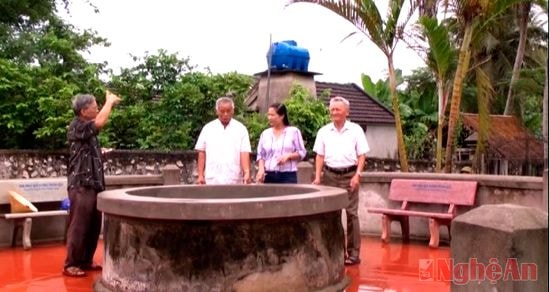 |
| The well in Trung Hau village, Dien Hoa commune (Dien Chau district). |
In Dien Bich commune, while most of the villagers' drilled and dug wells are contaminated with salt and have a yellowish-brown color, the well in Den village still has clear, cool water. No one can explain this special phenomenon, but the villagers believe it is a blessing and protection from the village deity. Not only does it provide water for the villagers, but most fishermen also come here to fetch water for both daily use and for good luck on their fishing trips. Ms. Vu Thi Yen, a local resident, said: "The well here is very clean; the water is as clear as spring water and never cloudy. People come here to draw water for drinking, and boats come here to draw water for their fishing trips. We live near the well and always protect and maintain its cleanliness so that the villagers have a clean water source to use."
In Dien Quang commune, there is still a village well dug in 1266 by Hong Thi Chau Nuong, wife of Prince Tran Quang Khai, when she followed her husband to Nghe An to prepare for the resistance against the Yuan-Mongol army. Here, she gathered people to establish a village and opened a large farm called Giang Lam (comprising the former Hanh Lam and Dao Vien communes), which is now the land of Dien Quang, Dien Hanh, and Dien Hoa communes. Her first task upon establishing the village was to mobilize the people to dig a large, full well to serve their daily lives and production. In Giang Lam, she taught the people how to grow mulberry trees, raise silkworms, weave silk, grow cotton, and weave cloth… After Princess Hong Thi Chau Nuong passed away, the villagers built a temple to commemorate her great contributions. Thanks to the water from this well, the people of Dien Quang developed the most famous vermicelli-making industry in the region. The well still exists today.
According to ancient beliefs, village wells were the source of life for the entire village; therefore, each commune in Dien Chau has 5-7 wells, some of which are hundreds of years old. In the past, the elders had to carefully plan the well digging, considering the geography and feng shui of the location, and paying attention to the groundwater flow. As a result, most wells have an abundant supply of clean, sweet, and fresh water year-round, without being turbid or salty.
Through the ups and downs of time, and with the development of society, piped water has reached everywhere, including rural areas. But in the minds of the people of Dien Chau, village wells hold profound cultural value. Therefore, in many villages, the wells are still kept clean by the people, and they mobilize social resources, contributing money and labor to carefully restore and preserve them. Many village wells are often located next to banyan trees, communal houses, or temples, contributing to a cultural space that is especially attractive to all generations of the village. Artisan Cao Xuan Thuong in Dien Hoa commune said: "Banyan trees, wells, and communal houses are part of village culture; descendants, whether they live far away or stay, always remember them. That's why in the past, every village had a well, like Dien Hoa commune, which has Thung well, Chua well, Con well, Quan well, and Phu well." The village well is not simply for fetching water; it also witnesses many memories and ups and downs in the lives of each villager, creating a sense of community that has been passed down from generation to generation.
Currently, Dien Chau district has 85 ancient village wells. With the goal of preserving "village culture" in the era of integration, maintaining the traditional cultural beauty of the countryside, and fostering love for the homeland in the younger generation, generations of Dien Chau people, especially the elderly, have mobilized hundreds of millions of dong and hundreds of man-days to restore the wells, carefully maintaining them to keep them clean and making them cultural hubs for the villages. Therefore, in Dien Chau today, the image of ancient village wells alongside banyan trees, village communal houses, and village temples remains perfectly preserved.
Text and photos:Mai Giang
(Dien Chau Radio Station)


