
Foreign press perspectives on the Victory of April 30, 1975
"America's involvement in the Vietnam War was a pointless sacrifice of American lives and money and a tragic chapter in American history."
“The final collapse of the South came so quickly, no one could have imagined it”; Vietnam was “resilient and heroic”; the victory “shook the world”… these are some of the comments from international journalists regarding Vietnam's April 30, 1975 anniversary.
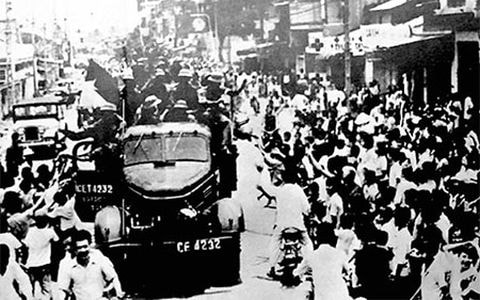 |
| The armed forces and people of Saigon welcome the Liberation Army as it enters the city. (Archival photo) |
America suffers its first defeat.
"Even if the Americans didn't suffer physical harm, the psychological damage they endured was immeasurable. Vietnam was the first war in which the United States failed to win, and it plunged America into bitter divisions," historian Nigl Cawthorne observed.
The New York Times also cited a secret Pentagon document, nearly 70,000 pages long, about the Vietnam War, discovered by lawyer Daniel. This made Americans understand the true nature of the war the US waged in Vietnam: it was brutal and senseless.
The Los Angeles Times wrote: “The Americans left, the Republic of Vietnam surrendered, Vietnam was returned to the Vietnamese people.” The Baltimore Sun wrote: “We were hurt and humiliated, but perhaps we also matured a little through the events of the Saigon-Gia Dinh war.”
A UPI reporter described it this way: “The smiling and cheerful Communist soldiers rode their tanks into the Presidential Palace in Saigon, shouting to the onlookers and journalists watching. They were completely oblivious to the presence of the journalists documenting the historic surrender of the Saigon government to the communists.”
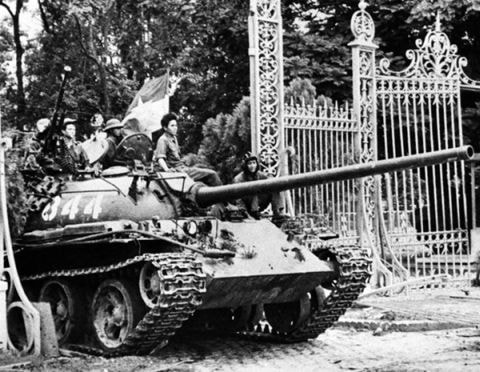 |
| Tanks rammed through the gates of the Independence Palace on April 30, 1975. (Archival photo) |
The French news agency AFP commented: "There is no doubt about it. The fighting in Saigon-Gia Dinh is over. This event will have a huge impact on the region and the world in the future." All the information widely published in Saigon, the US, and several Western countries caused embarrassment and anger among the White House and Pentagon authorities due to strong condemnation.
After nearly 30 years of silence, U.S. Secretary of Defense Robert McNamara finally lamented: “My colleagues in the administrations of John F. Kennedy and Lyndon B. Johnson were a remarkable group… Why did this group of the best and brightest make such a mistake on Vietnam? We owe it to future generations to explain why we made such a mistake.”
A victory that "shook the world"
One day after the complete liberation of South Vietnam, on May 1, 1975, the French news agency AFP wrote, "In 1975, the most outstanding event in Asia was Vietnam's April 30th, an 'aftershock' that shook the world."
In 2010, to commemorate the 35th anniversary of the April 30th event, AFP of France, AP of the United States, and many other news agencies participated in a photo exhibition titled "Vietnam, 35 Years Later." AFP assessed: "There is no doubt that this event will have a significant impact on the region and the world in the near future." They argued that these were honest moments of war, a wake-up call for humanity to do everything possible to prevent a similar war from happening again, regardless of who wins.
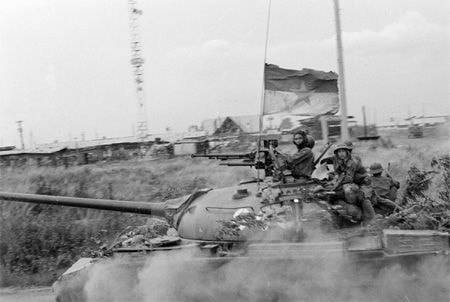 |
| Liberation Army tanks during the Ho Chi Minh Campaign. Photo courtesy of Hua Kiem/VNA. |
According to Alain Rusco, a French historian and expert on the history of Indochina, the events of April 30th "made a great impact internationally, showcasing a nation that refused to be subjugated by its enemies."
The events of April 30, 1975, held profound significance not only for the Vietnamese people but also for the global community. Mr. Rusco also wrote that, to achieve this victory, millions of Vietnamese people sacrificed their lives over decades of arduous and fierce struggle. Almost every Vietnamese family contributed to and suffered losses in this great war of national liberation.
On April 29, 2010, the Pasason newspaper, the voice of the Lao People's Revolutionary Party, published an article titled "The Heroic Struggle Tradition of the Vietnamese People," praising the brilliant leadership of the Communist Party of Vietnam and the tenacious and courageous fighting spirit of our people in the two wars of resistance against old and new colonialism, which created the glorious Dien Bien Phu Victory in May 1954 and the Great Spring Victory of 1975.
Creating a historical turning point.
With the headline "The Fall of Saigon," the New York Times on May 1, 1975, ran a large headline across eight columns on its front page, accompanied by a series of news articles and photos about the collapse of the puppet regime and the victory of the revolutionary forces. According to the article, April 30, 1975, was a "historic day for the world."
Also in its May 1, 1975 issue, the Associated Press published an article that stated, "Tanks, armored vehicles, and camouflaged trucks of the Liberation Army advanced rapidly into the Presidential Palace. At the same time, the neutral General Duong Van Minh went on radio and television to announce the surrender."
Besides the major newspapers, most programs on the three major American television networks on the evening of May 1, 1975, were dedicated to footage of the evacuation of Americans from Saigon on April 29, 1975, and news about the final moments of the regime known as the Republic of Vietnam, along with the birth of a new regime in South Vietnam.
To mark the 30th anniversary of Vietnam's reunification, the Washington Times published a special issue on Vietnam, highlighting Vietnam's efforts in reform and international economic integration. The special issue provides readers with authentic and vivid information about the country, its people, and its reform process.
The prestigious British news agency Reuters also published extensive and continuously updated articles about the Vietnam War at that pivotal moment. A Reuters journalist present in Saigon on April 30, 1975, wrote: “As a reporter at the Presidential Palace, I witnessed the lead tank of the liberation army ram through a sturdy steel pole, knocking down the puppet regime's flagpole, and then move on.”
Nearly ten other tanks quickly advanced. Revolutionary Government troops fanned out across the Presidential Palace area. South Vietnamese guards immediately raised their hands in surrender and lined up awaiting further orders. The flag of the Provisional Revolutionary Government flew triumphantly on the second-floor balcony, even as the three-striped flag still flew atop the building.
"Glory and goodwill"
Although decades have passed since the end of the Vietnam War, its "aftershocks" are still mentioned by the Japanese press with admiration and respect. The May 1, 2000 issue of the Asahi Shimbun begins with a timely editorial: "The Vietnam War ended with the victory of the liberation forces; this confirms that the era in which great powers used force to stifle nationalism has ended."
According to the article: "Today, Vietnam is carrying out the Doi Moi (Renovation) process under the leadership of the Communist Party of Vietnam, achieving many very proud accomplishments." The article cites that in 2000, President B. Clinton visited Vietnam, and subsequently, Prime Minister Phan Van Khai made a trip to the United States.
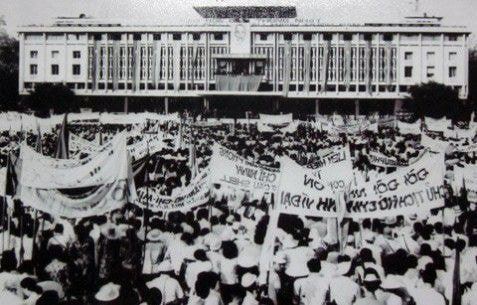 |
| People from all walks of life in Saigon attended a rally celebrating the victory. (Archival photo) |
In 2006, the Asahi Shimbun, in its April 29th issue, published an article titled "Vietnam: Glory and Goodwill," recreating the war through the accounts of witnesses who had directly participated in the conflict on both sides.
The text includes a touching passage about the humanity of a Vietnamese female guerrilla: “In April 1966, in the Cu Chi area, an 18-year-old female guerrilla discovered a group of American soldiers trapped in a minefield of the liberation army. She witnessed the soldiers sitting on the minefield reading letters from home, looking at photos of loved ones, and weeping. She couldn't bring herself to detonate the explosives. The American soldiers escaped death, unaware that this female guerrilla had refrained from killing them.”
Thirty years later, Nikkei, Japan's largest economic publication, in its April 28th issue, republished an image of the first Liberation Army tank entering the Independence Palace, accompanied by the commentary: "Vietnam after 30 years of war." The article emphasized: "The Vietnam War left a deep and lasting impression on the American psyche, creating a ripple effect throughout the Indochina region."
Lasting victory
Also in 2005, on the occasion of the 30th anniversary of the historic victory of the Vietnamese nation, the People's Daily - the official newspaper of the Chinese Communist Party - published a lengthy commentary on April 30th titled "Our Victory Will Forever Be Recorded in History." The newspaper emphasized that April 30th is a great holiday for the Vietnamese people and also a day worthy of commemoration by peace-loving and justice-seeking people around the world.
Meanwhile, Xinhua News Agency, in its issue on the same day, dedicated almost its entire international page to the theme of the April 30th victory and Vietnam's resistance war against the US. With the headline: "30 Years of Victory in the Resistance War Against the US: Images of Vietnamese Veterans," the newspaper published two photos of two Vietnamese veterans, their chests covered in medals, being respectfully presented with flowers by the people of Ho Chi Minh City.
Forty years have passed, but the victory of April 30, 1975, remains an indelible and glorious milestone in the hearts of the Vietnamese people and international friends.
Times have changed, and Vietnam has overcome difficulties and challenges, moving towards the future of integration and development. The resounding victory of the historic Ho Chi Minh Campaign remains a source of pride and motivation for the Vietnamese people to continue advancing on the path to glory and happiness.
According to VOV
| RELATED NEWS |
|---|


