
Suggestions for solutions to limit negative aspects in land auctions.
(Baonghean) - Auction activities in general, and land use rights auctions in particular, still suffer from many limitations, shortcomings, and negative aspects. The widespread problem is the proliferation of "land brokers"; in many cases, land auctions are merely a "staged event," with the actual auction price already agreed upon before the official auction takes place.
There are many regulations...
Since the 1993 Land Law, land use rights have officially been considered assets of organizations and individuals, valued and traded on the market, and have truly become a very important economic resource, especially in localities with large land reserves.
In Nghe An province, from a very early stage, the provincial authorities have made many efforts in exploiting land resources, especially in auctioning land use rights for residential purposes. Particularly, since the Land Law of 2003 came into effect, the auctioning of land use rights for residential purposes has been carried out in a fairly systematic and rigorous manner.
According to data from the Department of Justice, there are currently 19 professional auction organizations in the province. By the end of 2016, they had conducted 2,382 auctions, generating a profit of 250 billion VND compared to the initial starting price. In general, these asset auction organizations have conducted auctions in basic compliance with the law.
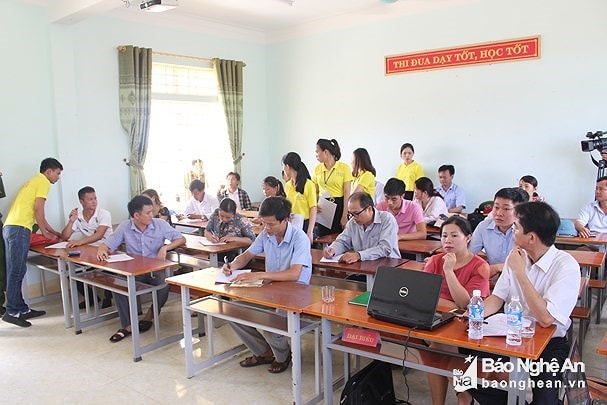 |
| A view of a land auction in Quynh Hong commune (Quynh Luu district). (Photo courtesy of the archives.) |
In Document No. 4883/UBND-NC dated November 2, 2018, the People's Committee of Nghe An province, regarding strengthening the management of land use right auctions in the province, stated that "...in reality, land use right auctions still reveal some shortcomings such as: some localities are still confused in implementing regulations on selecting auction organizations..., have not properly implemented regulations on publicly announcing the selection of auction organizations; the supervisory role of district-level People's Committees is not serious, not following the prescribed procedures; in some cases, the posted notices of asset auctions lack complete information, and there is still a situation where information about registered participants is leaked before the auction takes place; in some places, there are still instances of "auction brokers" and dummy bidders operating rampantly, colluding to lower or raise prices, distorting auction results, causing local insecurity and disorder, loss of budget revenue, and affecting the rights of participants." price...".
To limit and remedy this situation, the Law on Auctioning Assets of 2016 introduced many regulations such as strictly prohibiting auctioneers from exploiting their position for personal gain, colluding with the owner of the auctioned asset, auction participants, valuation organizations, asset appraisal organizations, and artificially lowering prices to falsify auction documents...But most significantly, the new regulations include: Article 56: "...the owner of the property shall publicly announce on their website and on specialized websites for property auctions the selection of an auction organization...";
Article 57: "...For real estate, the auction organization must publicly announce the auction at least twice in print or television newspapers of the central government or the province/city directly under the central government where the auctioned property is located, and on specialized electronic information websites about property auctions...".
To concretize and implement the Law on Auction of Assets 2016, on March 2, 2018, the People's Committee of Nghe An province issued Decision No. 12/2018/QD-UBND promulgating regulations on auctioning land use rights for land allocation with land use fees or land lease in Nghe An province. This decision includes many provisions aimed at minimizing negative practices in auctions, such as: stipulating a bidding increment of no less than 5% of the starting price (Article 11); stipulating a deposit of 20% of the starting price for land auctions for households and individuals, and between 5% and 20% for land auctions for investment projects (Article 14);...
Specifically, in Document No. 4883/UBND-NC dated November 2, 2018, to address shortcomings and negative aspects in land use right auctions, the People's Committee of Nghe An province requested the Department of Justice to disseminate and publicize laws on asset auctions; strengthen inspection, supervision, and monitoring of land use right auction activities. The Department of Natural Resources and Environment was requested to take the lead in coordinating with relevant agencies to guide and resolve difficulties and obstacles in land use right auctions; the Provincial Police Department was tasked with strengthening intelligence gathering and ensuring security and order at land use right auctions; and promptly detecting and strictly handling violations of the law in land use right auction activities. The People's Committees of districts, cities, and towns are responsible to the People's Committee of the province for the results of land use right auctions under their management...
...but there are still loopholes.
With the specific regulations mentioned above, the shortcomings and negative aspects in land use rights auctions in the past have been somewhat mitigated. However, research shows that the new regulations on land use rights auctions still have many loopholes that are easily exploited.
 |
| Outside the auction area, groups of people often gather, showing signs of collusion and price manipulation. (Photo: Archival image) |
As analyzed, publishing information in central or local mass media, with the current massive amount of press available, makes it very easy for auction organizers to "deceive" bidders. Posting notices at the commune People's Committee office where the auctioned property is located also makes it difficult for people in other areas to access the information.
According to regulations, the competent People's Committee will establish an Auction Supervision Team to oversee auctions. However, this is a new issue, heavily dependent on the qualifications, capabilities, responsibilities, and personnel involved. Conducting auctions at the auction agency's headquarters or a location designated by the auction organizer makes supervision difficult due to a lack of equipment and resources, and makes it challenging for authorities to verify the team's accountability and detect irregularities.
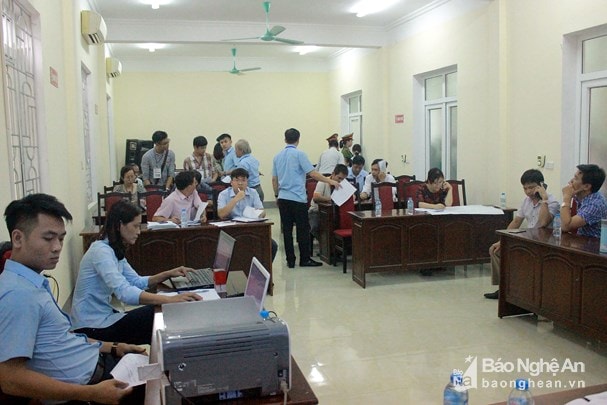 |
| A view of a land auction at the Nghe An Provincial Asset Auction Service Center. (Photo: Archival image) |
Auction registration: According to current regulations, individuals and organizations participating in the auction submit their application and deposit to the auction organization. The auction organization sells auction documents and accepts applications during business hours, continuously from the date of posting the auction notice until two days before the auction date. Although regulations exist, it is very difficult for authorities to directly supervise the acceptance of applications by the auction organization, and in reality, corruption has occurred. A solution is needed to address this issue.
More solutions to mitigate negative impacts and increase budget revenue.
To overcome the aforementioned limitations, minimize negative impacts, and increase budget revenue, we propose supplementing Decision No. 12/2018/QD-UBND dated March 2, 2018, of the People's Committee of Nghe An province on land use right auction with the following regulations:
First,The regulations should be supplemented with a mandatory requirement to publicly and freely disclose auction information on the Nghe An Provincial Electronic Information Portal so that authorities can monitor online and prevent information concealment.
Secondly,This allows citizens to register and submit applications to participate in the auction directly at the "One-Stop" office of the district-level People's Committee. This unit is responsible for forwarding the application and advance payment to the auction organization.
Third,Each district-level locality should arrange a common auction site, equipped with full online surveillance camera equipment (if possible, live streaming on the provincial website) to easily detect irregularities during auctions, identify "land brokers," and take appropriate action.


