
Hanoi successfully tests a new high-yield rice variety.
According to the Hanoi Plant Development Center, through trials of new rice varieties in the Spring 2014 crop, divided into two main groups – yield and quality – the results showed very clear improvements in lodging resistance, cold tolerance, disease resistance, and yield, which was 5-10 quintals/hectare higher than traditional rice varieties.
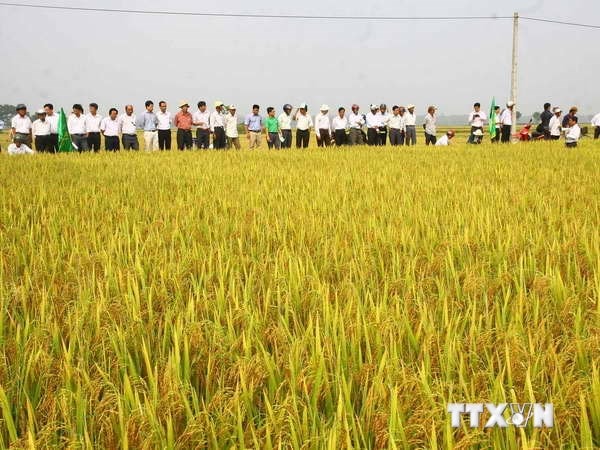 |
| Illustrative image. (Source: VNA) |
Specifically, in the Spring 2014 season, the Center conducted trials on the yield group including varieties DQ12 and KB2, with Khang Dan 18 as the control group; and the quality group including varieties Son Lam 1, Thuan Viet 1, and Huong Com 4, with Bac Thom No. 7 as the control group, in communes representing different rice-producing ecological zones of Hanoi such as Hat Mon commune, Phuc Tho district; My Thanh commune, My Duc district; Dong Xuan commune, Soc Son district; and the Center's plant breeding experimental station in Thuong Tin.
In addition, the Center is also conducting trial production of two promising new rice varieties: QR2 and Bac Thom, which are resistant to bacterial blight.
The results of the quality pure rice group trial showed that Son Lam 1 variety has a growth period equivalent to Bac Thom No. 7, average lodging resistance, fairly good cold tolerance, average susceptibility to brown spot and planthopper, mild bacterial leaf blight and blast, average yield of 56.39 quintals/ha, higher than BT7 by 5-7 quintals/ha, suitable for alluvial and low-lying paddy fields.
The Thuan Viet 1 variety has a longer growing season than Bac Thom No. 7 by 5-7 days, is fairly resistant to lodging, fairly tolerant to cold, fairly resistant to brown spot, bacterial blight, planthoppers, and blast, only slightly susceptible to brown spot, and has an average yield of 56.68 quintals/ha, which is 5-10 quintals/ha higher than Bac Thom No. 7. It is suitable for alluvial and low-lying paddy fields.
Evaluation of pure rice varieties for yield showed that DQ12 has a shorter growing season than Khang Dan 18 by 3-5 days, average lodging resistance, fairly good cold tolerance, average susceptibility to brown spot and planthopper, mild susceptibility to blast disease, and an average yield of 63.12 quintals/ha, equivalent to Khang Dan 18, suitable for flat and high-altitude paddy fields.
In the trial production, two rice varieties, Bac Thom No. 7 (resistant to bacterial blight) and QR2, were conducted at agricultural cooperatives in Hat Mon commune, Phuc Tho district; My Thanh commune, My Duc district; and Dong Xuan commune, Soc Son district, on a total area of 9 hectares. The varieties were sown and planted within the planting season of each locality.
Trial results at cooperatives show that the Bac Thom No. 7 rice variety is resistant to bacterial blight, has a growth period of 133-135 days, is resistant to lodging, fairly tolerant to cold, mildly susceptible to brown spot, rice planthopper, and blast disease, yields 52-60 quintals/hectare, has good rice quality, and is suitable for alluvial and high alluvial fields.
The QR2 variety has a growing period of 128 to 130 days, 5-7 days shorter than Bac Thom, is resistant to lodging and has good cold tolerance, moderate susceptibility to brown spot, rice planthopper, bacterial leaf blight, and mild blast disease, with a yield of 54-56 quintals/ha; suitable for alluvial and high alluvial fields.
Evaluations of three crops showed that the QR2 variety has a shorter growing season than Khang Dan by 5-7 days, a yield of 54-56 quintals/hectare, and sticky rice, making it suitable for planting in the main crop season to free up land for the winter crop.
According to agricultural engineer Nguyen Ba Bang from the Hanoi Crop Development Center, based on the results of trials and tests of new rice varieties, the Hanoi Crop Development Center has proposed to the Department of Agriculture and Rural Development to continue testing promising rice varieties such as Thuan Viet 1, Son Lam 1, KB2, and DQ12 in different ecological zones of Hanoi during the 2014 cropping season.
Therefore, accurate results are obtained before introducing these new rice varieties into large-scale trial production. Simultaneously, trial production of the QR2 variety will continue in the main cropping season to obtain accurate conclusions before incorporating it into Hanoi's rice variety structure. The Bac Thom No. 7 variety, resistant to bacterial blight, will be included in the high-quality commercial rice production structure in 2014 to reduce the current Bac Thom No. 7 variety, which is most susceptible to bacterial blight, especially in the main cropping season.
According to VNA


