
The U.S. House of Representatives grants President Obama fast-track negotiating authority.
The Obama administration's efforts to promote the Trans-Pacific Partnership (TPP) took another step forward on June 18th when the House of Representatives voted to separately pass the Trade Promotion Authority (TPA) bill, also known as fast-track negotiating authority, without attaching the Trade Adjustment Assistance (TAA) bill.
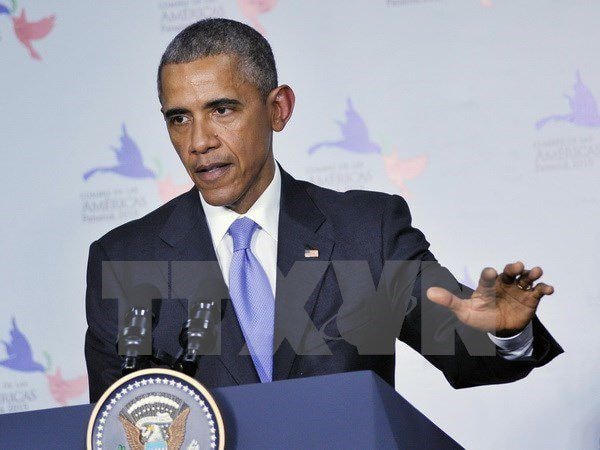 |
US President Barack Obama. (Source: AFP/VNA) |
The U.S. Congress announced that the TPA bill passed by a narrow margin of 218 votes in favor and 208 against. This move shows that the Obama administration's lobbying efforts in recent days have yielded results, as the TPA was passed independently, not as part of a package of bills that included the TAA bill, which was rejected by Democrats last weekend because they argued it was not strong enough to support American workers who lost their jobs due to the TPP. Leaders of both the Democratic and Republican parties in the House of Representatives made concessions by agreeing to separate the TPA and TAA into two separate bills for voting.
In this vote, only 28 Democratic House members voted in favor of passing the TPA, while 158 Democratic and 50 Republican members voted against it. Republican members expressed confidence that the House's decision to expedite the TPA vote ahead of the July 30 deadline indicated a greater likelihood that supporters of the bill would be able to secure enough votes to pass both the TPA and the TAA.
House Speaker John Boehner declared, "We are committed to passing both bills on trade promotion authority and trade adjustment assistance for the president to sign into law." White House spokesman Josh Earnest said that although the TPA was voted on separately, first by the TPA and then by the TAA, President Obama would not sign the TPA without the TAA.
However, although the House of Representatives passed the TPA separately, President Obama was once again unable to sign it into law because the version of the bill that passed the House was different from the version of the package passed by the US Senate late last month, which included both the TPA and the TAA. Therefore, this version of the TPA bill will have to be sent back to the Senate for a vote, expected next week. Speaking to the press, House Minority Leader Nancy Pelosi warned that she did not believe both houses of Congress would pass both bills and that the path ahead for the TAA bill was very uncertain. To date, most Democratic senators still oppose separating the TPA and TAA into two separate bills.
President Obama is focusing all his efforts on persuading Democratic lawmakers to support granting him the TPA (Transfer of Authorization). The TPA's approval would pave the way for President Obama to fully proceed with TPP negotiations with the 11 partner countries. After the negotiations are complete, the US Congress would only have the power to approve or veto, not to amend or supplement the agreement's provisions. Without the TPA, TPP negotiations would be prolonged because the 11 partners, especially Japan and Canada, fear that after signing, the TPP could be modified or amended by the US Congress.
(According to VNA/VN+)
| RELATED NEWS |
|---|


