
Effectiveness of agricultural and rural credit policies
(Baonghean) - After 4 years of implementing Government Decree No. 41/2010/ND-CP on credit policies serving agriculture and rural areas, the flow of credit to the agricultural and rural areas in the province has been facilitated, creating conditions for hundreds of thousands of farming households to access loans to invest in economic development in the province's agricultural and rural areas.
Like many farmers developing farm animal husbandry in Dien Chau district, Mr. Pham Van Can from Hamlet 10, Dien Trung commune, has been a loyal customer of the Dien Chau District branch of the Agricultural Bank for over 10 years.
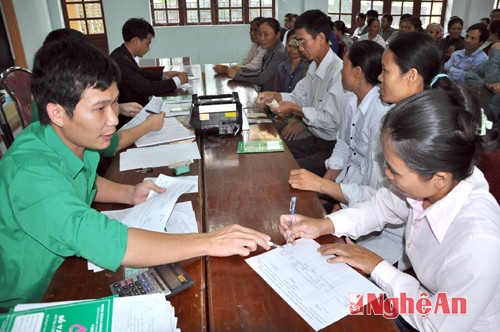 |
| Staff at the Dien Chau Branch of the Social Policy Bank of Nghe An Province guide customers through the loan application process. Photo: Huu Nghia. |
In 2002, Mr. Can began building his poultry farm. With limited capital, he approached the Agricultural Bank of Dien Chau district to request a loan for his farm. After project assessment, the bank approved the loan. Mr. Can boldly invested 1.5 billion VND in a closed-system poultry farm and approximately 1 billion VND in breeding stock. Today, his farm has a scale of 13,000 chickens, sometimes reaching 19,000, primarily raising commercial broiler chickens and Egyptian guinea fowl. He sells eggs and meat to markets in Ha Tinh, Quang Binh, Thanh Hoa, and Ninh Binh provinces. Each year, he sells 120-150 tons of commercial broiler chickens. In favorable years, the farm achieves total revenue of 3-4 billion VND, with a net profit of approximately 1 billion VND per year after deducting input costs. Mr. Pham Van Can said: “In the early years of establishing the farm, I received a loan of 1 billion VND from the District Agricultural Bank. Thanks to the successful business operations, my family has repaid the bank loan, and now only owes 300 million VND. The support and cooperation of the Agricultural Bank has helped my family increase investment and confidently conduct business, fulfilling all obligations to the bank on time.”
Decree 41 was issued to create favorable conditions for many economic sectors in rural areas to access capital, promoting production and business, and generating more material value for society. Mr. Bui Thanh, from Tan Thang hamlet, An Hoa commune (Quynh Luu district), borrowed capital from the Agricultural Bank of the district to invest in shrimp farming. Choosing shrimp farming as a way to develop his economy was a bold decision for Mr. Thanh, because shrimp farming is like gambling; if things go well, the profit is big, but if things go wrong, the loss is huge. With a loan of 600 million VND from the Agricultural Bank of Quynh Luu district, Mr. Thanh boldly invested in two shrimp ponds with an area of 1 hectare. Recently, he stocked 650,000 whiteleg shrimp fry, which have now been growing for two months. He plans to raise them for another month before selling them to the market. If everything goes well, he expects to harvest 7-8 tons of shrimp, worth 700-800 million VND, with a net profit of about 300 million VND after deducting input costs. Mr. Thanh shared with us that he wants to borrow an additional 500 million VND from the bank to expand his production scale for the next season.
For localities developing marine fishing, this year fishermen are focusing on borrowing capital to build new, large-capacity vessels to venture further offshore for extended periods, increasing fishing efficiency. Mr. To Hung, from Hamlet 3, Quynh Nghia Commune, is currently building a new 800 HP vessel worth 6.5 billion VND. This vessel is being built with capital pooled by eight brothers. Mr. Hung shared: "Thanks to the approval of a 1.7 billion VND loan from the Agricultural Bank of Quynh Luu District, disbursed according to the shipbuilding schedule, we have received significant and timely financial support to build our dream vessel. Previously, we fished with 420 HP vessels, mainly in the Gulf of Tonkin. Now, we have sold our old vessels to build larger ones with the aim of venturing 300-400 nautical miles offshore, maintaining fishing operations for months at a time, increasing the yield and value of seafood, and contributing to the protection of national sovereignty over the sea and islands."
The Agribank Son Hai branch serves seven communes: Son Hai, Quynh Long, Quynh Ngoc, An Hoa, Quynh Thuan, Quynh Tho, and Quynh Yen. To date, the outstanding loan balance is over 203 billion VND, with loans for the fishing industry accounting for two-thirds of the total. In the first six months of 2014, the outstanding loan balance increased by 23%. Specifically, in Tan An hamlet, loans were provided for the construction of six new fishing vessels in the first six months, with capacities ranging from 500 to 800 horsepower, averaging approximately 2 billion VND per vessel.
Mr. Ho Cong Dam, Director of the Agricultural Bank of Quynh Luu District, stated: Identifying investment in agriculture and rural areas as the branch's main task, each bank officer and employee strives to create the most favorable conditions for people to access capital, increase production investment, and ensure rapid capital turnover. As of June 30, 2014, the total mobilized capital of the Agricultural Bank of Quynh Luu reached VND 796,408 million, an increase of VND 75,153 million compared to the beginning of the year; outstanding loans reached VND 970,602 million, an increase of VND 118,694 million compared to the beginning of the year, a growth rate of nearly 14%. With 12,304 customers with outstanding loans, over 90% of the outstanding loans are for agricultural and rural customers. The four coastal communes of Quynh Long, Son Hai, Tien Thuy, and Quynh Nghia alone have outstanding loans of VND 238 billion, accounting for 24.5% of the total outstanding loans in the district. In the first six months of the year, loans were provided for the construction of 88 new fishing vessels, each with a capacity of approximately 800 horsepower. The average bank contribution per vessel was between 1.2 and 2 billion VND.
According to Mr. Phan Duc Tien, Director of Agribank Nghe An province, since the implementation of Decree 41, the outstanding loan balance of the Agribank system in the province has increased significantly. As of June 30, 2014, the total outstanding loan balance to the economy reached VND 11,728 billion, an increase of VND 753 billion compared to the beginning of the year. Of this, the outstanding loan balance under Decree 41 reached VND 7,058 billion, accounting for 60.1%. There are 105,990 customers with outstanding loans. Customers have absorbed capital well, produced and conducted business effectively, and repaid principal and interest promptly to the bank, with the non-performing loan ratio remaining below 0.5%. The credit investment structure has been approached relatively comprehensively, encompassing all stages in the process of agricultural production, rural development, and improving people's living standards.
However, alongside the positive aspects, the implementation of Decree 41 has also encountered obstacles, such as the slow issuance of land use right certificates in localities within the province; for farm models, even those farms that meet the criteria for farm certificates are still experiencing delays. This reality affects farmers and farm owners in accessing loan capital. Furthermore, according to Decree 41, the unsecured loan amount is large, with production households able to borrow up to 50 million VND. If local Party committees and authorities do not coordinate well with banks and borrowers, debt recovery will be very difficult in case of risks. In addition, effective production models and projects in agriculture and rural areas are limited, and there is no common model for the entire community. The consumption of agricultural products remains challenging, dependent on market conditions, with bumper harvests often leading to price drops, making it difficult for customers to repay loans. It is suggested that the agricultural sector and related industries need to coordinate closely and develop solutions to facilitate the consumption of agricultural products for farmers, ensuring that prices do not plummet even during bumper harvests. This will motivate farmers to confidently invest in larger-scale agricultural production.
Quynh Lan


