
Support for female workers raising young children.
(Baonghean) - “Female workers and breastfeeding - Let's create a friendly working environment to support female workers in continuing to breastfeed” is the action slogan of the 2015 “World Breastfeeding Week”. Besides the efforts of organizations and businesses to create favorable conditions, the most important issue remains raising awareness among the mothers themselves...
Ms. Phan Thi Huyen Thanh, from Quan Bau ward (Vinh City), is a sales employee at a private company. Although she works regular office hours, since her child was 6 months old, she has mainly fed him formula. According to Ms. Thanh, "I naturally have low milk supply, so my baby only had enough milk for about the first 4 months, after which my milk became less and thinner. I think breast milk only lasts for a certain period before it becomes bland and less nutritious, so I gradually switched to formula for my child. Currently, there are many types of formula for children that supplement many ingredients to support intelligence and physical health, so I feel quite reassured in my choice." Ms. Thanh's thinking is also the thinking of many mothers today. The improving living standards explain why many young mothers with better financial conditions choose to feed their children formula instead of breast milk. However, for female factory workers, life is still difficult, and most of them cannot ensure breastfeeding for various reasons.
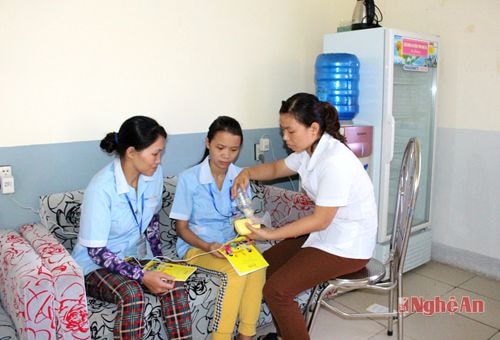 |
| Female workers with young children at Haivina Kim Lien Company express and store breast milk to ensure their babies have enough to eat at each mealtime, right in the company's cabin. |
Due to the nature of their work, young mothers working in the Bac Vinh Industrial Zone often have to be away from their young children before they are even a year old. Because of her busy work schedule and lack of childcare, Ms. Nguyen Thi Thuy, a worker at Matrix Company, had to send her nearly one-year-old daughter to her paternal grandparents in Nghia Phuc (Tan Ky) to be looked after. She shared: “When my daughter was over six months old, I went to work, and although I could leave early at 3 pm, I was too busy and had little time to rest, so my milk supply gradually decreased. She's only about a month away from turning one, and then I'll have to work overtime, sometimes until late at night, so she'll only be able to breastfeed at night. Thinking about that, I decided to wean her and send her back to my hometown so that her grandmother wouldn't have to come and live with us.”
Due to the need to earn a living, many female workers accept weaning their children early. Some young children are not breastfed in their first two years of life because the quality of the workers' meals is not guaranteed, leading to a decrease in milk supply. More concerning is that some female workers still lack a full understanding of the benefits of breastfeeding, and are not yet fully aware of the importance of maintaining their milk supply and providing adequate care for their children. For example, at Havina Kim Lien Company, since the end of 2014, the company, in coordination with the Provincial Labor Federation, has installed a cabin for expressing and storing breast milk at the workplace, aiming to facilitate female workers in expressing and storing milk for their children. Although the investment for this milking room amounted to nearly 100 million VND, including a breast pump, refrigerator, and air conditioner, only about 7 people use it each month. Meanwhile, approximately 50% of the company's more than 2,900 female workers have young children. There are over 300 female workers with children under 12 months old. According to Mr. Le Van Son, Chairman of the Trade Union of Havina Kim Lien Company, in the early days of installing the breast milk pumping and storage cabins, quite a number of women with young children registered to use them. However, the number has gradually decreased, despite the company's trade union regularly disseminating necessary knowledge to female workers about the benefits of breastfeeding and making every effort to facilitate them in pumping and storing milk on-site.
According to interviews with female workers, the majority of young mothers still pay little attention to ensuring their children receive adequate breastfeeding.
"This lasts for the first two years of life. Ms. Doan Thi Hoai, a worker at Havina Kim Lien Company, said: 'My child is now 9 months old. From the time my child was 6 months old until now, he only breastfeeds from 4 pm when I get home from work until evening. During the day, he drinks formula and eats solid food. Nowadays, formula is also rich in nutrients, so I'm not worried about him lacking nutrients…'"
Many female workers offer various reasons for not breastfeeding, such as: work conditions, lack of time, insufficient nutrients in breast milk compared to formula and other foods, children over one year old are more robust and can be weaned, etc. A lack of awareness regarding the importance of breastfeeding remains the biggest obstacle preventing the high rate of breastfeeding among female workers. In 2012, the Labor Law extended maternity leave from four months to six months, allowing women to stay home and exclusively breastfeed their children for the first six months. To raise awareness among female workers about breastfeeding, trade unions at all levels have intensified indirect and direct communication activities within units and enterprises. Communication is integrated with content on reproductive health care and mothers raising young children, with approximately 30 sessions per year in enterprises with a large number of female workers. Every year, the trade union also collaborates with the Provincial Population Department to organize awareness campaigns on reproductive health care and childcare, providing direct counseling to workers. To maintain breastfeeding until 24 months of age, from the end of 2014 to the present, the Provincial Labor Federation has collaborated with two companies, Minh Anh Kim Lien Garment Company and Haivina Kim Lien Company, to install support cabins for female workers with young children to help them express and store breast milk on-site; however, the effectiveness of these cabins has not been high.
These efforts have somewhat changed the awareness of female workers regarding breastfeeding. However, according to Ms. Nguyen Thi Thu Nhi – Vice President of the Provincial Labor Union, besides limited awareness, the main difficulty faced by female workers is their impoverished living conditions, which leave them with little opportunity to focus on maintaining their milk supply. Many workers wean their babies early to facilitate their work… In the coming time, the union will regularly inspect, monitor, and continue to direct grassroots unions to strengthen propaganda efforts to help female workers understand the benefits of breastfeeding and the importance of expressing and storing breast milk. Simultaneously, we will encourage businesses to provide reasonable support for female workers with young children. At the same time, we plan to continue surveying needs and install two breast milk expressing and storage cabins in two units in 2015 so that female workers can better focus on caring for their children during working hours. However, I believe that, in addition to the efforts of organizations and businesses, the most important thing is for female workers to be self-aware of the benefits of breastfeeding and to build their own "culture" of breastfeeding.
Dr. Que Thi Tram Anh, Head of the Department of Child Health Care and Malnutrition Prevention - Provincial Reproductive Health Care Center, noted: “Breast milk is the best food for children, especially newborns, because it contains sufficient energy and essential nutrients such as protein, carbohydrates, vitamins, and minerals suitable for absorption and development. Breast milk contains many antibacterial agents, strengthens the child's immune system, and protects against certain diseases that no other milk or food can replace. To have enough milk for their children, mothers need to ensure a nutritious diet from pregnancy; after giving birth, they also need to eat enough nutrients, drink plenty of water, milk, fruits and vegetables, and breastfeed frequently... In situations where mothers have to divide their time between work and childbirth, they should try to maintain at least 3 breastfeeding sessions per day for their babies. Exclusive breastfeeding for the first 6 months and continuing until 2 years of age is a great benefit; children will be less prone to illness, grow quickly, develop comprehensively, and be protected from disease.” "It combats malnutrition."
Dinh Nguyet


