
Iker Casillas: All the glory has faded.
Chile stripped Iker Casillas of his last vestiges of glory as a goalkeeper once hailed as "Saint Iker" by eliminating Spain from the 2014 World Cup.
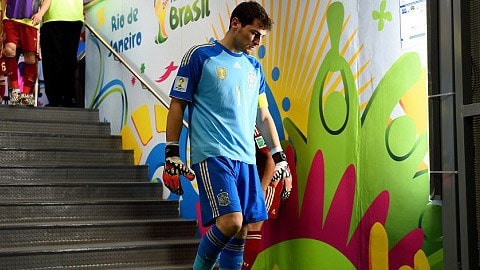 |
| Casillas had a disappointing World Cup. |
Casillas' nickname in Spain is "San Iker" (Saint Iker), but this World Cup has been a disaster for him. Four years ago, Casillas captained Spain to the World Cup title. And two years ago, he became the first goalkeeper in history to captain a team that had won the European Championship twice and the World Cup once. But that's all in the distant past. Already deeply wounded even before arriving in Brazil, Casillas faced a tragic end after a crushing 1-5 defeat at the hands of the Netherlands in the opening match. After the loss to Chile, that tragic ending became a reality.
From a human perspective, Vicente del Bosque was right to continue trusting and remaining loyal to the player who helped him achieve resounding success both as coach of Real Madrid and the Spanish national team. But from a footballing standpoint, it was a self-destructive disaster. David De Gea was injured in the match against Australia, but Pepe Reina is also a very reliable goalkeeper. Even so, Del Bosque stubbornly kept Reina on the bench.
So Casillas, still wearing the captain's armband with the burden of all past glories and present expectations, collapsed once again against a Chilean team that was fast, fearless, and ruthlessly effective. Two, perhaps three, goals conceded in the 1-5 defeat at the hands of the Netherlands were Casillas's fault. It's no surprise that in the 25 minutes of "lightning-fast warfare" in the first half, during which Chile scored both of their goals, the Spanish saint was martyred.
In the first goal conceded, Casillas's mistake was only partial. Known for his incredibly quick reflexes, he didn't rush out of his goal in time, and Eduardo Vargas was a step faster before slotting the ball into the empty net. In the second goal, Casillas was truly the culprit. Alexis Sanchez's free kick was incredibly powerful, but the ball went straight to the goalkeeper. Casillas could have caught it or pushed it away. He chose to push it away, but with that clumsy clearance, it landed right at the feet of the player who would score, Charles Aranguiz – arguably a beautiful assist.
Reina, full of team spirit, waited outside the pitch and offered many words of encouragement to Casillas during halftime. But many neutral fans would agree that Jose Mourinho was right: he dropped Casillas from Real Madrid's starting lineup solely for professional reasons. Casillas never truly recovered after being sidelined by Mourinho at Real Madrid at the end of 2012. That decision by the Portuguese coach also poisoned the atmosphere in the Santiago Bernabeu dressing room, and while many say it was just a political football confrontation, the reality is that even Mourinho's replacement, Carlo Ancelotti, decided that Diego Lopez was his number one goalkeeper.
Casillas became Real's Anders Lindegaard or Costel Pantilimon, only appearing in the Copa del Rey and Champions League. When Real won the Champions League final in May, they did so, but even with Casillas in the lineup: he played a nervous game. At just 33, an age when goalkeepers are still in their prime, Casillas seems to be past his prime. This is not surprising considering he has played 834 matches for both club and national team, with the match against Chile being his 156th for La Roja.
Towards the end of the match, when Spain pushed forward with all their might, desperately seeking even a consolation goal, but to no avail, Casillas must have had plenty of time to reflect. He stood dejected, hands on his hips, shirt untucked, occasionally scratching his head and staring blankly at the stands. “It’s hard to explain what happened. Today isn’t the day to assign blame,” he said after the game. But the defeat against Chile will very likely be Casillas’ last match as the starting goalkeeper for the Spanish national team.
Source: FOOTBALL +


