
Unlocking the tourism potential of Nghi Loc
(Baonghean) - Located in the lower reaches of the Lam and Cam rivers, Nghi Loc has a long-standing and rich cultural tradition of the Nghe An countryside, deeply imbued with its own unique characteristics...
Unlike previous trips, this time I didn't choose the attractive destinations already listed on the region's tourism map, such as Cua Hoi Beach or Bai Lu Resort in Nghi Loc. Instead, we sought out Mui Rong Beach in Nghi Thiet, which connects to Cua Lo Beach. To reach Mui Rong Beach, visitors have to go around Nghi Quang. Many people who come to the beach to escape the fatigue and heat of summer choose Nghi Thiet Beach instead of the crowded Cua Lo or Cua Hoi. They believe that Nghi Thiet Beach is just as beautiful as Cua Lo, and it's suitable for exploration and relaxation because it has a smooth, safe sandy beach with few crowds and no shops or services nearby. However, if you go with a group of friends, you can bring food and organize camping on the beach, which is very enjoyable.
In Nghi Thiet, visitors can especially explore the famous Trung Kien shipbuilding village, which is 700 years old. Legend has it that 700 years ago, when Le Loi led his army to fight the Ming invaders, he unfortunately ran aground on the Nha Le Canal. Hearing of this, a fisherman specializing in building wooden ships in the village came up with an ingenious idea: he sawed the wooden ship in half, turned it around, lifted it out of the shallow area, and rebuilt it. His ingenious plan was successful, and he was highly rewarded by the Tay Son general and bestowed the title "General of the Former Dynasty." This is the story of the founder of the Trung Kien shipbuilding village, a story that everyone in the village knows and proudly tells to visitors.
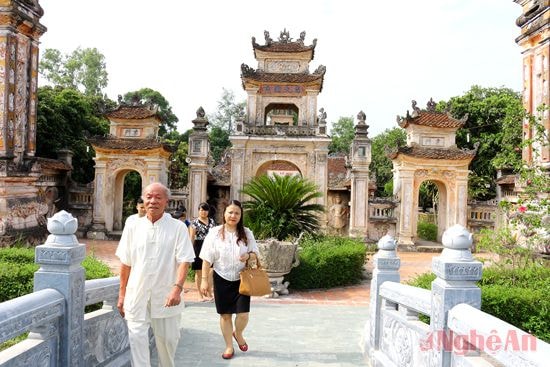 |
| Nguyen Xi Temple. Photo: TN |
Leaving Mui Rong beach, we headed to another famous Nghi Loc destination: Cua Hien beach (Nghi Yen). The first thing I noticed was the clear, blue sea, yet surprisingly quiet. Right on the beach, there are many rocks jutting out like fish, known as Ngu Hai rock beach. This is the only area in Nghe An that doesn't experience the scorching southwest winds in the summer. What sets Cua Hien apart from other beaches is its pristine scenery – the rocks, the sand, the roads, and even the mountains and forests. Although there aren't many restaurants in Cua Hien, and they still retain a rustic, rural feel, the seafood here is always fresh and very affordable. If you enjoy exploring, you can walk along this beach to reach Tien Phong beach in Nghi Tien, Mui Chuoi beach, and Hau beach in Nghi Thiet.
Bidding farewell to the majestic ships nearing completion and setting sail, to the winding mountain roads and idyllic beaches, we sought out historical sites – places that evoke immense pride in any resident of Nghi Loc. One such site was the temple dedicated to Nguyen Xi, which has received national recognition. We were greeted by Mr. Nguyen Dinh Hao, the 14th-generation descendant of Nguyen Xi. He was delighted that we expressed interest in learning about the history and life of this national hero, and stated that the people, understanding the contributions of this first-ranking national hero, felt compelled to visit and offer incense in respect, hoping for his blessings and peace.
The Nguyen Xi Temple is a place of worship dedicated to Grand Tutor Cuong Quoc Cong Nguyen Xi, a founding national hero of the Later Le Dynasty. He played a significant role in King Le Thai To's campaign against the Ngo invaders and in overthrowing Nghi Dan, bringing Le Thanh Tong to the throne and ushering in the golden age of Vietnamese feudalism. Nguyen Xi was not only a general with immense contributions to the national liberation movement but also played a major role in the construction and development of the country in the early Le Dynasty. Nguyen Xi served four kings: Le Thai To, Le Thai Tong, Le Nhan Tong, and Le Thanh Tong, acting as regent for both Le Thai Tong and Le Nhan Tong. For him, supporting the king meant supporting the people and the nation.
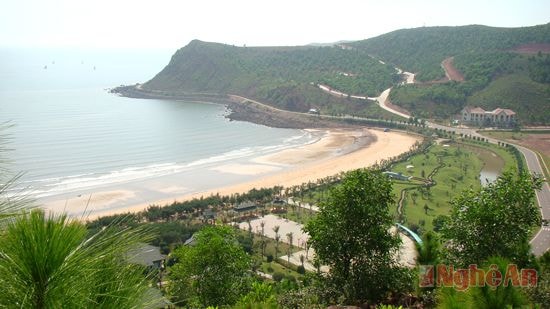 |
| Bai Lu Eco-tourism Area. Photo: Tran Duy Ngoan |
Besides the sacred Nguyen Xi Temple, Nghi Loc also boasts 22 classified historical relics, including 9 national-level relics and 13 provincial-level relics. In addition, the Le Dynasty Canal and Cam Bridge are revolutionary historical relics awaiting classification. The Cua Temple and the tomb of General Ninh Ve, located in the center of Nghi Khanh commune, 19 km from Vinh City and 9 km east of Nghi Loc district town, are noteworthy spiritual sites. Built during the Tran Dynasty, the temple is dedicated to Mother Au Co, Cao Son, Cao Cac, the Three Holy Mothers, and famous national and local figures such as King Tran Quang Khai, General Ninh Ve, Duke Nguyen Canh Que, and Confucian scholar Phung Thoi Ta. During the resistance against French colonialism, the Cua Temple served as a secret meeting place for the Party organization in Nghi Loc. In April 1931, Cua Temple was the gathering place for local people to protest, arrest Chanh Doan Hieu – a French collaborator, recover the official seal, and establish a Soviet government. When the Soviet movement was suppressed, the French arrested Comrade Hoang Van Tam (former Secretary of the Nghi Loc District Party Committee) and executed him at the foot of Dong Dinh Mountain, near Cua Temple, on June 20, 1932. These relics, artifacts, and vivid memories are enough to create a rich cultural heritage of a revolutionary land; and to inspire hopes and beliefs about it becoming an interesting tourist destination in the future…
Thanh Nga


