
Expedite the winter-spring harvest and begin summer-autumn production.
(Baonghean)At this time of year, across the fields of Yen Thanh, the spring rice is ripening to a golden yellow. Farmers are urgently harvesting the spring rice crop and immediately preparing the land for the summer-autumn planting season.
Ms. Bui Ha, residing in Hamlet 7, Xuan Thanh Commune, who is currently harvesting rice, said: "My family cultivates 4 sao (approximately 0.4 hectares) of rice fields, mainly using the high-quality AC5 variety. This year, the weather has been complicated, with prolonged cold spells from the beginning of the season. The rice plants were hit by heavy rains during the flowering period, but the yield of 3.2 quintals per sao is considered very good. At the beginning of the season, the land was carefully prepared and lime was spread to eliminate pests and diseases. The rice seeds were purchased directly from suppliers, ensuring quality. Ms. Ha's family also regularly inspects the fields to irrigate and detect pests and diseases, proactively spraying for prevention. By this time, the family has harvested 3 sao and has hired a multi-functional tractor to prepare the land for 2 sao."
Mr. Le Van Hai, Chairman of the People's Committee of Xuan Thanh commune, said: Xuan Thanh planted 397 hectares of rice, of which nearly 100 hectares were planted with BC15 variety, and the rest were mainly purebred Khang Dan, high-quality AC5 variety, and glutinous rice. This year, the BC15 variety suffered a general crop failure due to empty grains (yield of 120-150 kg/sao), while other rice varieties achieved high yields of over 330 kg/sao (average yield of over 6 tons/ha/season).
In the rice fields of Tang Thanh, farmers have been using the KuBoTa combine harvester very conveniently. Ms. Le Huong from Hamlet 1 said: "I planted 3 sao (approximately 0.3 hectares) of AC5 and glutinous rice, and I hired a combine harvester. It only took a little over an hour to harvest all 3 sao. I paid 220,000 VND per sao, which is cheap because the machine harvests and threshes the rice at the same time, so the farmers only have to bring the rice home to dry." According to Mr. Le Van Tue, Chairman of the People's Committee of Tang Thanh commune, the commune cultivated 261 hectares in the spring crop, of which over 90 hectares were planted with BC15 rice, and the rest were mainly purebred varieties like Khang Dan, glutinous rice, and AC5. BC15 suffered a crop failure, with a yield of about 80-100 kg/sao, while the other varieties achieved yields of 320-350 kg/sao. Basically, the commune has planned contiguous fields, making it very convenient to introduce mechanization into production.
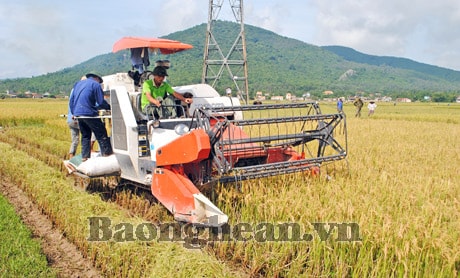
Farmers in Tang Thanh commune, Yen Thanh district, are harvesting rice using combine harvesters. Photo: VT
Mr. Dao Ngoc Hung, Acting Head of the Agriculture Department of Yen Thanh district, said: This spring, Yen Thanh district has allocated 13,209 hectares of rice, including 5,000 hectares of hybrid rice and 7,630 hectares of purebred rice (of which 3,300 hectares are BC15 rice). The estimated yield is 67.6 quintals/hectare (a 4.6% decrease compared to the spring crop of 2012).
Specifically, the BC15 rice variety was initially projected to yield 71 quintals/hectare, but due to many areas having empty grains, the average yield only reached 59.15 quintals/hectare. Basically, other varieties still yielded good harvests, achieving yields of 350-380 kg/sao (1 sao = 360 square meters). The decisive factor in the yield was the improved intensive farming techniques of the farmers in Yen Thanh. The district implemented timely technical solutions, such as crop variety structuring according to different soil types. In the lowland areas, the rice varieties planted are Khai Phong No. I, Nhi Uu 968, BT-E1, and Khang Dan 18. In the swampy areas, pure rice varieties such as NA2, AC5, Bac Thom No. 7, and DT52 are used. In the highlands and reservoir areas, the crop structure includes Khang Dan 18 mutant, glutinous rice 97, and testing of new potential varieties such as BG1 and BG6. The district encourages farmers to focus on using manure and NPK compound fertilizers in combination with single fertilizers (nitrogen, phosphorus, potassium) to ensure balanced nutrition.
The district has intensified the use of organic biological preparations (foliar fertilizers) to provide trace elements for optimal plant growth and development. The district also prioritizes irrigation, directing communes from the beginning of the season to mobilize resources to repair field and plot embankments, focusing on dredging tertiary and inland canals, removing tens of thousands of cubic meters of mud and soil. Thanks to the proactive management of water resources, most rice-growing areas have sufficient irrigation.
Reportedly, Yen Thanh district has harvested over 40% of its rice crop so far. As soon as the spring rice crop is harvested, farmers begin preparing the land for the summer-autumn crop. It is expected that Yen Thanh will finish harvesting the spring rice crop around May 25th.
This year's winter-spring crop saw Anh Son district planting over 3,100 hectares of rice, with over 85% being hybrid rice, mainly varieties such as Nhi Uu 986, GS9, Xuyen Huong 178, and Nghi Huong. The district also directed farmers to plant over 2,500 hectares out of 2,000 hectares of corn, primarily in Tam Son, Dinh Son, Hung Son, Tuong Son, Vinh Son, Thach Son, etc., with hybrid corn varieties C919 and NK66 being the main crops. In addition, farmers planted over 300 hectares of peanuts, sesame, and sweet potatoes.
Overall, since the beginning of the season, irrigation canals and reservoirs have been dredged and repaired, ensuring a proactive approach to irrigation. The introduction of suitable, disease- and pest-resistant rice and corn varieties, along with proper care and spraying practices tailored to local farming conditions, has minimized pest and disease damage to rice and winter-spring corn crops. Furthermore, favorable weather conditions, coupled with the district's attention to planting schedules and the development of specific, focused plans to ensure rice flowering after the last cold spell, have prevented yield limitations.
Mr. Nguyen Cong The, head of the Agriculture Department of Anh Son district, commented: This year, farmers have had a comprehensive bumper crop. Rice yields are expected to reach over 19,000 tons, with an average yield of 62-65 quintals/hectare (i.e., 3-3.2 quintals/sao), an increase of 2-5 quintals/hectare compared to the plan and 3 quintals/hectare compared to the same period last year. Along with rice, corn yields also averaged 60 quintals/sao, an increase of 5-7 quintals/sao compared to the plan. Particularly in some areas such as Tuong Son, Phuc Son, and Tam Son, corn yields may be outstanding. This is due to the rapid completion of corn planting from the beginning of the season, with planting completed before May 13th, whereas in previous years, planting was completed before April 16th. In particular, in localities such as Hung Son, Tuong Son, and Dinh Son, after the process of land consolidation and reallocation, the cultivated land area of each household is concentrated in one area, one plot, which is convenient for intensive farming to increase crop yields, especially corn and peanuts.
Currently, the winter-spring rice crop in the communes of Linh Son, Tuong Son, Long Son, Khai Son, and Lang Son is being harvested urgently. The district's policy is to direct farmers to harvest on a large scale, within the timeframe of May 15th to May 25th. As for corn, it is planned to be harvested 10-15 days earlier than usual, facilitating the planting of summer-autumn crops such as corn, beans, peanuts, and sesame on alluvial land suitable for the planting season, ensuring harvesting before flooding.
With great determination, farmers in Anh Son district are quickly harvesting the winter-spring rice crop, ensuring timely completion and adherence to the schedule to prepare the necessary conditions for summer-autumn production.
Van Truong - Luong Mai


