
Suffering due to slow progress of resettlement project.
(Baonghean) - With the rainy season approaching, residents of Pat village (Chau Tien commune) and Quan village (Lien Hop commune) in Quy Hop district are worried because the emergency resettlement project for people living away from disaster-prone and landslide-prone areas is behind schedule.
| RELATED NEWS |
|---|
 |
| Some households are subject to relocation in Quan village (Lien Hop). |
These streams and creeks, though seemingly peaceful, become "death traps" when the rainy season arrives, threatening homes, fields, and the lives of many local people. Even now, Mr. Vi Van Thanh in Quan village (Lien Hop commune) still vividly remembers the time his entire house was swept away by the flood in 2009. Mr. Thanh recounted: "It was morning, the whole family was having breakfast when the water suddenly rose. Looking outside, the whole village was submerged. We panicked and clung to each other, climbing onto the roof. Luckily, our house had a thatched roof; if it had been a concrete roof, there would have been no way to survive. That year, nearly 20 houses in the village were swept away by the flood. Our crops and rice paddies were also buried under mud." For many years, the ethnic minority communities living in the Muong Hat and Muong Nghinh areas of Chau Tien and Lien Hop communes in Quy Hop district have suffered the same fate. Because the villagers usually build their houses right at the foot of the mountain, close to the stream, just one heavy rainstorm causes a large volume of water from Chau Hong and Chau Tien to flood dozens of households in the two villages.
In response to this situation, in 2011, Quy Hop district approved an emergency relocation project for residents affected by natural disasters and landslides in Chau Tien and Lien Hop communes, with a total capital of 36.134 billion VND. According to the approval, Phase 1 of the project was to be implemented from 2012 to 2014 to relocate 42 households in Pat village, Chau Tien commune, and 31 households in Duoc and Quan villages, Lien Hop commune. The project's approval fulfilled the long-awaited aspirations of dozens of affected households, as well as the local authorities and residents. However, after more than two years, the construction progress of the resettlement area has been very slow. Specifically, in Pat village, Chau Tien commune, only land leveling has been completed. Similarly, in Duoc and Quan villages, Lien Hop commune, only land leveling and the construction of a temporary bridge have been completed. While the total number of items to be implemented includes: land leveling, local transportation, electricity, water, cultural center, sports field…
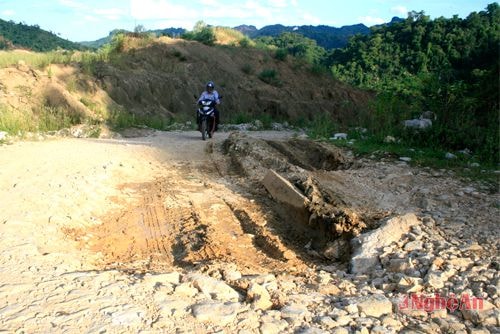 |
| The road leading to the resettlement area is in serious disrepair (small photo). |
To reach Quan village, one must traverse treacherous mountain roads more than 50 km from the district center to truly understand the hardships faced by the local people. According to Mr. Lo Thanh Dong, Chairman of the Lien Hop Commune People's Committee, the challenging road conditions are a major obstacle to the construction of the resettlement area. Leveling the 3.35 hectares of land allocated to 41 households requires considerable time and effort due to narrow roads and steep slopes, making the transportation of construction materials and equipment very difficult. As a household slated for relocation, Mr. Vi Van Thanh shared: “We’ve been waiting for years, but the resettlement area has only just finished leveling the ground. With the flood season approaching, my family had to buy 30 steel bars and 4 tons of cement to prepare for building a house to cope with this year’s flood. Although we were informed that each household would receive 20 million VND in relocation compensation, we haven’t received it yet, so we can only prepare the bare minimum of materials. However, what worries the villagers is that the resettlement area is planned on a fairly high hilltop, so if the house isn’t sturdy, it will likely be very dangerous during strong storms or winds.”
In Pat village (Chau Tien commune), the villagers are also worried about the upcoming flood season. The construction of the resettlement area brought joy to everyone, but now there is more worry than joy. Mr. Vi Van Ly, the deputy village head, confided: “The villagers here only have a small area of land for cultivation in Na Doong and Na Pen. Over the past two years, during the land leveling process, rocks and soil from the hilltop fell, encroaching on nearly one-third of Na Doong's land, significantly affecting the village's rice production. We hope the investor will speed up the construction so that the villagers can stabilize their lives soon.”
Explaining the construction progress at the resettlement areas, Mr. Vi Van Chuong, Head of the Rural and Mountainous Development Board of Quy Hop District, said: "The project is progressing slowly due to a lack of funding and the 'piecemeal' allocation. According to the plan, phase 1 was allocated 17 billion VND, but so far only 11.8 billion VND has been disbursed. Therefore, the construction and relocation assistance for households at the two resettlement sites are facing many difficulties."
Thanh Quynh
The Quan village resettlement area was built on an area of 3.35 hectares, accommodating 41 households, and the Pat village resettlement area, with an area of 4.24 hectares, served 42 households. According to the plan, the resettlement area for people displaced from disaster-stricken areas included land leveling, construction of internal roads, electricity and water supply systems, a community center, and a kindergarten, with a total investment of 36,347 million VND. Following the Prime Minister's Directive 1792/CT-TTg on investment reduction, after a short period of implementation, the Provincial People's Committee adjusted the investment project for phase 1 with a capital of 17,409 million VND. |


