
The G7 bloc calls for a global reduction in CO2 emissions.
The G7 countries have helped overcome obstacles on the path to the COP-21 Summit in Paris this December 2015.
Over two days, Sunday, June 7th and Monday, June 8th, 2015, at Elmau Castle in Bavaria, southern Germany, the Group of Seven (G7) industrialized nations – Germany, France, Italy, the United Kingdom, the United States, Canada, and Japan – met to discuss the global issue of "climate change."
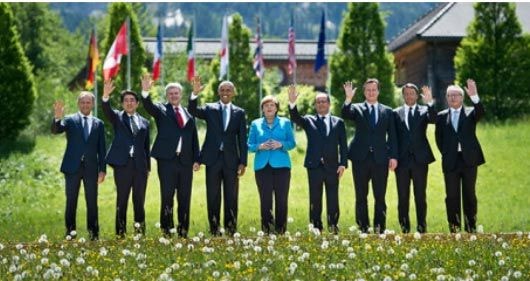 |
| G7 leaders at Elmau Castle, Bavaria (Germany). Photo: Source from the German government. |
This is one of the intermediary activities aimed at gradually resolving differences to reach a legally binding agreement at the "Climate Change Summit," known as COP-21, in December 2015 in Paris (France). The first meeting took place in February 2015 in Geneva (Switzerland), and another, longer meeting, lasting 10 days, also in Germany, was held in Bonn from June 1st to 11th, 2015.
After two days of intensive work, the G7 leaders expressed their support for a key agreement at COP-21 on reducing greenhouse gas emissions by 2100, the main cause of air pollution and global warming.
And at the end of this annual summit, alongside other important topics, the G-7 leaders still agreed on and issued a joint statement calling for "urgent and decisive action" on climate change. They declared: “We reaffirm our strong determination to contribute to the adoption at the Climate Change Conference in December this year in Paris (COP 21) of a declaration, a legally binding instrument with the same force as the United Nations Framework Convention on Climate Change.”
The G7 leaders added: "We are committed to doing our part to achieve a long-term low-carbon global economy, including the development and deployment of advanced technologies, striving for a transformation of the energy sectors by 2050." They also extended an invitation to "all countries to join us in this effort."
On a key point of disagreement among developed industrial nations worldwide, G7 leaders at this meeting in Bavaria (Germany) reaffirmed their commitment to the Copenhagen Agreement to mobilize $100 billion annually until 2020 from a range of sources to help developing countries implement greenhouse gas emission reduction projects.
The G7 countries further broadened their focus: "We recognize the potential of multilateral development banks (MDBs) in developing climate finance and helping countries transition to low-carbon economies. We call on MDBs to utilize their balance sheets to the fullest extent possible and to mobilize other partners to support national programs to meet these goals."
At the same time, the G7 countries also stated that they remain committed to "eliminating ineffective fossil fuel subsidies."
Finally, regarding energy security, the G7 leaders declared: "We view diversification as a core element of energy security and a goal to further diversify the energy mix, fuels and energy sources."
The recent unity among the G7 "rich and powerful" nations in Germany was a significant event, serving as a global call to action towards reducing CO2 emissions. It contributed to resolving disagreements and obstacles on the path to the success of the COP-21 World Climate Change Summit in December 2015 in Paris.
According to vietnamnet


