
Restoring and sustainably developing bamboo as a raw material.
Previously, Quy Chau had about 12,000 hectares of bamboo scattered across 8 communes, but due to indiscriminate exploitation, the bamboo area has decreased to about half; the remaining area is in a state of near-depletion due to lack of care and protection. Restoring and sustainably developing bamboo cultivation and making it a source of stable income for the people is an urgent requirement for Quy Chau.
(Baonghean)Previously, Quy Chau had about 12,000 hectares of bamboo scattered across 8 communes, but due to indiscriminate exploitation, the bamboo area has decreased to about half; the remaining area is in a state of near-depletion due to lack of care and protection. Restoring and sustainably developing bamboo cultivation and making it a source of stable income for the people is an urgent requirement for Quy Chau.
With the support of the Institute of Agricultural and Forestry Sciences of the Northern mountainous provinces, in 2011, a model for cultivating and protecting bamboo, known as the Green Commercial Production Project, was implemented in Xet 2 village, Chau Thang commune, Quy Chau district. The project's goal was to minimize the negative impact of human activities on the natural development of bamboo and to care for and harvest bamboo according to proper technical procedures. The project covered 21 hectares, allocated to 11 households; in the first year, 3 hectares were allocated to 2 households in Xet 2 village (1.5 hectares/household); in the second year, the project expanded by an additional 18 hectares to 8 households in 6 villages of Chau Thang commune.
It is noteworthy that the financial support for receiving land for cultivating bamboo was not substantial (each household received 2.4 million VND for clearing and preparing the undergrowth and 600 kg of NPK fertilizer), but thanks to hands-on guidance and the transfer of cultivation techniques directly in the field, the results were highly effective and well-received by the local people.
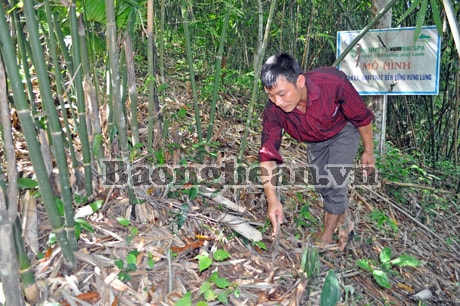
Mr. Vang Anh Tuan, an agricultural and forestry officer of the commune, inspects the techniques for caring for the bamboo plants.
Leading us on a tour of the model farm, despite its considerable distance from the village center and difficult access, Mr. Vang Anh Tuan, an agricultural and forestry officer from Chau Thang commune, was delighted to see the bamboo forest in Xet 2 village so well-cared for, with its lush, healthy bamboo plants. He said: "This model was implemented for two households in its first year, and now it has been handed over to the people for management, which gives us great peace of mind. In this same area, more than three years ago, the bamboo was exploited indiscriminately, leading to depletion and desolation. Now, with human protection, shelter, and care, the bamboo has grown green again."
Mr. Lu Van Ky (24 years old) from Xet 2 village, one of the first two households to receive bamboo cultivation under the Green Commercial Production Project, said: "Because my family is poor, the commune prioritized us in receiving the model earliest. In the first year of implementation, my family focused on cultivating and caring for the bamboo. From the second year onwards, we harvest 2-3 crops per year, each crop yielding 1 to 1.5 million VND. Based on the success of the project's cultivation model, my family has also protected and cultivated an additional 2.8 hectares. According to Mr. Ky, cultivating and caring for the bamboo according to the project's guidelines not only brings income to the family but, more importantly, fosters greater awareness in cultivating and protecting the bamboo. Although bamboo forests grow naturally, indiscriminate and reckless exploitation will lead to their depletion..."
It has been learned that protecting and caring for bamboo is relatively easy. Bamboo mainly grows naturally; when caring for it, attention must be paid to the timing of fertilization and clearing of undergrowth according to technical procedures. Costs are also low because bamboo is suitable for the soil conditions here, can grow interspersed with reeds, and is cultivated in remote areas with abundant land. Thanks to proper care and protection, bamboo in Chau Thang, Quy Chau yields high productivity, averaging 7 kg per plant, with some plants reaching 10 kg, and each clump containing 20-30 plants. If cared for and harvested according to proper procedures, each hectare of bamboo can yield about 20 to 30 tons of fresh bamboo, equivalent to 8-12 million VND. By restoring and protecting the existing bamboo area (nearly 6,000 hectares), Quy Chau can harvest about 9,000 tons of fresh bamboo annually (equivalent to 3,000 tons of dried bamboo). With the current price of dried bamboo at 25,000 VND/kg, the amount of over 75 billion VND/year is a significant source of income for people to alleviate poverty and increase their earnings…
From the model of protecting and caring for bamboo under the Green Commercial Production Project, Chau Thang now has 700 hectares of bamboo interspersed within forests that are protected and cultivated by local people. According to many locals, Quy Chau bamboo has an advantage that not all raw materials possess: besides the valuable seed source suitable for the region, the market is quite stable, and the investment costs are not high, making it suitable for most people, especially poor households. When harvested, people can sell fresh or dried bamboo, and there are always buyers coming directly to the commune. Currently, the area of bamboo cultivation is small, but the demand for bamboo as raw material for rattan and bamboo weaving and incense stick making is quite high every year. Quy Chau bamboo products are not only used as raw materials for incense and rattan weaving in the province, but are also highly favored by markets in the North because bamboo from Quy Chau forests is quite good, flexible, and durable...
Mr. Tran Van Chuong, Chairman of the Quy Chau District People's Committee, said: "Lung is one of the crop models that the district is encouraging people to cultivate and care for. Besides the project supported by the Northern Mountainous Provinces' Agricultural and Forestry Research Institute in Chau Thang, the district is currently organizing workshops to mobilize several non-governmental organizations to support investment in forest trees, including lungwood, expanding to other communes. The district's aspiration is not only to become a source of raw materials but also to attract handicrafts to the area so that lungwood has the highest commercial value; thereby creating more jobs and income for local laborers."
Lùng (a type of bamboo) is a plant that grows naturally in the mountainous region of Quỳ Châu, with the highest concentration in Châu Thắng and Châu Phong. For a long time, lùng has been used as the base of incense sticks for agarwood production and is an excellent raw material for export-oriented rattan and bamboo weaving. |
Phuong Ha
;
Other news
- Why are separate electricity prices needed for the steel and cement industries?(24/06/2013)
- GIZ calls for the protection of wildlife in Vietnam.(25/06/2013)
- Urgent safety inspection of irrigation and hydroelectric dams.(26/06/2013)
- Extend the loan for purchasing and stockpiling paddy and rice.(26/06/2013)
- Provincial leaders held a working meeting with the Japan External Trade Organization (JETRO) in Vietnam.(26/06/2013)
- Quynh Luu: 37 fishermen granted Class 4 fishing vessel captain certificates.(27/06/2013)
- Aquaculture production is estimated to reach 83,000 billion VND.(27/06/2013)
- Savings interest rate ceiling reduced to 7%(27/06/2013)
- The seafood fishing season is bustling in Quynh Lap.(28/06/2013)
- The young town of Hoang Mai - awakening its potential.(28/06/2013)
.
.
.
.
.


