
Strict control over medical workforce training
The recent announcement by the Ministry of Education and Training and the Ministry of Health to temporarily suspend the consideration of opening four medical training programs at multidisciplinary universities outside the specialized medical and pharmaceutical fields has been met with approval from many. However, numerous opinions still suggest that the two ministries conduct inspections and reviews of medical training programs.
Many schools recruit indiscriminately.
This proposal was made because, in the past period, the Ministry of Education and Training allowed the opening of schools indiscriminately without strict management, resulting in training quality that did not meet requirements, especially in multidisciplinary schools not belonging to the medical and pharmaceutical fields.
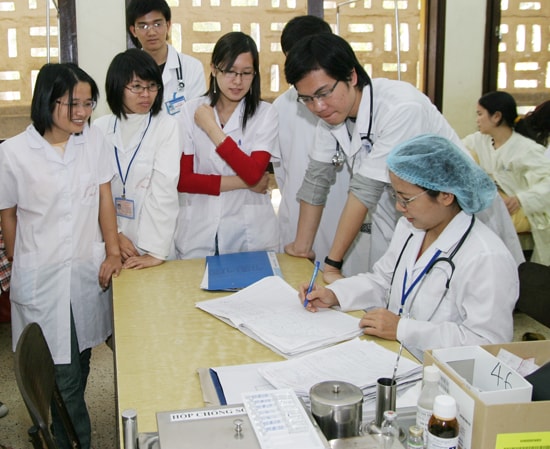 |
| A practical training session for students from Hanoi Medical University at the National Children's Hospital. |
| RELATED NEWS |
|---|
Agreeing with the decision to temporarily suspend the consideration of opening new majors in General Medicine, Dentistry, Traditional Medicine, and Pharmacy at non-specialized medical and pharmaceutical schools, Associate Professor Dr. Truong Viet Binh - Director of the Vietnam Academy of Traditional Medicine - stated: "Due to the shortage of medical personnel, non-specialized training schools recruit indiscriminately, which will certainly result in poor training quality."
Cannot relax
Also agreeing with the decision of the two Ministries, Associate Professor Nguyen Huu Tu - Vice Rector of Hanoi Medical University, said that training doctors requires thorough preparation, ensuring adequate practical facilities and a qualified teaching staff, especially for specialized subjects that require long-term training to have good teachers. Furthermore, the practical training facilities, such as hospitals, must also meet standards so that graduates can apply their knowledge after graduation. With such stringent training requirements, if non-specialized schools do not have sufficient time to prepare and gain experience, it will certainly affect the quality of training. Therefore, high and rigorous evaluation requirements are necessary. "The two Ministries should focus on investing in specialized medical schools to strengthen capacity, scale, and scope; this is the best approach," Mr. Tu suggested.
However, many medical training experts suggest that, in addition to temporarily suspending the consideration of opening new training programs, the Ministry of Education and Training and the Ministry of Health should thoroughly inspect and supervise the schools that have already opened these programs. Regarding the planning of medical and pharmaceutical training schools, this is not advisable because, according to the Higher Education Law, universities that meet all the necessary conditions are allowed to open programs. Furthermore, the proliferation of schools will create healthy competition in human resource development. Regarding the review of conditions for each school to open a program or the inspection and supervision of training activities, the participation of relevant agencies from both ministries is necessary, instead of just the Ministry of Education and Training as is currently the case.
Furthermore, some argue that, in principle, suspending the consideration of opening new programs is correct, but the Ministry of Education and Training should announce a specific timeframe. The two ministries need to establish unified criteria for the conditions for opening new programs, rather than easily granting permissions and then "closing them down" when deemed unsuitable. As National Assembly representative Bui Thi An from Hanoi said, flexibility is needed in suspending the opening of new programs, as it will affect institutions that truly meet the requirements; otherwise, an entire enrollment cycle will be missed.
According to KTDT


