
Peanut prices have dropped, making sales difficult.
(Baonghean.vn) -One day at the end of May, we visited Nghi An commune (Vinh City) – a locality with 250 hectares of land planted with peanuts in the spring season. Under the scorching sun...0In C, almost the entire peanut crop has been harvested by the farmers and dried whole, piled high along both sides of the road. After nearly four months of hard work under the sun and rain planting and tending, the harvested peanuts are now dry and withered, but the farmers are still waiting for traders to come and buy them…
Ms. Nguyen Thi Luyen, from Hamlet 2, Kim My (Nghi An), was sorting dried peanuts into sacks. Seeing visitors, she was delighted, thinking traders had come to buy peanuts. Before she could rejoice, her expression darkened, and she sadly explained: “My family planted 5 sao (approximately 0.5 hectares) of spring peanuts, yielding only 4 quintals of dried peanuts. Now the peanuts are drying out in the sun, and we’ve been waiting forever for buyers. This year, peanut prices have plummeted; we’re selling them for 15,000 dong/kg, and we still can’t sell them. Last year at this time, traders came to buy them while we were harvesting, at 22,000 dong/kg, and we got paid immediately. Now, it’s been over two weeks since we harvested and we still haven’t been able to sell them. My family is very anxious because we owe 1.5 million dong for fertilizer and supplies from the beginning of the season, and we also have to pay various taxes and fees. If we can’t sell the peanuts, how will we pay off our debts?”
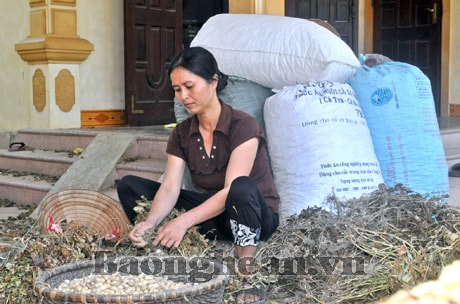
The 400 kg of peanuts belonging to Ms. Nguyen Thi Luyen's family (Hamlet 2, Kim My) have been dried and packed in bags but remain unsold.
Mr. Pham Xuan Hai's family in Hamlet 2, Kim My, planted 8 sao (approximately 0.8 hectares) of peanuts in the spring, yielding 8 quintals of dried peanuts. Nearly two weeks after harvesting, the peanuts, both tubers and stalks, are still piled up in the field. With falling prices and difficulty selling, Mr. Hai's family is disheartened and reluctant to harvest the peanuts. "This year the peanut plants are good, but there are fewer tubers, resulting in a lower yield than last year. On top of that, they're unsaleable. We're farmers, our livelihoods depend on these few sao of land, and we're supporting our children through university. Now, after all the hard work, there's no market for the peanuts. How are we going to make ends meet? If we could sell them at 15,000 dong/kg, we'd only break even compared to the investment in fertilizer, seeds, and labor. Since we haven't sold the peanuts, my family has had to borrow money for daily expenses, and we're struggling," Mr. Hai lamented.
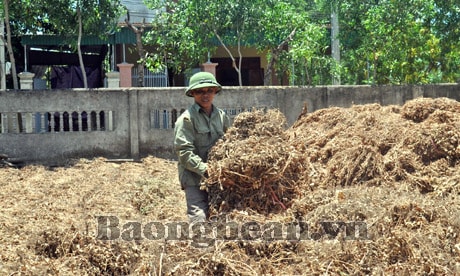
The 8 sao (approximately 0.8 hectares) of peanuts belonging to Mr. Pham Xuan Hai's family in Hamlet 2 are piled up in the garden after harvest because there is no buyer yet.
Not only Mr. Hai's family and Ms. Luyen's family, but all peanut farmers in Nghi An commune are in the same situation. Currently, the lives of the people are difficult due to high production costs, low output prices, difficulty in selling, and a sense of discouragement among the people. This reality is a cause for concern, as about 70% of the province's population lives in rural areas connected to agricultural production, yet after each harvest, farmers are constantly worried about finding buyers. The reality shows that the market for agricultural products is very unstable, dependent on the market and private traders. For many products, there is no organization that buys them, therefore farmers suffer greatly; they invest a lot of effort and money, but the output is unregulated and prices are low.
Speaking with us, Mr. Pham Huy Thong – Chairman of the People's Committee of Nghi An commune – said: In the spring of 2013, Nghi An commune had a total peanut production area of 250 hectares, with an average yield of 2.4 tons of dried peanuts per hectare. Production and harvesting were both favorable. However, the biggest concern for the locality currently is the almost complete lack of market outlets for agricultural products. While fertilizer prices are high, production investment costs are large, and the products are not being sold, it is very difficult for farmers. Some households harvest tons of peanuts, but if they cannot sell them and leave them until the rainy season, the peanuts will become rancid and of poor quality, making them even harder to sell. The local government sympathizes with the difficulties of the people, but is powerless to help. We hope that relevant agencies will find solutions to promote peanut exports, create markets for farmers, and create favorable conditions for them to invest in production and remain committed to farming.
Quynh Lan


