
They're asking for another increase in gasoline and diesel prices.
On May 29th, a source from the Petroleum Market Management Board stated that after the fuel tax was reduced from 19% to 18%, major fuel distributors continued to petition for price increases, claiming they were still operating at a loss... Are the businesses making a profit or a loss?
Information about petroleum businesses making profits has been causing a stir in recent days. This was announced by the Vietnam Petroleum Association. Mr. Trinh Quang Khanh, Permanent Vice Chairman of the Vietnam Petroleum Association, told the press that the main importing businesses are making a profit of approximately 270 VND/liter of gasoline, 290 VND/liter of diesel, 195 VND/liter of kerosene, and 130 VND/kg of fuel oil after deducting all taxes and fees. If an additional 300 VND profit margin is added, the main importing businesses are making a profit of 430-590 VND/liter or kg of petroleum products (depending on the product).
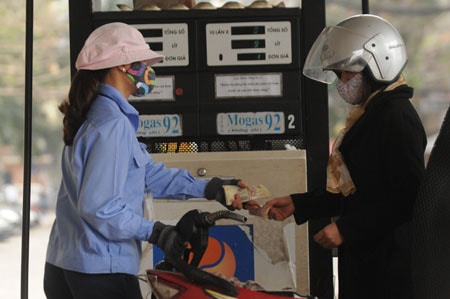
Because of the profit margin, gasoline companies have increased the discount offered to dealers to a common level of 650-700 VND/liter of gasoline, and in some places up to 900 VND/liter in the past few days.
However, a leader of the Petroleum Market Management Board denied that petroleum companies are currently making profits. Referring to the price of imported petroleum from Singapore over the past 10 days, he stated that prices have not decreased but are actually increasing; gasoline prices in Singapore, which were around $106/barrel at the beginning of May, have risen to approximately $112-113/barrel in the last two days. Even crude oil prices have only fluctuated slightly around $100/barrel, not decreasing. “Petroleum companies are currently losing 150-200 VND per liter of gasoline, and even more so with diesel,” the leader said.
According to economist Ngo Tri Long, there is currently insufficient basis to assess the profit and loss of gasoline and diesel businesses. He suggested that the petroleum industry should provide clear data and that the National Assembly should pay attention to this issue because gasoline and diesel directly affect people's lives. Petroleum businesses also denied making profits, all claiming to be losing nearly 300 VND per liter of gasoline and diesel sold based on the 30-day average price. The leader of a major petroleum distribution company in the South stated that the 30-day average price, from April 26th to May 26th, for RON92 was 110.6 USD/barrel; and for DO 0.05S was 116.5 USD/barrel. At these prices, the company is losing 247 VND per liter of gasoline and 297 VND per liter of diesel.
The question arises: why are petroleum companies increasing sales discounts for dealers despite incurring losses? An official from the Petroleum Management Board explained that petroleum companies have to increase discounts to "cut losses." According to him, due to slow sales and rising prices, companies have to increase discounts and compete with each other to quickly "push" existing inventory, recover capital to pay bank interest, and reinvest in new stock.
A 2% tax reduction wouldn't necessarily lead to a price increase?
Businesses' proposal to increase gasoline and diesel prices is currently under consideration by leaders of the Joint Ministry of Finance and Industry and Trade. A source from businesses indicated that they had previously proposed a 2% tax reduction to avoid raising retail gasoline and diesel prices. However, the tax reduction they hoped for was only 1 percent, which translates to a reduction of approximately 200 VND per liter or kilogram of gasoline and diesel.
Economist Le Dang Doanh stated frankly: Only the Ministry of Finance and the Ministry of Industry and Trade, along with the businesses themselves, know whether they are making a profit or a loss. Public opinion has never agreed with their claims of losses. "The profit and loss figures for the petroleum industry are often unclear, and it's difficult to verify them. With world oil prices continuously falling, how can they be making a loss? Especially with the recent reduction in import taxes on petroleum, the cost of doing business in the petroleum sector has clearly decreased significantly," Mr. Doanh emphasized.
According to Dan Viet - TH


