
Dien Doai Fishing Village
(Baonghean) - Dien Doai and Dien Kim (Dien Chau) have long been famous for their fish breeding industry. Today, the industry has developed into a reliable source for fish farmers throughout the central region of Vietnam, from Quang Tri to Thanh Hoa.
Following the directions of Nguyen Phi Nga, Vice Chairman of the People's Committee of Dien Doai commune, we went to the house of Mr. Nguyen Ngoc Le, considered one of the first people to introduce the craft to the village.
Welcoming us under the shade of longan trees, right by the fish pond, amidst the scent of ripe longan, Mr. Le told us: After leaving the army, while still unsure of what profession to choose for the future, the commune decided to convert 26 hectares of low-lying, swampy rice paddies, previously used by the cooperative for ineffective fish farming, for its members. The commune encouraged him to take on 1.3 hectares to set an example for everyone. That was in the early 1990s. By cultivating rice, raising fish, and planning, he gradually accumulated wealth. His farm alone was worth several billion dong. From 1991 to 2003 was the basic construction phase; each year, in addition to family labor, Mr. Le hired nearly 400 laborers. Each year, the reclaimed land was used to plant one rice crop, and after harvesting, fish were released into the ponds. The 1.3 hectares of land were divided into many ponds, each pond raising a different species of fish.
On the edge of the pond, he planted sugarcane and raised pigs. Each year, he earned tens of millions of dong from pigs and sugarcane, and invested the rest in the fish pond. The years 1995, 1996, and 1997 were the golden age of fish farming. Each plot of land used for raising fish fry yielded 5 million dong after 2 months. The target of 100 million dong per hectare was achieved from that time onwards for the fish farming business. We don't know about hidden wealth, but what we saw was that he bought an expensive car, invested nearly 1 billion dong in wedding catering facilities, and also raised two pairs of deer. With the money he earned, he sent his two children to work in the United Kingdom.
Currently, his production facility consistently produces over 25 tons of fish fry and adult fish annually. He is gradually investing in other, less strenuous areas.
Besides Mr. Le's model, we also visited Mr. Tran Trung Tin's snakehead fish farming model. Born in 1987, Tin admits he's "stupid" and couldn't learn, so he switched to learning fish farming. But judging by his demeanor and calculations, no one would think he's unintelligent. He's nicknamed the "king of snakehead fish" because he was the first person to bring snakehead fish to Dien Doai for farming. In 2007, after hearing about the popularity of snakehead fish farming through newspapers and television, Tin packed his bags and went to "seek guidance." With the knowledge he gained, he bought 5,000 fingerlings to raise. Following the instructions, the fish ate a lot and grew quickly.
Before the joy could even fully develop, worry struck: In winter, the catfish died in large numbers, making them unsaleable, and even giving them away was unacceptable. Upon investigation, Tín learned that the disease was due to the fact that the catfish, being native to warm climates, couldn't tolerate the cold of winter. Therefore, he had to devise a farming schedule tailored to the weather, from ordering and stocking the fry to harvesting, ensuring everything avoided the cold. Tín's established process involved stocking the fry from February to December, with harvesting completed in December. Since 2008, this process has been consistently successful. Tín also raises catfish on two plots of land and traditional fish on two plots. Leading us on a tour of his 60m² cement tank for raising catfish, stocked with 10,000 fry, Tín confidently assured us that this year he expects to harvest 5 tons of market-ready fish.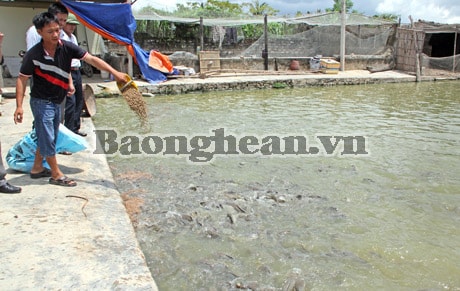
The snakehead fish farming model of Mr. Tran Trung Tin's family (Dien Doai commune, Dien Chau district).
According to Tín's calculations, a net profit of 10,000 VND per kilogram of fish would generate an income of 50 million VND. The snakehead fish (both fingerlings and mature fish) raised in his own pond alone yielded nearly 200 million VND in profit. Not only did Tín creatively find the right season and farming methods, but he also handled both the input and output services for this fish. He was practically an exclusive distributor of snakehead fish fingerlings to farmers from Hà Tĩnh all the way to Thái Bình. Tín also took care of the market for the fish. From selling his own fish to traders in Hà Tĩnh, Quảng Bình, and Vinh City, Tín established connections and provided services to other farmers, selling dozens of tons of fish to consumers each year, generating a considerable income.
Dien Doai, once a barren wasteland overgrown with reeds, has now become a fertile land. Fish farming, both for breeding and consumption, has contributed to the prosperity of 337 households from hamlets 3 to 11. Annually, fish farming contributes 135 billion VND to the commune's total income. This fish farming has also given rise to three crop rotation formulas in Dien Doai: fish breeding - fish consumption, one rice crop - one fish crop, and two rice crops - one fish crop. These formulas are effectively helping the local people alleviate poverty.
Mr. Tuan


