
Gathering feedback on the draft revised Penal Code to promote democracy.
Deputy Minister Dinh Trung Tung emphasized that maximizing the wisdom of the people will result in a high-quality and effective Criminal Code.
The draft Penal Code (amended) was put forward for public consultation from July 15th to September 14th, 2015. Following the Constitution and the Civil Code (amended), this is the third time a draft law has been put forward for public consultation, demonstrating the importance of law to society and promoting democracy and collective intelligence to meet the demands of the current period. Deputy Minister of Justice Dinh Trung Tung gave an interview on this matter.
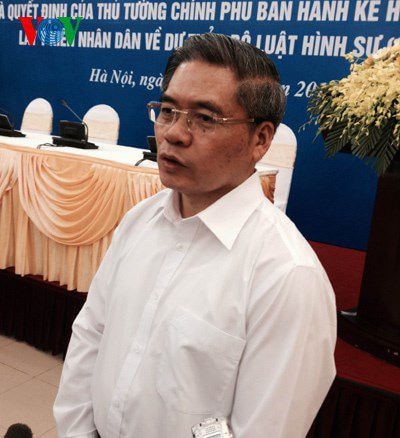 |
| Deputy Minister of Justice Dinh Trung Tung |
PV:Sir, could you please explain the importance of the amended Criminal Code and the reasons for seeking public opinion on this draft law?
Deputy Minister Dinh Trung TungThe decision to solicit public opinion on the draft revised Penal Code was made by the National Assembly. The National Assembly assigned the Government to organize the collection of public opinion for two months, prior to the 10th session, for consideration; if favorable, the draft will be promulgated.
The process of soliciting public opinion on the amended Criminal Code, just as it was previously done on the amended Civil Code, is of immense importance. This is a comprehensive and fundamental amendment, affecting all citizens and society as a whole. Therefore, promoting democracy and maximizing collective intelligence is essential to create a fundamentally comprehensive amended Criminal Code that meets the socio-economic development needs of the country and the requirements of crime prevention.
Therefore, it must be recognized that this is also a broad and profound political campaign. In the Resolution of the Standing Committee of the National Assembly, the Government's plan clearly assigns responsibilities to central and local agencies and departments to organize the process meticulously and to truthfully and fully reflect the opinions of the people so that the Government can synthesize them, report to the National Assembly, and then revise and submit them to the National Assembly for consideration and approval.
PV:What are the notable points regarding the content presented for public consultation, and what impact will this have on the draft law, sir?
Deputy Minister Dinh Trung TungAppendix 1 contains 8 items that the Government plans to solicit public opinion on. These are issues where opinions still differ. Each issue has two or three different viewpoints, and the Government's plan for this appendix clearly analyzes each viewpoint, explaining why one is supported and why another is supported, in order to provide comprehensive information for the public to consider.
These are all major issues, many of which are new and will directly affect the draft of the Penal Code. If resolved well, it will result in a high-quality Penal Code that meets the general requirements of the country now and in the future.
PV:So, after the Constitution and the Civil Code, this is the third time we've organized a public consultation. Drawing on lessons learned from previous consultations, what are some key points to consider this time to improve the process, sir?
Deputy Minister Dinh Trung TungThe recent public consultations on the 2013 Constitution and the Civil Code, in my opinion, have basically met the requirements. However, the consultation period for the Constitution and the Civil Code was quite long. This time, the Criminal Code only has two months, so we must be extremely urgent and ensure the quality and effectiveness of this process. Because if it is not done well, it will be costly and wasteful without achieving the set goals.
Therefore, this is also the work of the entire political system, and with the active, voluntary participation and involvement of the people, I believe that although the time is short, this consultation will certainly yield good results.
PV: Thank you, sir.
The content for public consultation includes the entire draft of the amended Penal Code, focusing on issues such as: the criminal liability of legal entities and the types of crimes for which legal entities are held criminally liable; the scope of criminal liability of minors and alternative measures for handling criminal offenses committed by minors; the conversion of fines and non-custodial correctional penalties into fixed-term imprisonment...
The following issues were also discussed: abolishing the death penalty for certain crimes; regulations prohibiting the application or execution of the death penalty in certain cases; and regulations prohibiting sentence reduction for those sentenced to death but whose sentences are commuted to life imprisonment...
Citizens can provide feedback directly or in writing; at conferences, seminars, and forums; through the Ministry of Justice's electronic portal and other appropriate forms.
According to VOV.VN


