
Cuong Temple Festival: Returning to our roots
(Baonghean) - Every year, in the spring (from the 12th to the 15th of February in the lunar calendar), a large number of people in Dien Chau district flock to Cuong Temple to commemorate the great contributions of Thuc An Duong Vuong, who, together with the people, fought against the Qin and expelled the Zhao, winning independence and freedom for the nation. This marked the beginning of a golden chapter in the history of the Vietnamese people's indomitable and resilient tradition of resisting foreign invaders.
An Dương Vương, whose real name was Thục Phán, was a descendant of 18 generations of Hùng kings. He possessed extraordinary strength, intelligence, and strategic brilliance. Thục Phán played a major role in uniting the northern tribes of Vietnam, rallying skilled generals and the entire population to defeat the invading Qin army.
During the triumphal procession, Thục Phán was enthroned as king, taking the title An Dương Vương, and renamed the country Âu Lạc. He moved the capital from Phong Châu to Cổ Loa and reigned for 50 years (from 257 to 208 BC). Under An Dương Vương's reign, the country developed in many aspects, especially making new strides in rice production and national defense. An Dương Vương had the Cổ Loa citadel built in a spiral shape, with the Đào River outside connecting the branches of the Hồng River, where warships patrolled day and night. Notably, he created a highly effective crossbow that could kill many enemies with a single shot (known as the "divine crossbow").
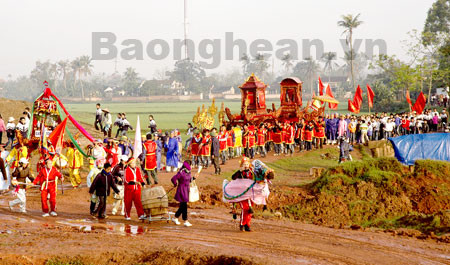
The procession carrying the palanquin from Xuan Ai Temple to Cuong Temple. Photo: Tran Canh Yen
At that time, in the North, Trieu Da and his son refused to submit to the Chinese feudal state and rebelled, establishing their own kingdom in the Southeast. With the ambition of expanding their territory, Trieu Da repeatedly invaded Au Lac. However, An Duong Vuong, with his high walls, deep moats, powerful army, skilled generals, and formidable weapons, repeatedly repelled Trieu Da's invading forces. Unable to conquer Au Lac by military strength, Trieu Da cunningly resorted to a peace treaty, forming an alliance through marriage and arranging for his son, Trong Thuy, to marry Princess My Chau, waiting for the opportunity to conquer Au Lac. Little did An Duong Vuong know that the love and happiness of My Chau and Trong Thuy, coupled with Trieu Da's despicable scheme, would lead to unimaginable national disaster for Au Lac.
In 208 BC, King An Duong of Thuc was unexpectedly attacked by Trieu Da's army, forcing him to retreat south and commit suicide at Cua Hien, north of Mo Da mountain, now located in Dien An commune, Dien Chau district. To commemorate the contributions of King An Duong, the people of Dien Chau erected a temple on the summit of Mo Da mountain and hold an annual festival, attracting a large number of locals and visitors from all over.
The Cuong Temple Festival has become an indispensable part of the daily life of the people of Dien Chau, Nghe An, and visitors from all over. As scheduled, the festival takes place annually from the 12th to the 15th of February in the lunar calendar. This year, Dien Chau district began preparations for the Cuong Temple Festival in early January. All communes simultaneously launched campaigns to clean up the environment, creating a green, clean, and beautiful environment, and displayed banners and slogans such as "Welcome to the Cuong Temple Festival 2012" from mid-February. Currently, the radio stations of 39 communes and towns are continuously broadcasting information about the origins of the Cuong Temple Festival. Athletes from the communes, along with high school students from schools in the southern cluster, have basically completed their training in martial arts programs to participate in performances of karate, traditional martial arts, etc., during the festival days.
At the Cuong Temple Festival, visitors not only get to enjoy the solemn and respectful ceremonies before the spirit of Thuc An Duong Vuong and other deities, reflecting the rich national identity of Dien Chau coastal land, but also immerse themselves in the vibrant festival atmosphere with folk games and cultural and sporting activities such as cockfighting, Ferris wheel rides, tug-of-war, and other traditional games.
In particular, visitors can immerse themselves in the melodies of the Ca Tru Club, the Poetry Club, and folk music performances; admire the beauty of the Cuong Temple with its charming beauty reflecting the coastal landscape of Dien Chau... The Cuong Temple Festival is also an opportunity for tourists to visit Cua Hien - Ho Xuan Duong, Dien Thanh coastal resort area, Co Am Pagoda - Linh Son Lake - Hai Vai rock formation reflected in the poetic Bung River. Visiting these historical sites and scenic spots in Dien Chau, a place with over 1,380 years of cultural history, allows us to reflect and remind each other to preserve, protect, and promote the value of our cultural heritage.
Visiting Cuong Temple is an opportunity for people from all regions, from the lowlands to the highlands, from rural areas to coastal regions, to meet and interact with each other, showcasing the traditional cultural features of each locality, and especially to recall the historical traditions of their ancestors, and to pray for favorable weather, bountiful harvests, calm seas, abundant fish and shrimp, peaceful villages, and happy, prosperous families.
Thu Huong


