
Quang Trung King Temple Festival
(Baonghean) - As scheduled, every year on the 5th day of the first lunar month, the people of Vinh City and visitors from near and far flock to the temple of King Quang Trung on Dung Quyet mountain to attend the commemoration ceremony of the Ngoc Hoi - Dong Da victory. This year, in addition to the solemn ceremony, the festival also revived traditional folk games such as traditional wrestling, tug-of-war, and martial arts performances. This is the second year the temple has organized the ceremony of issuing lucky charm cards, wishing everyone peace and good fortune in the new year.
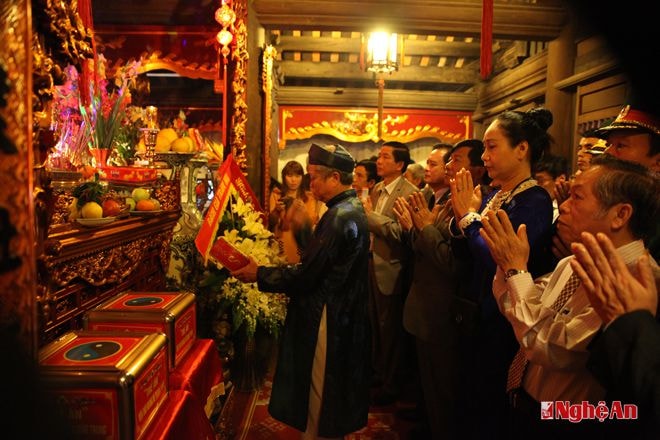 |
| Delegates perform a ceremony to request "Seal Cards". Photo: Xuan Nhuong |
The resounding victory at Ngoc Hoi - Dong Da
226 years ago, amidst internal strife and external threats, with the country being invaded by the Manchu Qing Dynasty, Nguyen Hue - Quang Trung organized a coronation ceremony and immediately ordered his army to march north to repel the foreign invaders. On December 29th, 1788 (the year of Mau Than), the rebel army arrived in Nghe An. He ordered General Ham Ho Hau to recruit and train soldiers, and in a short time, they recruited more than 10,000 troops to attack Thang Long citadel.
On the eve of the Lunar New Year of the Year of the Rooster (1789), three Tây Sơn infantry armies set out from Tam Điệp. The main attack, personally commanded by Emperor Quang Trung, struck directly at the southern defenses of Thăng Long, using Ngọc Hồi fort as a key stronghold. Admiral Long commanded the attack, launching a surprise assault on Đống Đa fort and then penetrating deep into Tôn Sỹ Nghị's headquarters at Tây Long Palace. Prior to this, Admirals Lộc and Thuyết, commanding two naval forces, also set out from Biện Sơn, crossing the sea to attack Hải Dương and blocking the Qing army's retreat route via Lạng Giang, Phượng Nhãn, and Yên Thế. With their military genius, advantageous formations, and the swift, powerful attack of the Tây Sơn army, the entire Qing defense system and resistance were shattered in just five days and nights. The battles of Ngọc Hồi and Đống Đa on the morning of the 5th day of the Lunar New Year were resounding victories, playing a decisive role in the great defeat of the Qing army and the liberation of Thăng Long. The Qing commander, Sun Shiyi, "lost his wits, without even having time to put on his armor or saddle his horse, led his cavalry across the pontoon bridge and fled north." The Qing army in Thang Long was largely annihilated, many generals were killed, and the remaining troops fled in disarray. At noon on the 5th day of the Lunar New Year in 1789, Emperor Quang Trung, his robe stained black with gunpowder smoke, mounted on a war elephant, led his victorious army straight into Thang Long amidst the joyful welcome of the people.
The victory at Ngoc Hoi - Dong Da marked a glorious milestone in the history of our people's and nation's struggle against foreign invaders, ending the domination of the Manchu imperialists and bringing peace and independence to the nation.
Quang Trung Temple Festival
For a long time, the temple dedicated to King Quang Trung has been an indispensable destination for every citizen of the city during the Lunar New Year. Especially on the 5th day of the first lunar month, visitors flock to the temple in even greater numbers, as this is an occasion to commemorate the glorious historical events of our people and nation: the victory at Ngoc Hoi - Dong Da, the Spring victory of the Year of the Rooster (1789), and to express gratitude for the great contributions and achievements of the national hero Nguyen Hue - Quang Trung, who unified the country, expanded its borders, and contributed to the prosperity and happiness of the people.
Amidst the crowds flocking to Quang Trung Temple on the grand occasion, Mr. Nguyen Viet Thanh (70 years old) from Block 12, Trung Do Ward, happily shared: "Every year I bring my grandchildren here to offer incense and commemorate King Quang Trung. It's an opportunity for them to understand the history of Nghe An province in particular, and the country in general."
To prepare for a solemn and respectful commemoration ceremony, the temple management board prioritizes welcoming visitors and ensuring security and order. Mr. Vu Hong Duc, Deputy Head of the Vinh City Culture Department and Head of the Quang Trung Temple Management Board, stated: "To meet the people's affection for Emperor Quang Trung; to continue promoting and developing the spiritual and cultural values associated with tourism services, right from the time leading up to Tet (Lunar New Year), we have coordinated with the Trung Do ward government to clean up the temple area and decorate with banners and slogans from the foot of the mountain to the temple gate. The temple management board, in coordination with the city police and Quang Trung ward, has deployed personnel to ensure security and order during the New Year and the festival. This is the second year that Quang Trung Temple has distributed 8,000 'Quang Trung Linh Tu' (Quang Trung Temple Seal Cards) to visitors attending the festival on January 5th, meeting the religious needs of the people."
Besides enjoying the cultural and spiritual values, admiring the beautiful natural scenery, and the tranquil and sacred atmosphere of the temple, visitors to the Quang Trung Emperor Temple also have the opportunity to enjoy the special flavor of bitter tea, a local specialty harvested by the Management Board from naturally grown bitter tea plants on Dung Quyet mountain where the temple is located.
Thanh Thủy – Thu Hương


