
Linking together to produce safe agricultural products.
(Baonghean) - Producing safe agricultural products is one of the most important aspects in the restructuring of agriculture towards increasing added value and sustainable development.
PV:Could you please tell us about the current situation regarding the production of safe agricultural products in Nghe An province? What are the difficulties in producing agricultural products that meet food safety and hygiene standards?
Mr. Nguyen Quy Linh:Producing safe agricultural products is a crucial aspect of agricultural extension activities during the restructuring of agriculture towards increased added value and sustainable development. Therefore, the agricultural extension system has been working alongside agricultural production management sectors and localities, focusing resources and collaborating with producers to effectively organize the production of safe agricultural products.
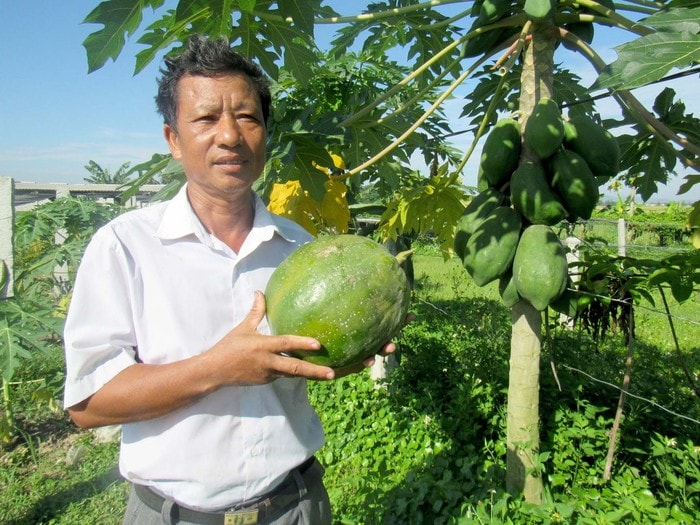 |
| The papaya farming model that generates high income for Mr. Nguyen Van Ba's household (Dien Lien commune, Dien Chau district). Photo: Quang An |
In reality, thanks to the active involvement of all levels and sectors and the widespread media coverage, people's awareness of producing and consuming safe agricultural products has gradually improved. Consumers are becoming more discerning in choosing clean agricultural products to ensure their health and safety, and producers are also becoming more aware of their responsibility in creating safer products for society. Therefore, safe production areas are increasingly expanding, yielding products of higher quality and economic value.
However, the production of agricultural products that meet food safety and hygiene standards in the area still faces many difficulties and obstacles that need to be addressed to create momentum for safe agricultural production. While producers' awareness has improved, it has not yet fully met the requirements. Many agricultural production areas still do not fully comply with food safety and hygiene regulations; some production areas do not meet the required standards; fertilizers, pesticides, and antibiotics are used indiscriminately in livestock farming, and products are harvested without adhering to the prescribed quarantine period. Meanwhile, local agricultural production remains fragmented and household-scale, making it difficult to control the process.
In particular, the link between production and consumption remains weak, the market for clean agricultural products is unstable, and many products have not yet been contracted for sale with businesses; most agricultural products are consumed widely throughout the province through local markets, making it difficult to control the quality of input products, leading to consumers having difficulty distinguishing between safe and unsafe agricultural products; the effectiveness of producing safe agricultural products is not higher than that of traditional production.
Post-harvest technology is generally weak, affecting processing and the enhancement of added value for safe agricultural products. Infrastructure in many raw material areas does not yet meet the requirements for producing safe agricultural products.
PV:To overcome these difficulties, what solutions has the industry focused on implementing in this area recently, sir?
Mr. Nguyen Quy LinhOver the past period, agricultural extension activities, in collaboration with localities and relevant sectors, have focused on implementing various solutions to gradually improve the quality of agricultural products. First, we have intensified communication efforts through mass media to raise awareness among producers and consumers regarding the production and selection of safe products for processing and consumption. We have also promoted training to enhance the capacity of farmers in safe and sustainable production techniques for crops and livestock, and the effective use of pesticides and veterinary drugs.
Accordingly, over 1,200 training courses have been organized annually for farmers throughout the province, contributing to raising the sense of responsibility of producers towards the community. At the same time, efforts have been intensified to build demonstration models for the production of safe agricultural products.
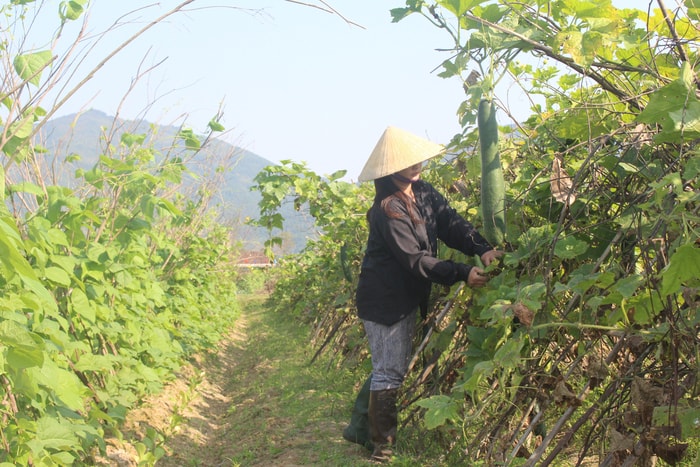 |
| Growing green squash in Nam Xuan commune (Nam Dan district). Photo: PH |
To date, the agricultural extension system, agricultural service sectors, and localities have developed hundreds of models for replication, such as biosafety livestock farming models, models applying biological bedding to ensure ecological environment, safe vegetable production models according to VietGAP standards, rice cultivation models applying SRI technology and the 3 increases 3 decreases process; biosafety shrimp and aquaculture farming models, and the establishment of VietGAP zones in aquaculture... From these, workshops and field visits have been organized to help people understand and follow the models.
Through safe agricultural production models following VietGAP standards, people are gradually becoming familiar with record-keeping and data retrieval methods so that they can immediately meet VietGAP requirements when the standards are applied. Simultaneously, coordination of programs and projects is being promoted to build agricultural product chains based on business needs, connecting producers to create goods that meet market demands. Facilitating better connections between retail chains selling safe agricultural products and producers is also crucial. This will help develop specialized farming areas to serve the market.
It can be affirmed that, through the synchronized implementation of various solutions, safe agricultural commodity production has made significant progress in recent years, and we now have many effective models that can be replicated.
In the livestock sector, there are models such as biosecure farming aimed at ensuring environmental hygiene and preventing disease outbreaks. Based on practical results, nearly 45,000 pigs have been raised using this model to date. Many farming areas have improved environmental hygiene through production models using biological bedding; 12,000 sows have been converted from domestic to foreign breeds in farms; and 350,000 poultry have been raised using biosecure methods.
In the agricultural sector, improved rice intensification techniques (SRI) are applied to an area of 4,600 hectares; safe vegetable production (cucumbers, watermelons, zucchini, green beans, cantaloupe, etc.) covers 1,600 hectares; and 420 hectares of upland land are converted to growing cucumbers, zucchini, cabbage, and kohlrabi according to VietGAP standards.
In the aquaculture sector, over 7 VietGAP-certified shrimp farming areas have been established, covering an area of 240 hectares. Two diversified farming areas are located in Dien Van (Dien Chau) with 27 hectares and Nghi Hop (Nghi Loc) with 40 hectares. 76 hectares have been certified for safe vegetable production, and 40 hectares of oranges have been certified as safe orange production facilities.
PV:Could you tell us what breakthrough solutions the agricultural extension sector will implement in the coming period to improve the effectiveness of agricultural extension activities?
Mr. Nguyen Quy Linh:First and foremost, we will continue to do a good job of disseminating information and providing technical guidance to raise awareness among farmers in producing safe agricultural products. We will gradually build groups and cooperatives for agricultural commodity production, thereby concentrating human resources and organizing production in a coordinated manner to facilitate safe production.
In particular, appropriate solutions are needed to effectively connect businesses and farmers. This is considered one of the top priorities today, providing both a market for agricultural products for farmers and a stable supply of quality goods for businesses. Simultaneously, implementing quality control measures for agricultural products through technologies and product traceability will help consumers feel more secure when choosing products. We will also strengthen coordination with the Nghe An Agricultural Market Forum to build and expand linkage models, enhance trade promotion, and build effective product chains. We will gradually expand safe production areas, build agricultural product brands, and aim for VietGAP certification for agricultural products.
PV:Thank you, sir!
Phu Huong
(Perform)


