
Will a strategic axis between Russia, China, and India be formed?
(Baonghean) - The recent meeting of the foreign ministers of Russia, China, and India, while not a high-profile event, has attracted significant public attention due to its strategic implications. Based on the meeting's outcomes, including Russia and China's support for India's accession to the Shanghai Cooperation Organization (SCO), public opinion is speculating about the possibility of forming a strategic axis between Russia, China, and India, building upon the strategic triangle established 10 years ago. Will this scenario materialize?
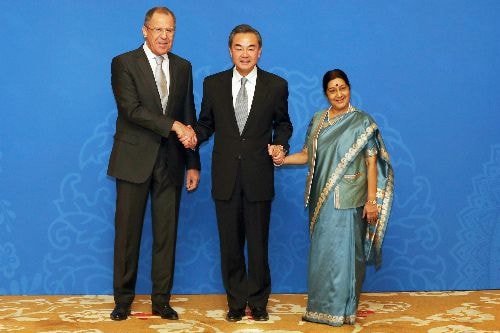 |
| From left to right: Russian Foreign Minister Sergey Lavrov, Chinese Foreign Minister Wang Yi, and Indian Foreign Minister Sushma Swaraj in Beijing on February 2. Photo: Reuters |
Russia, China, and India want to increase their voice in the region and the world.
Looking at the overall joint statement issued after the meeting of the three foreign ministers of Russia, China, and India, it is immediately clear that the three countries desire to develop deep and broad relations in many areas. However, it is noteworthy that the majority of the statement addresses commitments to cooperation among the three countries on regional and international issues, such as commitments to strengthen coordination and cooperation to maintain peace and stability in the Asia-Pacific region, and calls for “the development of an open, comprehensive, transparent security mechanism and a cooperation mechanism in the region.” The joint statement also assesses “the special importance of cooperation among the three countries within the framework of the Shanghai Cooperation Organization (SCO), considering it one of the key tools to promote multilateral cooperation in politics, economics, security, and humanitarian activities in the region.” These points demonstrate that through this joint cooperation mechanism, Russia, China, and India not only aim to promote the development of the three countries but also use this mechanism to increase their combined voice on common regional and global issues.
Looking forward to a closer relationship.
Since 2005, Russia, China, and India have held joint Foreign Ministers' meetings, but this cooperation mechanism has not yet had a significant impact. Russia, China, and India also cooperate within the framework of the Group of Emerging Economies (BRIC), however, within this mechanism, the countries focus more on economic cooperation, while political cooperation seems to be largely neglected. Therefore, world opinion suggests that the recent meeting shows that Russia, China, and India want the international community to acknowledge the geopolitical reality of the Russia-China-India strategic triangle and want to push this cooperation mechanism to a new level, possibly even into a Russia-China-India axis, as some international news outlets have suggested. As the three largest and most powerful countries in Asia, and among the world's leading nations, closer ties between these three countries would undoubtedly create a major shift in the political landscape, not only regionally but also globally. If formed, this axis could pose a formidable counterweight to the United States and the European Union.
Will a strategic axis between Russia, China, and India be formed?
It's not difficult to see that Russia and China have many reasons to push this forward. In the context of Western isolation and sanctions, Russia is striving to expand cooperation eastward, opening up opportunities for economic cooperation while simultaneously strengthening its political position and voice in the region and the world. For China, cooperation with Russia and India would clearly increase its prestige and influence. However, the situation is different for India. Unlike Russia and China, India has very good relations with the United States. There isn't the same major conflict between India and the US as there is between the US and Russia and China. Therefore, whether a Russia-China-India axis is formed largely depends on India. India knows that strengthening relations with Russia and China will inevitably affect its relationship with the US, and vice versa. Thus, it is immediately apparent that the Russia-China-India axis is placing India in a difficult position, as it must balance its relationship with the United States on one side and Russia and China on the other. This could be a major obstacle preventing India from enthusiastically participating in building closer relations with Russia and China within this new axis.
Secondly, strategically, a Russia-China-India axis is unlikely to form because, aside from the immediate short-term goal of helping Russia and China counterbalance the US and strengthen the three countries' voices on the international stage, all three countries harbor significant suspicions about each other. While Russia and China claim to be natural and most important partners, Russia is wary of China's rapid development potentially threatening its position, especially in the Far East. Russia and China are also quietly vying for influence in Central Asia – once considered Russian territory, but where Russia is gradually losing influence. China and India have a long-standing border dispute that has recently resurfaced. Because of these obstacles, it is clear that a close Russia-China-India relationship is unlikely. Any form of relationship between these three countries would be more formal and short-term than substantive.
Vietnam Russia


