
Sacred Quả Sơn Temple Festival
(Baonghean) - Every year, from the 18th to the 20th of the first lunar month, people in Do Luong district and surrounding areas eagerly flock to the Qua Son Temple Festival - a traditional festival commemorating King Uy Minh Ly Nhat Quang.
Sacred Quả Temple
Quả Sơn Temple is one of the four most sacred temples in Nghe An province, renowned for its "first Cờn, second Quả, third Bạch Mã, fourth Chiêu Trưng". The temple was built by the people at the foot of Quả Mountain in Miếu Đường village, Bạch Đường hamlet, Nam Đường district (now Bồi Sơn commune, Đô Lương district). The temple is dedicated to Uy Minh Vương Lý Nhật Quang – a district chief who made significant contributions to building the homeland of Nghe An and expanding and protecting the national borders.
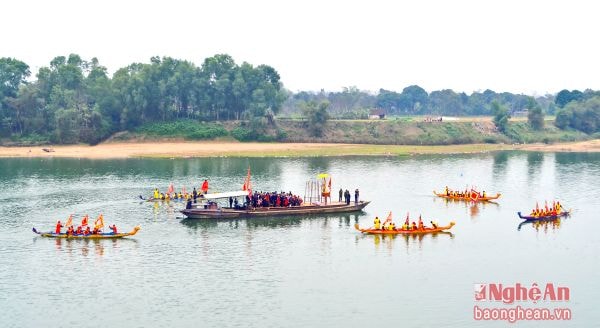 |
| Procession by waterway at the Quả Sơn Temple Festival. Photo: Lương Mai |
According to historical records and legends of Quả Sơn Temple: In 1039, Lý Nhật Quang was appointed by the king to oversee tax collection in Nghệ An province with the title "Uy Minh Crown Prince". In 1041, Lý Nhật Quang was appointed as the Governor of Nghệ An with the title "Uy Minh Marquis Lý Nhật Quang".
This is a significant milestone affirming the immense role and influence of Ly Nhat Quang in the Nghe An region. In 1044, King Ly Thai Tong promoted Ly Nhat Quang from the title of "Marquis" to "King," making him Uy Minh King Ly Nhat Quang, and granted him the "Tiet Viet" authority (meaning he had the right to represent the king, was trusted by the king, and was entrusted with the power to decide all political matters in Nghe An).
During his reign over Nghe An, with his benevolent and people-oriented policies, along with numerous reforms and policies for economic, political, and cultural development, Ly Nhat Quang made significant contributions to consolidating and developing Nghe An from a "borderland" and "frontier" region into a major stronghold, a solid fortress in terms of military, economic, and cultural aspects, not only for the Ly dynasty but also for subsequent dynasties.
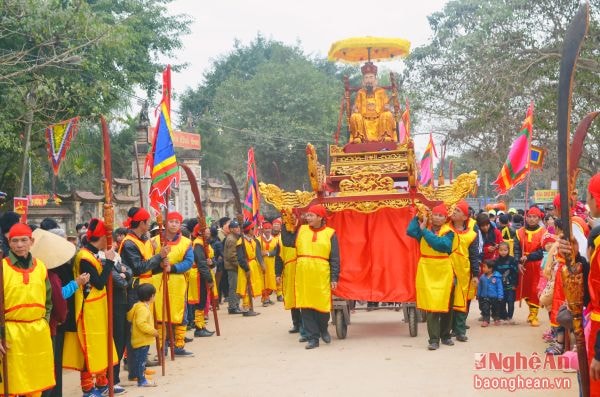 |
| The procession at the Quả Sơn Temple Festival. Photo: Lương Mai |
In 1057, King Uy Minh Ly Nhat Quang passed away and became a saint at the foot of Mount Qua. The people of Nghe An were deeply saddened, weeping and remembering him, and erected a temple in his honor at the very place where he passed away and became a saint, called the Qua Son Temple. Along with the Qua Son Temple in Boi Son commune, there are currently more than 30 other temples in Nghe An province also dedicated to him. The author of the book "Viet Dien U Linh Tap" affirmed that he is "the benevolent deity of the entire region".
Through the vicissitudes of history, due to time and war, the Quả Sơn Temple today no longer retains its former scale and grandeur (7 buildings, 40 rooms in the Lý-Trần style). In 1952, bombs from the French colonialists severely damaged the temple. Only the ancient stone stele and the tomb of the Venerable remain.
In line with the policy of preserving, restoring, and enhancing national historical and cultural relics, in 1996, with the assistance of the Nghe An Provincial Department of Culture, the Party Committee, the government, and the people of Do Luong District, along with visitors from near and far, the Qua Son Temple was gradually rebuilt in its original location. On February 12, 1999, the Qua Son Temple was classified as a "National Historical and Cultural Relic" by the Ministry of Culture and Information according to Decision No. 05/QD-BVHTT. The 17th day of the 12th lunar month each year is the anniversary of the death of Uy Minh Vuong Ly Nhat Quang, also known as the temple's memorial ceremony. The 19th and 20th days of the 1st lunar month each year are the days for the Qua Son Temple Festival.
A highlight of the temple festival is the procession to thank the Goddess of Mercy at the Goddess of Mercy Temple, also known as Tien Tich Temple, located 4 km west of the temple in Lam Son commune. Legend says that the Goddess of Mercy frequently provided divine assistance to Ly Nhat Quang in his affairs of state and guided him to the place of enlightenment and sainthood at the foot of Mount Qua. Every two years, in even-numbered years, the procession travels upstream on the Lam River and by land through five ancient villages. In each village, the people organize solemn ceremonies to pay their respects to the Goddess.
This could also be called the Spring Festival, where the people of the region, on behalf of the people of Nghe An province, express their gratitude to the hero of the nation-building era, the patron saint of the region. It is also an occasion to welcome the spring with a spirit of martial arts and traditional folk games. Each festival attracts tens of thousands of local people and visitors from far and wide.
The restoration and preservation of the Quả Sơn Temple Festival profoundly reflects the traditional moral principle of "drinking water, remembering the source," reviving the spirit of martial arts and traditional cultural and artistic activities, meeting the needs and aspirations of a wide range of people and descendants of the homeland living throughout the country. It is also an opportunity for people to have fun, relax, expand their social circle, and satisfy their spiritual needs. Attending the Quả Sơn Temple Festival, each person will feel the unique characteristics of the festival space, the sacred realm, the solemnity of the ceremonial part, and the attractive and lively atmosphere of the festivities, all reflecting the distinctive features of this once sacred land.
Preserving and promoting the value of historical relics.
Even before the festival day, in the days following the Lunar New Year, people from all over the region and province flocked to Quả Sơn Temple to pray for peace, good fortune, and wealth. Ms. Nguyễn Thị Anh Quang, Vice Chairman of the People's Committee of Đô Lương District, stated: The 2017 Quả Sơn Temple Festival was directed and organized by the People's Committee of Đô Lương District, with the direct participation of the communes of Bồi Sơn, Ngọc Sơn, Lam Sơn, Bắc Sơn, Tràng Sơn, Đặng Sơn, and many other forces throughout the district. Starting from the 16th day of the first lunar month, sports activities, cultural performances, traditional folk games, and stalls selling specialty products of Đô Lương District were held in the temple grounds.
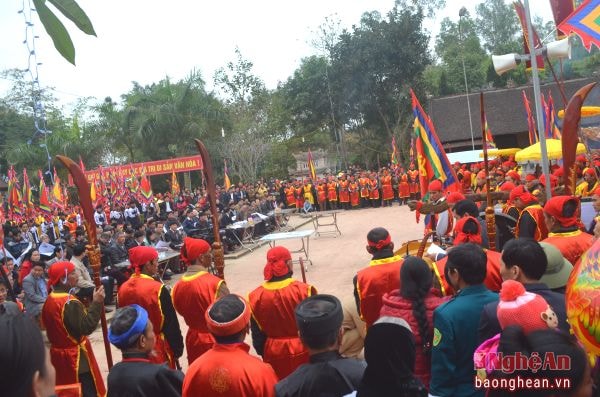 |
| A large number of people participated in the Quả Sơn Temple Festival. Photo: Lương Mai |
On the evening of the 19th of January, a cultural performance will be held to celebrate the festival, followed by the Announcement Ceremony at Quả Sơn Temple at 9 PM. This year, the festival will feature the release of floating lanterns on the Lam River in front of the temple. The main procession of the deity will officially begin at 6 AM on the 20th of January (lunar calendar). First, there will be the Ceremony of Presenting the Deity, followed by the procession of the water deity, King Lý Nhật Quang, to give thanks at Bà Bụt Pagoda. The thanksgiving ceremony at Bà Bụt Pagoda will include traditional rituals expressing gratitude. Finally, the procession of the deity's palanquin back to the temple and the enthronement ceremony will conclude the festival.
This year, in particular, to prepare for the 2017 festival and subsequent years, Do Luong district has allocated over 1 billion VND from its budget (along with social contributions) to build many infrastructure projects such as paving both sides of the horse house, around the main temple, next to the guardhouse and behind the Left and Right side buildings. They have also constructed a traditional shop within the temple grounds using corrugated iron, and replanned the parking area. Notably, the district has recorded audio recordings about the historical site for promotional purposes and reprinted the book "Uy Minh Vuong Ly Nhat Quang and Nghe An".
The local Party committee, government, and people of the district hope that the Quả Sơn Temple Festival will be recognized by the Ministry of Culture, Sports and Tourism as a National Intangible Cultural Heritage, befitting the contributions of Uy Minh Vương Lý Nhật Quang. At the same time, they hope to preserve and enhance the Quả Sơn Temple relic, making it increasingly solemn and majestic, befitting its original stature.
Thanh Thủy - Lương Mai
| RELATED NEWS |
|---|


