
Sacred rituals at Chieng Ngam Temple
(Baonghean.vn) - The Chieng Ngam Temple Ceremony is a spiritual ritual held annually during the Spring Festival. People from the Chau Quy region often gather in Chau Tien commune, Quy Chau district, to participate in the ceremony, paying homage to their ancestors, those who founded the village, praying for favorable weather, bountiful harvests, and vowing to live and work well to build a happy family and homeland.
"Father Nguyen Dinh Thuc incites parishioners."
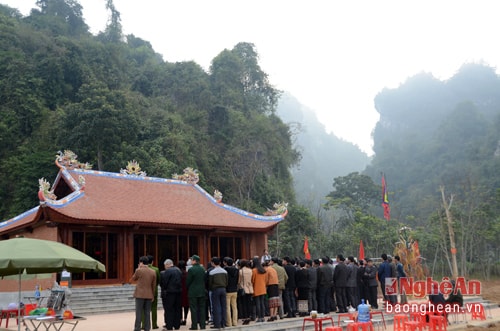 |
| From early morning, a large number of people from Quy Chau district gathered at Chieng Ngam Temple. Photo: Thanh Chung |
For the Xên Bản and Xên Mường ethnic groups in Quỳ Châu district, the Hang Bua Festival is the most important festival, a place of longing for the local people. People attending the festival often return to offer incense at the Chiêng Ngam temple to express their gratitude and seek strength from their roots to improve their lives.
The Chieng Ngam Temple has a long history, dedicated to three tutelary deities: the three brothers Xieu Bo, Xieu Ke, and Xieu Luong, who were instrumental in establishing the village and settlement in the Chieng Ngam area of Phu Quy. The temple is divided into three sections: the central section is dedicated to the three deities Xieu Bo, Xieu Ke, and Xieu Luong; the right section is dedicated to the Mountain God; and the left section is dedicated to the River God.
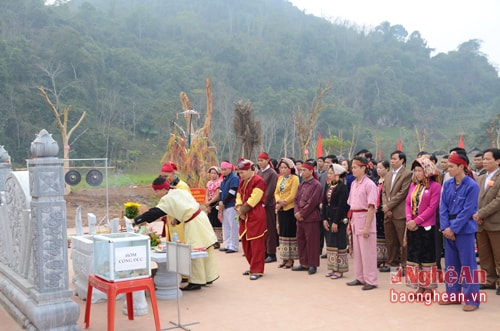 |
| Performing spiritual rituals before entering the Hang Bua Festival in 2017. Photo: Thanh Chung |
Since 1945, the Chieng Ngam Temple had been damaged and was only in ruins. In 2005, the temple was restored on the foundation of the old one. After more than 10 years of use, the temple again deteriorated and fell into disrepair. With the approval of the Provincial People's Committee for investment in upgrading, a new temple was built according to the plan and completed and put into use on January 19, 2017.
Prior to the opening of the 2017 Hang Bua Festival, Quy Chau district held a ceremony to worship the tutelary deity of Muong Chieng Ngam. Early in the morning of the grand ceremony, a large number of people from the former Trung Son and Thuy Van districts gathered at the high mountain in Hong Tien 2 village – where the Chieng Ngam temple is located. They solemnly, dressed in traditional costumes and professional attire, ascended the 98 stone steps and gathered under the shade of a centuries-old fig tree next to the sacred temple. In front of this temple, perpetually shrouded in mist and clouds, the festival organizers arranged gongs, drums, platforms, carved wooden frames, and ceremonial poles for the Xang Khan ceremony.
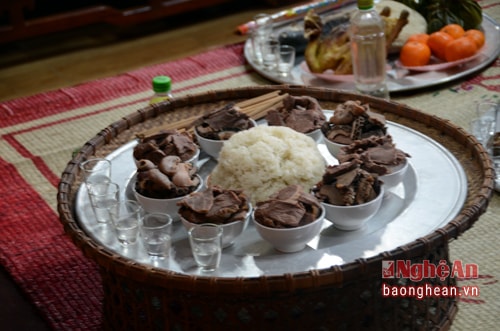 |
| Offering to the ancestors, those who contributed to the founding of the village, the products of the Chieng Ngam region. Photo: Thanh Chung |
Before the ceremony began, women in traditional brocade dresses with jingling silver peaches hanging from their hips, and strong, handsome young men from the nine villages of Chau Tien commune, carried trays of offerings. The trays were rich with local produce and many dishes. These included boiled chicken, grilled fish, sticky rice, meatballs, rice wine, and oranges, tangerines, and apples. The main dish for the ceremony was buffalo meat.
In previous years, when the lives of the people in the surrounding area were still difficult, goat meat was used instead of buffalo meat. In recent years, as living standards have improved and people have become more prosperous, they have insisted on using buffalo meat again, following the old custom. They believe that buffalo is a lucky animal, and that offering buffalo as a sacrifice in any given year brings good fortune, favorable weather, and harmonious human relations.
The auspicious hour had arrived, and the three chief shamans, on behalf of the people of the ethnic groups in Quy Chau district, performed the rituals in front of the Chieng Ngam temple.
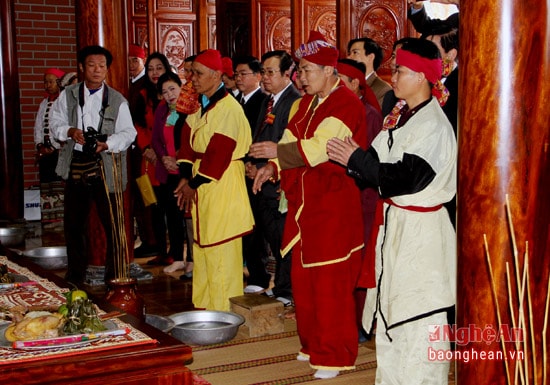 |
| Three shamans preside over the ceremony. Photo: Thanh Chung. |
In the main hall, the chief shaman, dressed in coarse hemp robes, invites the village's founding and founding deities, who have been passed down through generations, to partake in the offerings; respectfully requesting their blessings for the descendants, wishing everyone good health and good fortune in the new year, so that they may build happy families and a prosperous village.
According to the customs of the Thai people in Quy Chau and the unwritten rules of the shamans: The prayer must convey all the wishes and intentions of the district and should not be written down to be recited, but rather deeply imprinted in the heart.
The ceremony concluded with the resounding sounds of gongs and drums echoing throughout the mountains and spreading to distant lands. People attending the ceremony stepped forward one by one to light incense sticks in reverence and partake in a small offering of food for good fortune. The dances and songs then began, reminding everyone of the vows made at the sacred Chieng Ngam temple on this auspicious first day of spring.
Thanh Son - Ho Phuong


