
'Loopholes' in the management of goods consigned on passenger buses.
(Baonghean) - With no paperwork or procedures required, low costs, and fast delivery times, the method of consigning goods on passenger buses is increasingly being chosen by many people. However, this very convenience has given rise to many serious consequences, requiring stricter management of goods consignment activities.
Sending and receiving packages is so easy!
Posing as someone needing to send a package to the mountainous district of Quế Phong, we approached the BN bus company at 5 AM, in front of Vinh Bus Station (Lê Lợi Street, Vinh City). The driver quickly picked up the package and placed it in the trunk. Without asking about the contents or requiring a receipt, only asking for the recipient's phone number for contact at the final stop and a transaction fee of 50,000 VND, the package was quickly secured on the bus.
Not only with BN bus company, but sending and receiving goods on passenger buses is very simple, mainly relying on the reputation of the bus company and verbal agreements between the two parties, without any binding procedures, invoices, or documents. Besides receiving goods at main bus stations, most bus companies also make it convenient for customers by receiving goods along the route, or even at home.
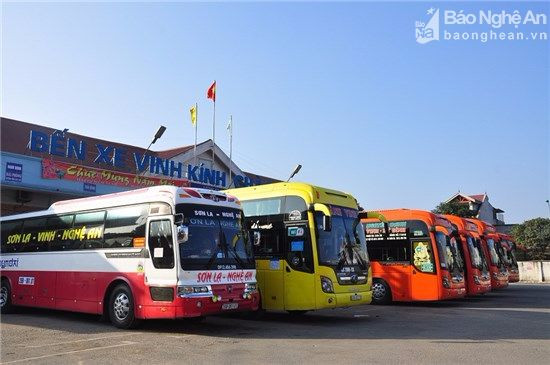 |
| The number of passengers and goods entering and leaving Vinh Bus Station daily is very large, but management is still lacking in strictness. Photo: PC |
The ease of sending and receiving goods has made this service a familiar choice whenever people need to transport goods within or outside the province. However, this has also given rise to many negative consequences. There have been numerous cases of passenger buses transporting smuggled goods, prohibited items, cash transactions, and flammable or explosive materials, making this form of goods transportation inherently risky.
Most recently, the theft of foreign currency worth the equivalent of 6.1 billion VND on a Tuan Thuy sleeper bus traveling the Vinh - Hanoi route has shocked public opinion. On February 17th, according to the bus owner's report to the authorities, on the evening of February 15th, the bus company received a package from Ms. Pham Thi Mien, residing in Block 2, Hong Son Ward, Vinh City, to be delivered to someone in Hanoi. The package was placed in a cabinet on the bus, and on the morning of February 16th - when the bus arrived at Nuoc Ngam Bus Station (Hanoi) - the package was discovered missing.
The Vinh City Police quickly launched an investigation and arrested two suspects for theft. The case was solved in a short time, helping to stabilize the security and order situation in the area, but at the same time raising many concerns about the laxness in the management of consigned goods on passenger buses.
Reviewing the records of violations related to the transportation of goods on passenger buses reveals shocking instances of recklessness and negligence on the part of bus owners when accepting flammable and explosive items. A prime example is the oxygen tank explosion on the Thuan Sang passenger bus in February 2014, while traveling through Dien Hong commune, Dien Chau district, which resulted in two deaths and 14 injuries. Another example is the explosion caused by a "gift package" consigned to a passenger bus, which was actually a homemade mine disguised as a speaker, occurring in late September 2014 and seriously injuring three people. Particularly noteworthy is the annual seizure by authorities of dozens of cases involving the transportation of large quantities of firecrackers on passenger buses during the Tet holiday season.
"Gaps" in management
Despite numerous unfortunate incidents in the transportation of consigned goods, transportation businesses have not shown much improvement in inspection and control. It is known that in Nghe An province, apart from a few businesses with offices and fully implementing all stages of receiving, confirming, inspecting, and transporting goods, such as Van Minh Co., Ltd. and Phuc Loi International Travel Joint Stock Company, most believe that "mutual trust is all that's needed!"
In reality, many drivers and their assistants view transporting goods as an opportunity to earn extra income in addition to their fixed wages paid by the vehicle owner. Vehicle owners also find it difficult to control this additional transportation activity.
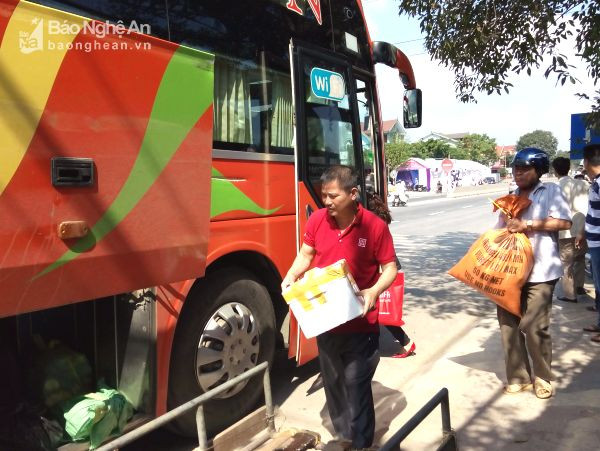 |
| Passenger buses pick up passengers and goods along National Highway 1A in Dien Chau district. Photo: Mai Giang |
At bus stations, control measures are quite lax. According to Mr. Vu Hoang Huynh, Head of Vinh Bus Station, the station's security team monitors vehicles entering and exiting the gate, but only visually, without the support of technical tools. If they detect passengers or vehicles transporting prohibited goods or flammable/explosive items such as gas cylinders, oxygen tanks, gasoline, or oil, they are resolutely denied entry. Vehicle owners who do not comply are reminded, and the most severe measure is suspension of the vehicle and stopping departures.
However, Mr. Huynh also admitted that once goods are packaged, it is very difficult to detect violations, "that responsibility belongs to the driver, the assistant driver, and the cooperative owner, because the officials and staff at the bus station do not have the right to open the goods for inspection." This reality of management based on visual inspection occurs at 14 large and small bus stations throughout the province.
Upon investigation, it was found that there are currently no regulations prohibiting passenger transport companies from carrying goods; there are only strict prohibitions on transporting certain prohibited items such as weapons, ammunition, explosives, narcotics, opium, psychotropic substances, and obscene materials.
Mr. Nguyen Viet Hung, Head of the Transport Management Department of the Department of Transport, said that currently there are 33 enterprises and cooperatives providing fixed-route and contract passenger transport services in the province. In the past, the department has issued many official documents and directives to strengthen inspection and control of goods transportation on passenger vehicles, preventing the transportation of flammable, explosive, and toxic substances, but the department has only handled cases within its authority.
Specifically, the penalties are governed by Decree 46/2016/ND-CP, which stipulates fines ranging from 3,000,000 to 5,000,000 VND for transporting hazardous, toxic, flammable, or explosive goods, or animals and other goods that affect the health of passengers on passenger vehicles. Depending on the severity of the violation, the vehicle's license plate may be revoked, the driver's license confiscated, or the transport company's business license revoked. However, the Ministry of Transport does not have the authority to open packages to inspect goods unless a violation is detected.
Similarly, the Market Management Department only has the authority to coordinate with the police force to conduct inspections and take action when vehicles carrying goods in violation of regulations are detected. The police force also finds it difficult to inspect and control all passenger buses circulating throughout the province, with numerous stops for picking up passengers and transporting various goods.
The "loopholes" in managing goods consigned on passenger buses have been an alarming reality. It's difficult to solve this problem in the short term; however, to gradually reduce violations, perhaps regulations should be implemented requiring bus companies to inspect goods together with customers, sign a confirmation, and clearly state their names, addresses, and ID numbers. In addition, traffic inspectors and other relevant authorities need to strengthen inspections and controls, coordinate inter-agency efforts, and promote public awareness campaigns, providing reliable shipping and postal services.
Phuong Chi


