
"A Sad Lullaby" in the Deserted Village
(Baonghean) - Lying in the house of the village headman, Lầu Nhìa Xồng, in Nậm Khiên village (Nậm Càn, Kỳ Sơn), we heard the mournful lullaby of a young Hmong woman. Her voice was very young, but it sounded so heartbreaking, weighing heavily on our hearts with a feeling of weariness and resentment.
Seeing my curiosity, the village chief, Lầu Nhìa Xồng, turned to me and said, “That’s Lầu Bá Dìa’s wife. It’s a pity, their family is poor, and they’re young but don’t know how to make a living or take care of their children.” We asked him if this was another case of child marriage, like many other couples in this high mountain region. He nodded in confirmation. He asked if we wanted to go to Dìa’s house, to see the life of this young couple who already have three children. Then he stood up, and we followed him.
Lầu Bá Dìa's house was a dilapidated shack made of simple wooden planks. The most valuable possession in the family was probably an old television. Seeing us enter, Lầu Bá Dìa offered us a jar of wine. Dìa was small in stature, his face showing signs of hardship. When we asked about his family, Dìa seemed hesitant, as if he didn't want to talk about the impulsiveness of his life. However, after we shared a few drinks, he poured out his heart, as if he had been eagerly waiting to confide in us. From his story, we learned that Lầu Bá Dìa was born in 1988 and had been married for 10 years. His wife, Hạ Y Mỹ, is from Tây Sơn commune and is one year younger than him. They met while playing marbles during Tet (Vietnamese New Year). Their feelings developed quickly, and after only a few days of knowing each other, they were already planning their wedding. When we got married, we didn't really think about how we would live together; we just thought we liked each other and decided to live together. But after becoming husband and wife, we realized how many worries lay ahead. Both families were struggling, and there was almost no support. We toiled in the fields all day long, yet we couldn't escape poverty.
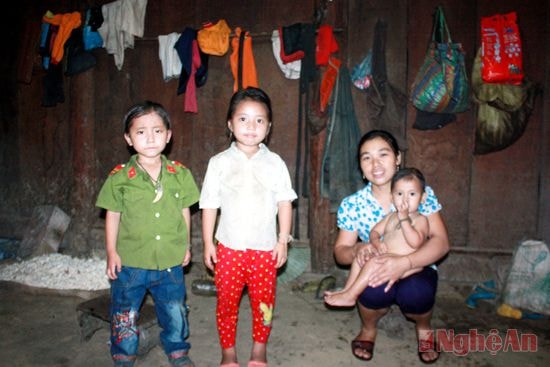 |
| Ha Y My's family |
At 26, Ha Y My is a mother of three children, the oldest in second grade and the youngest just over a year old. Life is already difficult, and the children are frequently ill. Many days, when the children are sick with fever, the couple can only sit and look at each other, then call their parents to help care for them. Sitting in a corner of the house, holding her child, Y My occasionally turns to join our conversation: “Sometimes I feel so discouraged, gentlemen. I see how poor we are, but I don’t know what to do to make a living. If I had known this, I wouldn’t have gotten married so early.” Y My’s words sounded tearful. The child occasionally cries incessantly, prompting the mother to soothe and sing lullabies. Y My’s face, like her husband’s, is etched with worry and hardship. Many of her friends her age haven’t even gotten married yet, but she already has three children.
Early in the morning, we left the house of the village chief, Lầu Nhìa Xồng, and headed up to Liên Sơn village. There, we met the family of Và Y Chi. This was also the family of a very young couple. Và Y Chi, a Hmong girl, was in the 7th grade at Nậm Càn Secondary School during the 2008 Lunar New Year. That year, she went with her friends to play the pò po game and met Mùa Bá Súa from Lượng Minh commune (Tương Dương district). Having feelings for each other, Y Chi agreed to let Súa "take" her as his wife. At that time, Y Chi was only 13 years old. Meeting us, Y Chi was saddened as she recalled her school days. She said, “That day, when I let Ba Sua take me home to be his wife, I told him that after the wedding I would still go to school like my friends, and he agreed. But then, two days after the wedding, when I went to school, everyone looked at me strangely. Embarrassed, and with the overwhelming workload at my husband's house, I had to drop out of school and follow him to the fields. Sometimes I couldn't even take care of myself, let alone take care of my husband's whole family.” Looking at the young mother sitting there hugging her child, she seemed more pitiful than blameworthy. Mr. Va Giong Chua – Y Chi's father – added, “When the two of them came home demanding to get married, my family tried to dissuade them, but she threatened to commit suicide by eating poisonous leaves if we didn't let them get married. As parents, we couldn't bear to watch our child like that, so we had to give in to her demands.”
We asked about the procedures for registering a marriage and the State's regulations on marriage and family. Y Chi said, "Back then, we didn't register because we weren't old enough. We had to wait until we were both old enough before we dared go to the commune committee to complete the procedures. I know that what we did was against the law, but that's how it is here. Once you love each other and become husband and wife according to the Hmong custom, you can't turn back now." Fortunately, later on, Y Chi's husband learned a trade in electronics repair, so life became somewhat less difficult. The daily grind of working in the fields was a huge burden for her. She said that all her friends are now studying and have trades, so they don't have to worry about families or children. Her eyes gazed into the distance at the desolate mountains and forests, as if remembering a past of her school days that could never return.
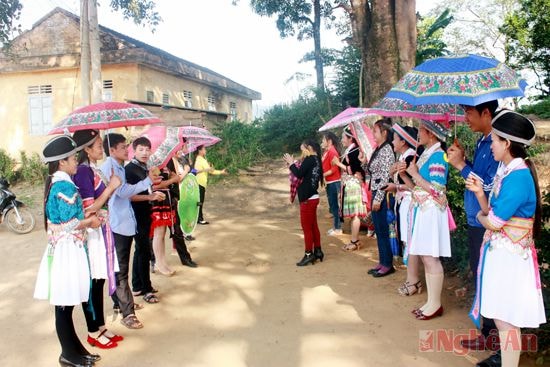 |
| The boys participate in throwing the "po po" (a type of projectile) to "catch a wife" at a very young age. |
Following the villagers' directions, we continued on to Tham Hin village, where Va Ba Tru had just held his wedding. We arrived just as Tru and his wife were preparing their tools to go to the fields. Before Tet, Tru was still a 10th-grade student at Ky Son Ethnic Boarding High School. After meeting Xong Y Nhia in Na Cang village (Na Ngoi commune), the impulsive feelings of their youth overcame their dreams of studying. They got married when they were just over 15 years old, much to the worry of both families and the questioning of their peers. Perhaps now, having just gotten married and living with their parents, this young couple cannot yet understand the immediate concerns of family life. I asked Tru: "Why didn't you continue your studies and instead came home to get married at such a young age? Didn't anyone say anything?" She innocently replied, "We're going to get married anyway, so if we don't take her home, someone else will snatch her away. Everyone says I shouldn't get married right now, but it doesn't matter, I'm perfectly fine after getting married..."
When asked, Mr. Lo Kham Phu, the principal of Nam Can Secondary School, said: "The issue of students getting married early has been greatly reduced, but it's not completely gone. The school has made great efforts to educate and focus on training life skills for the students. But every year after Tet (Lunar New Year), there are female students who drop out of school to get married."
Bidding farewell to the people of Nam Can commune, leaving behind the melancholic lullabies of young parents, we carried with us a haunting and lingering sense of unease. When will those sad lullabies finally cease echoing in those deserted villages?
Dao Tho


