
Flash floods, landslides: The same old worries return!
(Baonghean) - Tuong Duong district has a hilly and mountainous terrain with steep slopes and many rivers and streams, so when there is sudden heavy rain, flash floods, landslides, and mudslides are very likely to occur. Currently, many families in the district live near streams and hills - areas prone to landslides - and need to be relocated to safer places.
Na Be village, Xa Luong commune (Tuong Duong district), is traversed by two streams: Ang stream and Tat stream. Many houses belonging to the Khmu people are located along the banks of these streams. Among them, many houses are at risk of flash floods and landslides. According to statistics from the Xa Luong commune People's Committee, 13 households in Na Be village are slated for relocation. Visiting Na Be village in late September, we witnessed many residents expressing worry and anxiety about the approaching rainy season. Mr. Ven Van Son of Na Be village lamented: "My family's stilt house was built here in 2002. At that time, the stream bed was dozens of meters away from the house, but after many years of rain and floods, the stream banks have gradually eroded, and now the stream bed is right up to the house's foundation. Recently, village and commune officials came to survey the area, but so far no one has paid attention to resolving the issue." Now, whenever it rains heavily, no one in the family dares to sleep; they sit and observe, ready to evacuate if there is a flash flood or landslide.
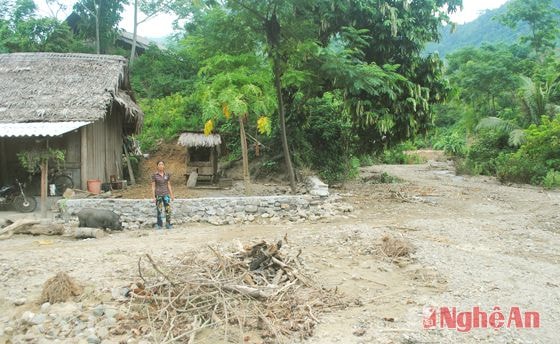 |
| The family of Mr. Vi Văn Kiên, in Na Bè village, Xá Lượng commune, built an embankment around their house to cope with flash floods and landslides. |
Across the Ang stream, opposite Mr. Son's family, is the house of Mr. Vi Van Kien. Leading us to the front of his house, Mr. Kien explained: "During the heavy rains in early September, water flooded the house. We were so scared that my wife and I bought cement, gathered stones from the hill, and shoveled sand from the stream to build a barrier around the house to protect against the flood. However, this barrier, only about 40 cm high, can only stop the stream's flow during moderate rain. It can't stop the torrential downpour from the high mountains during heavy rain. The most dangerous thing is when the muddy water, carrying soil and rocks, rushes down from the mountain; at that point, human strength is too weak to resist." What surprised us was that Mr. Kien's house is closest to the stream, yet the village and commune haven't included it in the list of households at risk of flash floods.
Mr. Luong Van Thang, the village elder of Na Be hamlet, led us to the rocky, uneven ground left behind by last year's flood. He explained that the Tat stream used to be narrow, but over time, it has widened due to erosion caused by heavy rains and floods. The wider the stream, the greater the risk to people's lives and property. Many families have had their pigpens, chicken coops, and outbuildings flattened by rocks and debris from the mountains. Currently, many families along the Tat stream are living in constant fear of floods, such as the families of Vu Van Dinh, Noc Thi Chien, and Moong Van Thach...
In Nhon Mai commune, there are currently 8 households slated for relocation, including 8 at risk of flash floods and landslides, and 4 at risk of mudslides. Every year, the local authorities try to persuade these households to move to safer locations, but due to difficult family circumstances, they remain there and refuse to leave. To proactively respond to heavy rains, the commune has established several flood and storm prevention teams to assist residents in evacuating people and property to safe areas. The local authorities hope the district will soon implement support policies and cooperate with the local authorities to resolutely compel these households to relocate to safe places.
Although Hoa Binh town is the central area of the district, it has the highest number of households at risk of flash floods, landslides, and mudslides, mainly those living along the embankment of National Highway 7. According to the town's People's Committee report, there are currently 29 households in the town that need to be relocated to safer areas. Of these, 18 households are at risk of flash floods and landslides; 11 households are at risk of mudslides. Mr. Nguyen Dinh Trinh, from Hoa Dong block, one of the households at risk of landslides, expressed his concern: "In previous years, landslides frequently occurred during prolonged heavy rains, affecting our property and crops. Therefore, during prolonged heavy rains, our family proactively moved our belongings and livestock and reinforced our house."
Yen Na commune has many streams, meaning that many families living along these streams are at high risk of flash floods. Next to the Ve stream in Na Khom village is the house of Mr. Kha Van Tinh's family. Mr. Tinh is worried: Every year, the stream flows fiercely, flooding his house to a depth of nearly 1 meter. His family wants to move to a safer place, but they lack the funds and haven't found a suitable location.
According to Mr. Loc Ha Giang, Secretary of the Party Branch of Na Khom village: Currently, there are about 4-6 households in the village at high risk of flash floods. Relocating these households to a safe place is very difficult because the village has no more land available. The only option is for these households to buy garden land from other families to build houses. In reality, these families are in very difficult circumstances and cannot manage on their own. The village earnestly hopes that the authorities will help these households relocate to a safer place.
Thus, it can be seen that, despite the high risk of loss of life and property due to flash floods, localities and even the people themselves are facing difficulties when considering relocation. These difficulties stem not only from financial constraints and land availability but also from the complacency of households and the indifference and lack of decisive action from some localities.
Speaking with us, Mr. Lo Kham Kha, Head of the Agriculture Department of Tuong Duong District, said: Flash floods, landslides, and mudslides often occur unexpectedly. The consequences are enormous, including houses being swept away or buried under mud and rocks, and even affecting human lives if not dealt with promptly. Tuong Duong District has a hilly and mountainous terrain with steep slopes, meaning the risk of flash floods, landslides, and mudslides is very high, while many people live on both sides of streams and rivers. Following the principle of "prevention is key," more than a month ago, under the direction of the District People's Committee, the Agriculture Department sent notices to the communes to review and compile statistics on families at risk of flash floods, landslides, and mudslides. However, until nearly the end of September, only a few communes had submitted specific reports, and many localities still had not sent data to the department. With the rainy season approaching, the Department of Agriculture is currently assigning its staff to directly coordinate with local authorities to conduct surveys. For households at high risk of flash floods, landslides, and mudslides, the District People's Committee will allocate funds from the flood and storm prevention budget to support relocation to new, safe areas, in accordance with the Provincial People's Committee's policy. The commune and village authorities must arrange and allocate land for these households. If a locality no longer has community land available, they should encourage relatives to donate garden land for family members to have safe housing.
With the rainy season approaching, Tuong Duong district needs to accelerate the relocation of households at risk of flash floods, landslides, and mudslides to safe areas to avoid damage caused by heavy rains and floods. To effectively carry out this task, in addition to timely support from the district, there must be decisive involvement from the commune and village authorities and the awareness of each individual citizen.
Text and photos:
Xuan Hoang


