
Unique drinking customs in Nghe An province, the capital of traditional rice wine.
(Baonghean.vn) - With nearly 20 regularly operating rice wine production groups, Chom Muong village in Mau Duc commune, Con Cuong district, Nghe An province is currently the largest producer of rice wine in western Nghe An. Furthermore, this Thai ethnic village also has its own strict rules for drinking rice wine.
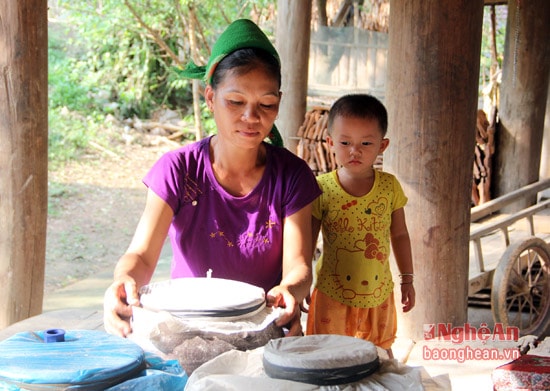 |
| The women of Chòm Muộng village are taking care of their ancestral rice wine jars. |
One hundred people make rice wine.
Chòm Muộng is located about 6km from the center of Con Cuông district town. This Thai ethnic village has long been famous throughout the highlands of southwestern Nghe An province as a major producer of rice wine, supplying not only the local people but also the villagers. Chòm Muộng rice wine has traveled by truck to Vinh province, and even to Hanoi... Foreign visitors who come to support the village's economic development projects also express their interest. "They've even bought some to take back home as gifts," shared a long-time rice wine maker.
The village of Chòm Muộng has over 200 households specializing in rice farming. Glutinous rice is also the main ingredient for brewing rice wine. Ms. Vi Thị Điều, the head of the village's women's association, shared: "Since I came to the village as a daughter-in-law, I've seen the women brewing rice wine. In 1989, as the head of the women's association, in charge of the village's rice wine production group, I learned the craft from the elders. Since then, despite the difficult roads and the river crossings, many people have come to buy rice wine from Chòm Muộng village." Currently, there are nearly 20 rice wine production groups in the village, each with 7-15 members, mainly women.
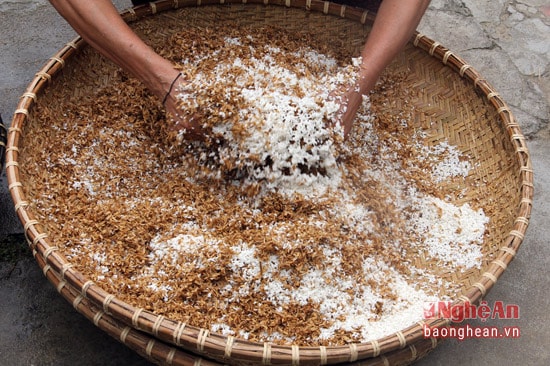 |
| The people of Chòm Muộng village mainly use rice to make rice wine, which makes the wine taste better. |
Many places use cassava to brew rice wine, but the people of Chòm Muộng village mainly use glutinous rice. The yeast used for brewing is entirely from natural sources. “Everyone has their own secret, but the yeast for rice wine is always made from glutinous rice fermented with alcohol. In addition, there are some forest leaves, each person's own secret. Sugarcane leaves, jackfruit leaves, and dried ripe jackfruit are also indispensable because they make the rice wine in Chòm Muộng sweet as if sugar had been added,” according to Ms. Vi Thị Điều.
October each year is the rice wine production season for the Chòm Muộng people. Of the more than 190 women members in the village, 160 participate in this work. The women of Chòm Muộng choose this time to produce rice wine because it's when their farming work is almost finished...
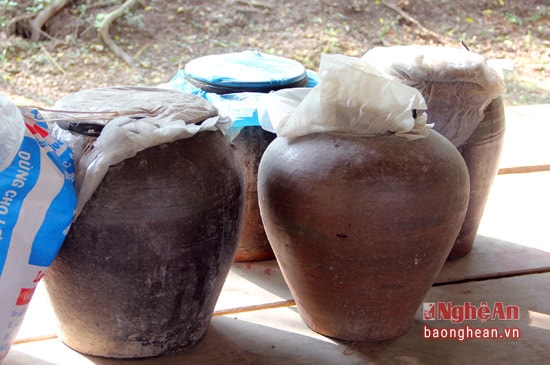 |
| These jars of wine need to be aged very carefully; they can be preserved for a year without turning bitter. |
To make a batch of rice wine to their liking, the women of Chòm Muộng village have to prepare months in advance. After pressing the yeast into pellets, they dry them in the sun until mold forms, then mix them with sticky rice and clean rice husks before fermenting them in earthenware jars. After two weeks, the rice begins to turn into wine. However, it takes one to three months before it's ready to drink. A jar of rice wine from the Chòm Muộng people can be preserved for a year. The longer it's aged, the better it tastes.
"Rules" for drinking alcohol in Chòm Muộng
Not only is Chòm Muộng village famous for producing traditional rice wine in the mountainous region of Nghe An, but it also has its own unique and well-structured drinking customs. That's why people call these rice wine drinking gatherings in the highlands "festivals."
A drinking party is started with a specific number of people, usually 6, 8, or 10. The amount of rice needed is calculated by the volume of rice in a buffalo horn. A "traditional drinker" who doesn't participate in the drinking is appointed to pour the rice. The "traditional drinker" will then ask the group how many horns they should drink.
After reaching an agreement, the "cham" (a term referring to a traditional Vietnamese drinker) poured wine from a buffalo horn until the jar was full and shouted, "Cham pours, new cham!" The drinkers all shouted in unison, "Cheers, cham!" and began to sip the wine from the bamboo straw. Only when they had drunk the predetermined number of buffalo horns would they pass the jar to another group.
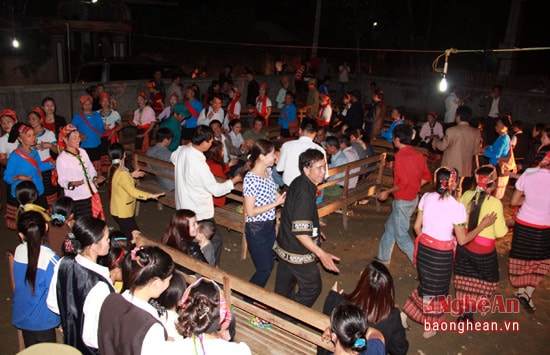 |
| The rice wine of Chòm Muộng village is not only produced for sale but also for the villagers to use during festivals. (illustrative photo) |
The most enjoyable part of these rice-drinking gatherings is the competitions between different groups. These are usually between men and women, hosts and guests. These "fierce" competitions often take place at weddings, National Unity Day (November 18th), Lunar New Year, etc. In the end, neither the winner nor the loser suffers any loss. The festivities usually end with joyful laughter.
Only those who break the rules are penalized. This includes forgetting to say "toast" or smoking marijuana in front of older people. Those who don't drink "respectfully," meaning they don't smoke marijuana enthusiastically, will be penalized by having to drink double the number of horns of liquor consumed by the entire group.
According to the head of the women's association in Chòm Muộng village, this strict drinking rule stems from the remarkably high alcohol tolerance of the women there. Even the women with the lowest alcohol tolerance in this Thai village can drink five horns of liquor, each horn containing 250-300ml. However, this is a light liquor, so it rarely causes people to get drunk like homemade liquor.
Ms. Điều added: "These rice wine gatherings usually only take place on joyous occasions. 'Nobody drinks on working days. You see,' she said with a hearty laugh, pointing towards the terraced rice fields. Many villagers from Chòm Muộng were down in the fields harvesting their crops."
Huu Vi - Ho Phuong


