
Delicious dishes made from horseshoe crab.
(Baonghean)Previously, people only bought horseshoe crabs as pets, but now, they have become an attractive dish characteristic of coastal regions, offering a slightly different taste compared to everyday shrimp, fish, squid, and crab.
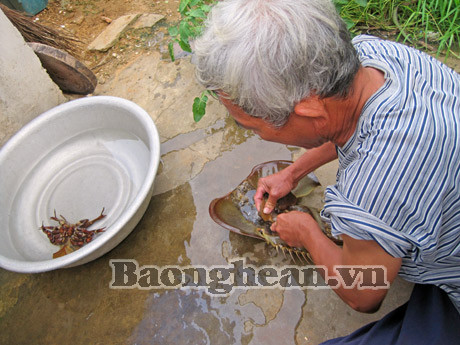
Around mid-afternoon, my friend called, saying he'd just caught a few pairs of horseshoe crabs and wanted me to come over for a meal. So, even though it looked like it was about to rain, I thought about the pleasure of sitting and having a drink, and I sped over. Every time I go to a friend's house for a meal, I always head into the kitchen. I'm used to it; eating a normal meal is fine, but when it comes to making appetizers, the women are usually invited to "sit around and watch" (rarely), while the men are left to prepare the food. Yet, with this particular dish, I could only watch my friend show off his skills.
 \
\
Preparing horseshoe crab meat requires speed and skill.
Preparing horseshoe crab meat requires skill and decisiveness when draining the blood. Of course, it can be used to make blood pudding, but more importantly, it's crucial to avoid losing the characteristic bitterness of the meat. The shell, intestines, and liver are also carefully removed and absolutely nothing comes into contact with the meat. When the fragrant aroma wafts from the kitchen to the living room, the boy is sent by his father to fetch a bottle of liquor from under the cupboard, and the conversation begins to ramble on...
The story goes that, long ago, there was a poor couple who made their living as fishermen. One day, the husband went out to sea with his fellow fishermen and unfortunately encountered a great storm. No one escaped the raging waves. The entire fishing village was plunged into grief and mourning. The wife, overwhelmed with grief, almost went mad. She left home hoping to find her husband somewhere, walking and walking along the long coastline. One day, she came to a large mountain and, exhausted, fell asleep under a tree. While half-asleep, she suddenly heard a loud explosion and saw an old man with a long white beard standing before her, asking, "Who are you? How dare you lie down in front of my house?" The woman burst into tears and replied, "I am looking for my husband." Then she recounted her story and begged the tree spirit for help. The tree spirit, taking pity on her, revealed, "Your husband is still alive, but he is currently on a remote, desolate island and cannot return on his own." Then, the tree spirit gave the woman a pearl and told her that if she held it in her mouth, she would fly across the sea to meet her husband. But she had to keep her eyes and mouth closed, and not drop the pearl, or she would face misfortune. After that, the old man disappeared. The woman was overjoyed. She took the pearl, held it in her mouth, and tightly closed her eyes. Suddenly, a strong wind blew, and she felt herself become light. A moment later, she felt her feet touch the ground. Slowly, she opened her eyes and saw her husband huddled on the beach. Recognizing each other, the couple were overjoyed. They chatted for a long time before discussing their return to their old village.
The husband embraced his wife around the waist as she carried him across the sea. But overwhelmed with joy at reuniting with her husband, she forgot the tree spirit's warning, still trying to speak to him with the pearl in her mouth. Suddenly, the pearl fell out, and the wife only managed a single cry before both fell into the sea. They were then transformed into horseshoe crabs. Today, horseshoe crabs often travel in pairs underwater, the male embracing the female like husbands embracing their wives as they flew across the sea in the past. Their love, even after their transformation into horseshoe crabs, remained deeply intertwined and inseparable. The folk sayings "loving each other like horseshoe crabs," "being inseparable like horseshoe crabs," and "sticking together like horseshoe crabs" originate from this story.
No one in the coastal community is unfamiliar with horseshoe crabs. They usually live in deep waters with hard shells like crabs, a flattened, round body about a handspan in diameter, eight small legs under their belly, and a very long tail (people often say girls braid their hair into a ponytail because of the association with the long tail). And just like in the fairy tale, whenever horseshoe crabs are caught, they are usually caught in pairs, the male usually half the size of the female, clinging tightly to each other like shadows. If only one is seen, they will immediately release it back into the sea because it is a sea cucumber, which looks very similar to horseshoe crabs but is smaller, has more spines, and eating it will cause poisoning.
But catching horseshoe crabs isn't as easy as catching fish, because they're seasonal. Fishermen have to calculate the tides and plan their fishing days accordingly; the most horseshoe crabs are found from March to September. People usually only use female horseshoe crabs for meat, discarding the males because they're smaller. From the main ingredient, horseshoe crab meat, many different dishes can be prepared, each with its own unique flavor, such as: horseshoe crab blood soup, horseshoe crab salad, sweet and sour stir-fried horseshoe crab legs, stir-fried horseshoe crab with lemongrass and chili, crispy fried horseshoe crab eggs, stir-fried horseshoe crab eggs with betel leaves, steamed horseshoe crab, battered and fried horseshoe crab, grilled horseshoe crab cartilage, stir-fried horseshoe crab with vermicelli... Preparing horseshoe crab dishes requires spicy, sour, and hot seasonings like galangal, lemongrass, chili, and vinegar; and characteristic herbs like betel leaves, onions, and coriander... because horseshoe crabs are crustaceans and have a cooling nature. To create these unique and delicious dishes, the process of preparing horseshoe crab meat is elaborate and meticulous. From slaughtering the horseshoe crab to cooking it, even a slight oversight can cause allergic reactions or stomach upset for those who eat it.
Among the dishes made from horseshoe crabs, the most appealing and popular are grilled horseshoe crab and sweet and sour stir-fried horseshoe crab. For grilling, only four pieces of muscle meat are used from the entire horseshoe crab because the meat is tough and expands like a flower. A charcoal grill is lit, then the horseshoe crab is placed over the fire, turning it over and over continuously until it turns golden brown and fragrant, indicating it's cooked through. Especially from October to February (lunar calendar), horseshoe crabs begin to mate, and female horseshoe crabs during this season often carry bellies full of small, pepper-sized eggs. At this time, grilling horseshoe crab eggs is a must. Grilled horseshoe crab eggs are served with finely chopped pickled radishes, herbs, crushed roasted peanuts, fish sauce with garlic, chili, and fried onions… Horseshoe crab eggs are rich, fragrant, high in protein, delicious, and nutritious. Once you taste grilled horseshoe crab eggs, you'll surely never forget this seafood dish.
Sweet and sour stir-fry, made from horseshoe crab legs, is characterized by its rich, tangy, spicy, salty, and sweet flavors. Before removing from the heat, a few betel leaves are added to enhance the aroma. The shells of horseshoe crab legs are much softer than those of crabs, making them easy to eat, like sucking on a snail. Fried horseshoe crab patties and grilled horseshoe crab legs are favorites among children. There's also horseshoe crab stew cooked with tomatoes, horseshoe crab eggs, and herbs like betel leaves, onions, and coriander... which can be eaten with rice noodles until you're full.
Previously, perhaps due to the elaborate and time-consuming preparation, few restaurants served this dish. It was usually only prepared at home, in a spare moment. However, in recent years, the demand from tourists for this unusual dish has increased, so horseshoe crab has gradually become a special item on restaurant menus. The people of Quynh Phuong village (Quynh Luu district) have also developed a new occupation: catching horseshoe crabs alongside their traditional fishing for fish, squid, and crabs. During horseshoe crab season, each trip can yield an average of hundreds of pairs of horseshoe crabs. Mr. Ho Xuan Doan, a fisherman from Quynh Phuong commune (Quynh Luu district), said: “Horseshoe crabs are very valuable now, each pair costs from 250,000 to 300,000 VND. If you buy the females separately, it's 200,000 to 250,000 VND/each, males aren't as expensive. But you have to make special nets, with large mesh, about 1.5 meters high, and you have to go to the fishing grounds to find them. After catching the horseshoe crabs, you have to lay them on their backs and bring them back quickly, otherwise they will die and lose value.”
Because horseshoe crabs are a type of seafood that only lives in the wild and is difficult to farm, catching them has become the main means of supplying restaurants. It's also a new livelihood, providing additional income for fishermen who still struggle to make a living from the sea and their boats. They offer tourists visiting Nghe An another unique seafood dish, and remind them of a touching and meaningful fairy tale amidst the hustle and bustle of modern life…
Ho Lai


