
A region of "exceptional natural beauty and outstanding people".
(Baonghean) - In the memories of many, Nam Trung commune was a rural area facing many difficulties, as it was located in the "flood-prone" area of Nam Dan district. However, today, Nam Trung has risen strongly, becoming one of the first communes in Nam Dan to achieve the new rural standard. This is the most comprehensive reflection of the changes in this homeland rich in revolutionary traditions.
A land of "exceptional people and rich history"
Nam Dan is known as a region of "sacred land and outstanding people." Nam Trung (formerly Trung Can) is no exception, boasting many renowned generals, learned and talented individuals who contributed to the people and the nation. According to the book "Examination Records of Nghe An - (1075 - 1919)" compiled by Dao Tam Tinh, Nghe An has two villages famous for their high number of scholars: Quynh Doi village (Quynh Luu district), accounting for 17% of the total number of scholars in Nghe An, and Trung Can village (Nam Dan district), accounting for 11%.
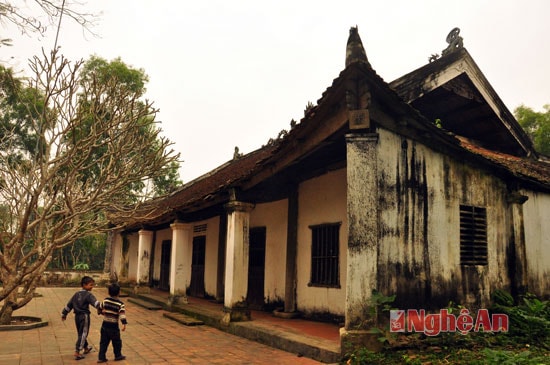 |
| Trung Can Temple - Nam Trung - Nam Dan. Photo: Tran Hai |
From the 17th century to the early 20th century, Trung Can commune had 8 people who passed the highest-level imperial examinations and 16 who passed the mid-level examinations. Dr. Tong Tat Thang is considered the first person to pass the imperial examinations in Trung Can during the Le Dynasty. He served as Minister of Personnel and concurrently as Grand Academician of the Eastern Pavilion; he was granted the title of Nghia Quan Cong and achieved many glorious victories in protecting the border and preserving the territory of the country and his homeland. Trung Can is also the birthplace of outstanding national figures such as Trung Quan Cong Nguyen Nhan My, who contributed to the restoration of the Le Dynasty; and Tam The Ngu Hoang Hoa Thuong Thuong (who passed the doctoral examination in the year of the Water Dragon – 1712),...
The Nam Trung area today still preserves many historical and cultural relics. Among them are two relics classified as national-level historical and cultural relics: the Trung Can communal house and the tomb of Doctor Tong Tat Thang; and the memorial site of Comrade Nguyen Tiem – the first Secretary of the Nghe An Provincial Party Committee. There are three provincial-level historical and cultural relics: the Dong Chau communal house, the church and tomb complex of Nguyen Nhan My; and the Duong Lieu communal house. In addition, the temples of Giap Dong, Giap Bao, Lum Tum, Quynh Trai, etc., have contributed, and continue to contribute, to the pride of the people of Nam Trung.
And here, since 2010, the Memorial House of the late Minister of Public Security Tran Quoc Hoan has been built and recently upgraded and renovated to commemorate the 100th anniversary of the Minister's birth, becoming a cultural landmark that further strengthens pride and inspires the people of South Central Vietnam.
Towards prosperity and civilization.
On the first day of 2016, visiting Nam Trung commune, we clearly felt the resurgence of a rural area rich in revolutionary traditions, a region located in the "flood-prone heart" of Nam Dan district, now transforming itself. Walking around the commune, we saw long stretches of concrete roads replacing the muddy dirt paths. Tall buildings housing schools, clinics, offices, and residential houses are interspersed among lush green gardens, adding a touch of charm to the vibrant rural landscape.
Ms. Ha Thi Minh from Hamlet 10 shared: "In recent years, the commune has directed the overall planning of village roads, alleys, schools, health stations, and cultural centers, so the beautification and renovation of neglected gardens and fields have also been taken care of, and the lives of the people have improved significantly as a result."
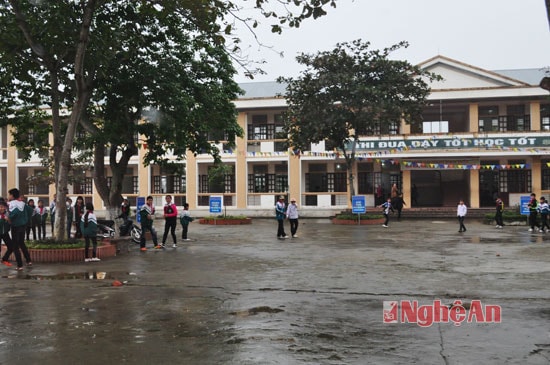 |
| Nam Trung Secondary School meets the standards. |
Comrade Dinh Hong Quang – Standing Deputy Secretary of the Party Committee of Nam Trung commune, said: To implement the new rural development program, the commune Party Committee issued specialized Resolution No. 06/NQ-DU, from which the commune People's Committee developed a plan, reviewed the current situation, built a project to submit to the competent authority for approval and implementation. Propaganda and mobilization work was prioritized, with the pioneering and exemplary role of cadres and Party members "leading the way" and mobilizing the people to participate. Accordingly, in addition to the spring rice crop, the commune focused on directing people to cultivate corn, peanuts, vegetables including Dong Anh pumpkins, green beans, various types of cabbage, and build embankments for fish farming.
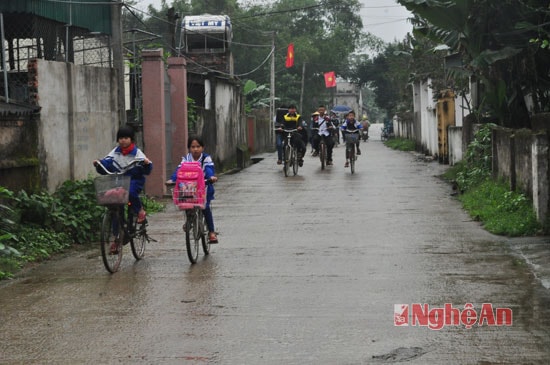 |
| The rural transportation system meets standards. |
Through land consolidation, the commune has concentrated 5% of its land in certain areas for people to lease. 24 households have leased between 1 and 6 hectares to establish farms and livestock breeding facilities raising buffaloes, cows, pigs, chickens, ducks, geese, fish, and rice. A typical example is Mr. Ho Duy Hiep in Hamlet 7, who leased 3 hectares of land for rice production combined with fish farming (producing approximately 2 tons of fish per year) and duck farming with a scale of 1,000 meat ducks per batch (3 batches per year). Another example is Mr. Nguyen Van Thang in Hamlet 3, who raises 20 buffaloes, 30-40 pigs per batch, and over 100 geese, combining fish farming and rice cultivation.
The people of Nam Trung commune are now very active, pursuing many different professions to improve and enhance their lives.
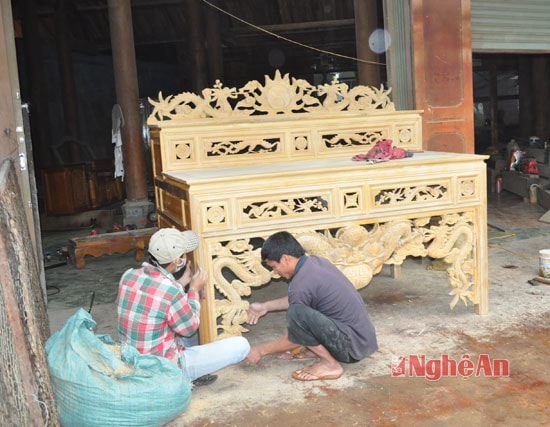 |
| Nam Trung has 13 woodworking factories that bring high economic value to the people. |
Currently, in Nam Trung, up to 20% of the working-age population, equivalent to 600 laborers, are employed as bricklayers both within and outside the district; over 100 laborers participate in the "two-basket" service, daily purchasing agricultural products produced by people in the commune and neighboring communes and transporting them to the Vinh market. The traditional carpentry trade, with 13 workshops, continues to expand and diversify products according to market demand, attracting nearly 100 laborers. Nam Trung also has over 500 people working in markets such as South Korea, Japan, Taiwan, and Malaysia. As a result, the average per capita income in Nam Trung has increased to 29.7 million VND/year (end of 2015), and the poverty rate has decreased to 6.4%.
With a developing economy and favorable conditions for mobilizing the people's strength, coupled with effective support from the State, assistance from businesses, and contributions from expatriates, the locality has built infrastructure. Nam Trung is also a locality that has achieved national standards in healthcare and was recognized as a new rural commune in 2014, along with the first three pilot communes of Nam Dan district.
Building new rural areas is a long-term, continuous process, serving as a foundation for higher development. Therefore, becoming a new rural commune is a prerequisite and driving force for the Party Committee, government, and people of Nam Trung to continue competing in labor and production, building a stronger and more prosperous homeland, worthy of its rich revolutionary and scholarly traditions, a land of "spiritual significance and outstanding people".
Mai Hoa
| RELATED NEWS |
|---|


