
Muong Chieng Ngam joins the festival.
(Baonghean)When spring bathes the newly planted rice fields with warm golden sunshine, brightening the colors of mountain peach blossoms and wild orchids, it is also the time when the land of Quy Chau comes alive with the Hang Bua Festival... Like a promise to the mountains and forests, this year's Hang Bua Festival is once again held solemnly, with a large number of people from the ethnic groups of the Northwest region of Nghe An province eagerly gathering at the foot of Pha En mountain, Hong Tien 2 village, Chau Tien commune (formerly part of Muong Chieng Ngam) to offer incense in gratitude to the founders of the village and participate in the vibrant cultural, artistic, and sporting activities of the festival.
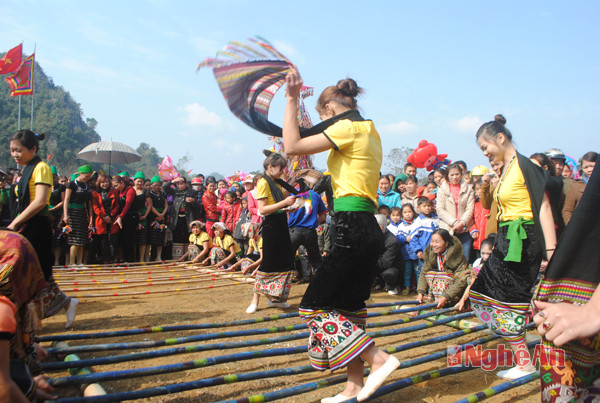 |
| Bamboo pole dancing at the Hang Bua Festival. |
| RELATED NEWS |
|---|
Therefore, everyone tries to arrange their household and farm work to attend the festival and celebrate. The flamboyant Thai girls, dressed in their traditional dresses, wearing long scarves, carrying umbrellas, and jingling silver peaches at their sides, dance and jump; the elderly women, dressed in darker colors, with headscarves, leisurely chew betel nut, walk slowly, their eyes sparkling, smiling subtly, reminiscing about the past; the young men carry flutes, pipes, and even pretty little fruits to pray for love; the old men cherish the jars of rice wine, the folk songs, and the traditional dances... The Thai people in particular, and the ethnic groups of Quy Chau district in general, highly value traditional values and customs, so most people don't rush to the festival area in front of Hang Bua but instead go to the nearby Temple of the Guardian Deity of Muong Chieng Ngam to offer incense to their ancestors.
A slow, reverent stream of people ascends the 98 time-worn blue stone steps to enter the temple. The steps, arranged in a sequence of seven smaller steps interspersed with a larger one, follow the slope of Pha En mountain, reaching towards the sky. From the temple, the vast, picturesque landscape of Muong Chieng Ngam today, with its majestic mountains, expansive rice paddies, lush greenery, and the continuously rotating waterwheel, unfolds before their eyes. Under the shade of a centuries-old persimmon tree in front of the temple, Mr. Vi Van Doc, 75 years old, from Luong village, Chau Binh commune, said: “The temple dedicated to the tutelary deity of Muong Chieng Ngam has a long history, worshipping three tutelary deities: Mr. Xieu Bo, Mr. Xieu Ke, and Mr. Xieu Luong, ancestors who contributed to the founding of the village. Previously, due to the many ups and downs of history, the temple was damaged, and the rituals were not regularly maintained. In recent years, with the trend of returning to our roots, protecting and promoting the cultural identity of the nation, the temple has been restored and rebuilt in a magnificent manner. The temple is very sacred. Before Tet, I was seriously ill, and my children and grandchildren came here to pray for my health. Thanks to the blessings of our ancestors and the healing of the doctors, I am now strong enough to attend the ceremony again.”
On the main day of the Hang Bua festival, following the old custom, the festival organizers, along with delegates, tourists, and people from 12 communes and towns in the district, came to offer incense and perform the Grand Ceremony at the temple. At 8 a.m., three shamans presided over the spiritual ceremony according to the traditional customs of the Thai ethnic group. To be the chief priest at the Thành Hoàng Temple, the shamans responsible for the spiritual well-being of the Thai people must be from Châu Tiến commune, possess high moral character, and be elected by the people. During the ceremony, a stream of people respectfully bowed before the temple amidst the lively sounds of gongs and drums. The chief shaman, Lo Căm Diệp, stepped forward to offer incense, expressing the gratitude of the descendants to the gods and their ancestors, and praying for the ancestors' blessings for abundant fish, plentiful rice, favorable weather, good health for everyone, and continued prosperity for the homeland. After the ceremony, the shamans invited everyone to enter the temple to drink rice wine and eat some sticky rice, chicken, and fish from the offering tray to receive blessings. Outside the temple, the festivities had already begun.
At 8 a.m., tens of thousands of people had gathered at the Hang Bua festival grounds, including many international tourists. This year, the area in front of Hang Bua has been leveled and expanded by Quy Chau district to include stalls, parking, camping areas, and sports fields; mahogany trees have been planted around the area to provide shade, and additional facilities have been built at the end of the field to serve the public. The opening ceremony began with spectacular welcoming songs and dances performed by the Quy Chau district's ethnic minority folk art troupe. The songs and dances, imbued with the cultural identity of the ethnic groups, praised the homeland and the peaceful, hospitable land of Quy Chau, always seeking friendship and solidarity. In his opening remarks, Mr. Phan Duc Dong, Chairman of the Quy Chau District People's Committee, reviewed the ancient history of Muong Chieng Ngam in particular and Quy Chau district in general. and affirming the immense value of the Hang Bua Festival in preserving and promoting the cultural heritage values of the land and people of this region; at the same time, expressing the desire to receive more help, support, and investment from all levels of government, organizations, and individuals to improve the economic, cultural, and spiritual lives of the local people, and better meet the cultural, spiritual, and exploratory needs of tourists.
The opening drumbeat, sounded by Comrade Lang Van Chien, Secretary of the District Party Committee, signaled the official start of a vibrant festival in the Muong land. The sounds of gongs and drums filled the air; Thai girls danced, sang, and played traditional games like throwing the ball; here and there, the sounds of flutes and pipes echoed; elsewhere, old men and women, young men and women, gathered around jars of rice wine, singing folk songs and stories. All these sounds blended together into a unique melody characteristic of the village festival. Visitors, initially observing, also participated in all the activities. The Hang Bua Festival is a cultural festival, so it focuses more on the celebratory aspects. This year, in addition to the main festival program, there are many activities, such as: art and culinary competitions, beautiful campsite competitions, Thai script writing competitions, traditional folk singing and rice wine performance competitions between traditional cultural clubs, embroidery and weaving competitions, yarn spinning competitions, incense making competitions, ethnic costume shows, Hang Bua beauty pageant and bonfire, volleyball, crossbow shooting, stick pushing, tug-of-war, Ferris wheel rides, traditional games, stilt walking, and throwing the "con" (a type of ball)...
The competitions were all exciting, attracting viewers and enthusiastic cheers. Opposite the main stage was the camp area for 12 communes and towns, along with various agencies and 3 volleyball courts. To the left was the exhibition area showcasing cultural products from the Chau Thuan Traditional Culture Club, and further on was the culinary arts competition area with many eye-catching dishes. The dishes all adhered to the traditional flavors of the ancient Thai people, and of course, grilled fish and sticky rice cooked in bamboo tubes were indispensable. At the foot of the mountain was the crossbow shooting competition for the girls, while outside were booths displaying products made from rattan, bamboo, and brocade. Amidst the joyful cheers, young men and women sought their love through the tossing of the ball. A young man offered a betel nut to a newly met girl as a way of expressing his feelings...
To attend the festival, one must understand the local culture and appreciate the scenery. Many visitors have explored Hang Bua, a cave steeped in legends of the battle between the Mountain God (Phi-Nu-Pha-Hung) and the Water God (Phi-Nam-Huoi Ha), and the love story of Tao Khun Tinh and Nang Ni. The stalactites and fascinating rock formations within the cave are testaments to these mythical tales. According to Mr. Thai Manh Hung, a visitor from Tan Hoa Hamlet, Ha Huy Tap Ward, Vinh City: “Hang Bua is just as beautiful as Phong Nha and Thien Duong Cave, and it surpasses them in its warmth and human connection, as it was once home to our ancestors; today, the cave is a popular meeting place for couples.” In front of the cave entrance, the organizers cleverly arranged a photo exhibition themed around the Party and the homeland of Quy Chau, subtly conveying the message of continuity and honoring both traditional and contemporary values. The exhibition was particularly attractive to viewers, especially children. This year's festival features hundreds of different stalls selling consumer goods, with food and beverages being the most numerous. Through this festival, the Organizing Committee hopes to further promote local commercial activities.
The festival lasted for three days and nights, from February 19th to 21st, with activities spread out so that everyone could participate at any time. As evening approached, some people left, and others arrived because the festivities were still lively. At the stilt-house-style camps, incense from the Tan Lac craft village was burned, filling the air with a warm, fragrant aroma. People toasted each other with a glass of wine to start the new year. Carefully brewed rice wine was served to friends from afar, inviting them to visit Ton That Cave, Elephant Cave, Om Cave, and climb Pha Xang Mountain the next day...
The most distinctive and captivating part of the festival is undoubtedly the Hang Bua beauty contest. Eighteen contestants, dressed in traditional costumes, are all radiant and beautiful, possessing a deep understanding of their homeland's history and culture. Thai girls are always like that – beautiful in appearance and character, talented, and hospitable. Mr. A-Lanh-D-Vo, head of the Belgian Development Cooperation delegation, was invited to attend the Hang Bua Festival for the first time and expressed great enthusiasm and delight at witnessing the unique cultural and sporting activities. He praised the traditional dishes and the custom of drinking rice wine. He said: “This is a very interesting experience for me, helping me learn more about Vietnam and its people in general, and Nghe An and Quy Chau in particular. In my capacity, I will further promote comprehensive cooperation between the two countries and contribute to the development of tourism, economy, and society in Quy Chau.”
In Muong Chieng Ngam, an ancient story is still passed down. It tells: “Once upon a time, there was a fairy of extraordinary beauty. One day, while strolling through the mountains of Chieng Ngam, she was immediately captivated by the beauty of the place. She frolicked in the meadows, chasing butterflies, picking flowers, singing with birds in the forest, and playing with fish and shrimp in the streams. Lost in the poetic beauty of nature, she didn't notice the darkness. The gates of heaven closed, leaving the little fairy alone in the cold night. She sat weeping beneath Pha En mountain until she dissolved into the mountain rocks…” Perhaps this ancient story partly explains why the Thai girls in this ancient land are so beautiful – the fairy of old has transformed into countless mortals. And I know that the Hang Bua Festival is also a “fairy” – the joy from today’s festival will transform into faith, determination, and strength to build the homeland in each of the people; And so, even though the gates of heaven remain open, the "fairies" are reluctant to leave.
Thanh Chung


