
Enhancing the capacity of healthcare workers at the commune level.
(Baonghean) - To improve the capacity of staff at commune-level health stations, the Nghe An health sector has been implementing many solutions simultaneously, such as: implementing Project 1816, recruiting and training local staff, gradually meeting the primary healthcare needs of the people; however, certain limitations still remain…
(Baonghean) - To improve the capacity of staff at commune-level health stations, the Nghe An health sector has been implementing many solutions simultaneously, such as: implementing Project 1816, recruiting and training local staff, gradually meeting the primary healthcare needs of the people; however, certain limitations still remain…
Over the past period, the Nghe An Health Department has implemented many solutions to improve the capacity and professional qualifications of health workers at commune health stations. Implementing the Ministry of Health's Project 1816 and the Provincial People's Committee's Decision 92 on the rotation of personnel from higher levels to support lower levels, over the past five years, the Health Department has sent nearly 500 doctors to work at 153 health stations. This rotation has contributed to improving the quality of medical examination and treatment for lower-level health workers through the transfer and training of professional skills and the updating of knowledge.
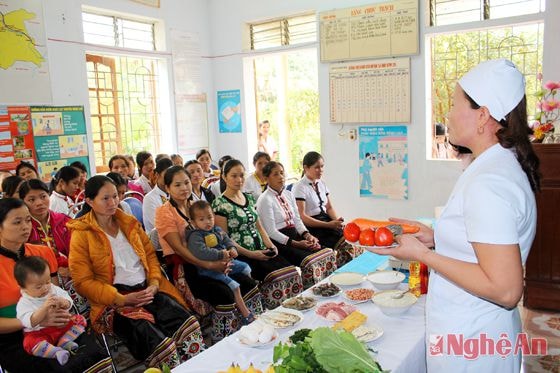 |
| Providing nutritional counseling for mothers with young children at the commune-level health station (Quỳ Châu). |
Along with the rotation of medical staff, Nghe An has sent students selected for doctoral training and medical assistants for specialized training. Currently, 200 doctors from commune health stations are studying at medical universities nationwide. Simultaneously with training medical personnel, over the past five years, Nghe An has recruited over 400 doctors and pharmacists with university and postgraduate degrees, bringing the total number of doctors in the province to 1,565 and pharmacists to 77. In addition, the Nghe An Health Department also prioritizes training through workshops. Currently, the department is collaborating with Vinh Medical University to launch a capacity-building course for commune health station staff. 190 trainees from commune health stations are attending specialized courses in pharmacy, obstetrics, and traditional medicine.
To date, all 480/480 commune-level health stations have medical staff, 88% of communes have doctors working there, and 100% of health stations have secondary-level midwives and obstetric and pediatric medical assistants. In 2015, with the number of doctors currently undergoing training and graduating, plus the number of doctors already working in the communes, totaling 287, 100% of commune-level health stations in the plains and 90% in mountainous areas have doctors working there.
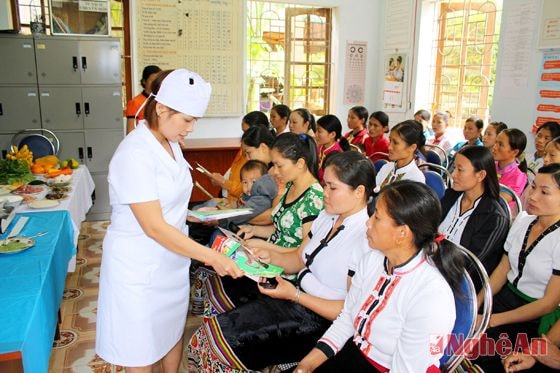 |
| Distribute leaflets to local people to promote the benefits of breastfeeding. |
Along with human resource solutions, during the 2011-2015 period, the province focused on investing in medical facilities and equipment: Annual budget expenditure for the health sector averaged approximately 6.5% of the total budget expenditure. Nghe An utilized various budget sources such as government bonds, national target programs, Program 30a, provincial budget, ODA, and social mobilization to invest in healthcare. Healthcare infrastructure construction in 2014 increased 8.5 times compared to 2005; 198 new health stations were built with a total investment of 338.4 billion VND, and now 100% of communes have health stations. Regarding health station equipment, each year, the provincial and central government budgets invested an average of 50-70 billion VND, self-funded capital of 40-50 billion VND, and target programs contributed 15-20 billion VND. Currently, 63.5% of communes, wards, and towns in Nghe An province have met the standards for providing basic healthcare services to the people.
The Nam Trung Commune Health Station in Nam Dan District is a reliable healthcare facility not only for the local residents but also for the people of the Nam Nam region. Residents of Nam Trung, Nam Cuong, Khanh Son, and Nam Phuc communes choose it as their primary healthcare provider because the Nam Trung Health Station has ultrasound machines, complete equipment, and highly skilled doctors who are proficient in using the equipment and provide enthusiastic service. In 2014 alone, the Nam Trung Commune Health Station handled nearly 300 successful childbirths and provided over 10,000 visits for examination and treatment. These figures are a testament to the trust placed in the capabilities of the commune health station's staff. Dr. Ho Xuan Hung, Head of the Nam Trung Commune Health Station, shared: “Healthcare staff at the station must demonstrate professional competence, responsibility, and dedication to patients. To meet the healthcare needs of the people, doctors and medical staff must constantly study and improve their skills to treat increasingly complex disease patterns.”
Considering the entire province, a considerable number of commune health stations have a team of capable and qualified medical staff. For example, the Khanh Son Commune Health Station in Nam Dan District provides examination and treatment for approximately 9,000 people annually, with 73% of the commune's residents participating in health insurance. People trust the station because it has a competent and complete team including 1 doctor, 1 traditional medicine practitioner, 1 nurse, 1 obstetrician, 2 general practitioners, and 1 pharmacist. Similarly, the Ngoc Son Commune Health Station in Thanh Chuong District provides examination and treatment for over 12,000 people annually, including over 500 inpatients. Pregnant women in the commune receive at least 3 check-ups as required, 100% of mothers give birth at the health facility, and no obstetric complications occur; the Nghia Tien Commune Health Station in Thai Hoa Town treats nearly 5,000 people annually…
However, in many localities, health stations still lack medical equipment; and the capacity of station staff remains limited. Mr. Luong Van Bang, Head of the Thong Thu Commune Health Station, Que Phong District, said: "Thong Thu is a border commune with 13 villages, and the Thai ethnic minority accounts for 99.9%. Although the station has 7 staff members and 13 village nurses, due to limited local capacity, a large number of patients had to be referred to higher-level facilities in 2013."
Even the Dien Van Commune Health Station in Dien Chau District – the first commune to meet the national criteria for healthcare and awarded the title of Heroic Labor Unit during the đổi mới (renovation) period by the State – is currently hiring four additional technicians to operate the equipment. Improving the capacity of commune-level health station staff requires a continuous process. Dr. Bui Dinh Long, Director of the Nghe An Department of Health, stated: The sector will continue to strengthen the number of doctors in areas lacking personnel; focus on training, especially sending doctors for advanced and specialized training programs at universities; strive to ensure sufficient doctors at health stations by 2017, and by 2020, a ratio of 8.5 doctors per 10,000 people, matching the national average. The health sector prioritizes capacity building through continuous rotation and transfer of personnel and high-quality medical examination and treatment techniques. In some specific areas, doctors are assigned to work both at health stations and hospitals to allow them to continuously improve their skills through further education. The focus is on updating and improving the knowledge, political awareness, and foreign language skills of over 3,000 commune-level health workers.
Improving the capacity of healthcare workers at health stations is not solely the responsibility of the health sector; it depends on strengthened leadership and guidance from all levels of government, the involvement of mass organizations, and social mobilization efforts. Doctors and medical staff cannot achieve high professional standards if health stations lack necessary equipment; they cannot pursue further education and professional development without incentives and encouragement; and they lack the motivation to improve their skills without a favorable working environment and opportunities for advancement.
Thanh Son


