
Improving the quality of vocational training in ornamental plant cultivation.
(Baonghean)Our province currently has five villages specializing in ornamental plants and trees. The ornamental plant and tree industry achieves three basic goals simultaneously: culture, environmental landscape, and economy. However, we are still struggling with the artistic shaping of bonsai trees and ornamental plants.
Traditional bonsai trees from our ancestors have been largely defined by styles such as ascending dragons, dragon shapes, three blessings, five blessings, seven sages, father and son, and literati… along with four basic styles: upright, slanted, horizontal, and hanging. However, contemporary bonsai art remains stuck in the monotonous "village style." Therefore, our bonsai exports lack the persuasive power of major brands like Bonsai (Japan)… We also lack large-scale training schools for bonsai art; the only public school in the country offering intermediate and basic level training is the Northern Agricultural and Rural Development Vocational College. Some agricultural universities in Hanoi, Hue, and Ho Chi Minh City have departments of horticulture, focusing heavily on gardening. Therefore, teaching bonsai art, especially contemporary bonsai art, still requires continuous learning and innovation.
Nghe An province has abundant potential in ornamental plant cultivation, with many types of bonsai trees. Recently, the North Nghe An Vocational School of Economics and Technology opened five training courses in ornamental plant cultivation. Most students came from all walks of life, from retired officials to current officials, from cooperative members to former teachers and veterans… Students of all ages, male and female, were enthusiastic and passionate about learning and practicing. Although the training program was short (200 hours of both theory and practice), most students loved the profession and were very satisfied with their work after the course. To achieve this, the practical instructors needed to be dedicated, intelligent, and skilled.
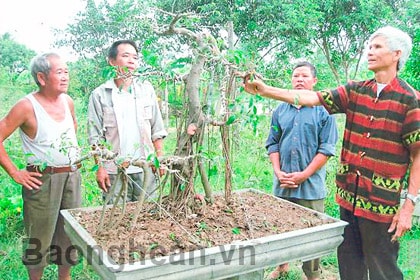
Teacher Le Xuan Hoi (on the right) is instructing a group of students from the Dien Thang (Dien Chau) SVC class on creating contemporary bonsai art.
The heart of a practical instructor must closely follow each student and each group, truly guiding them step by step, dedicating their entire mind to the work, and instilling the spirit they entrust to it. At the same time, the practical instructor must also know how to "pave the way" to new ideas from students so that from an already "old" and "unusual" raw material, they can together create something perfectly beautiful.
A skilled bonsai instructor must know how to grasp, guide, and capture the essence of the tree in order to shape, bend, and create an eye-catching and authentic work of art; this is also the skill of a practical instructor who embodies all three elements: Heart, Mind, and Art.
Only then will generations of students be willing to learn, be creative, and take control of the game.
Ho Duc Thinh (Quynh Luu)


