
The Charm of Phuong Lich
(Baonghean) - Hearing that I was about to go on a business trip to Dien Chau, my friend who works in the Culture sector suggested I visit Dien Hoa, see the ancient village of Phuong Lich, and admire the nearly 150-year-old village communal house to better understand the cultural and historical heritage of that land…
A truly authentic journey unfolds along the smooth, newly paved rural roads, leisurely admiring the lush green fields and reminiscing about a hundred years ago, when mulberry cultivation, silkworm rearing, and weaving flourished in this land. The fabrics of Phuong Lich are renowned far and wide for their beauty and durability; the locals simply call them Bui fabrics, even immortalized in a traditional folk song: "Live wearing Bui fabrics, die buried in gold!"
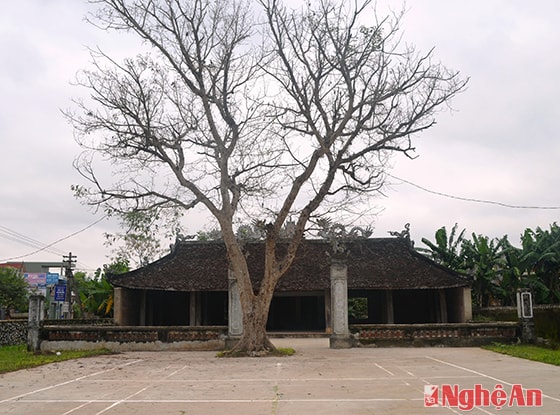 |
| The Phượng Lịch communal house relic. |
I tried to find out the origin of the colloquial name "Bui fabric," but there was no clear answer other than the ancient legend of Princess Hong Thi Chau Nuong - the third wife of General Tran Quang Khai, who is revered as the founder of the village, credited with reclaiming and developing this land and teaching the people the renowned art of weaving. The legend says that in 1266, the Tran Dynasty issued a decree appointing Prince Tran Quang Khai as the governor of Nghe An. Princess Hong Thi Chau Nuong followed him. There, she gathered people, established a village, and opened a large farm called Giang Lam, encompassing the former Hanh Lam and Dao Vien communes, which are now the land of Dien Quang, Dien Hanh, and Dien Hoa communes. After the resistance against the Mongol invaders, she returned to Thang Long (Hanoi). The villagers of Phuong Lich, remembering her contributions to the development of Cua Lo village, built a temple in her honor and maintain the tradition of offering incense and flowers annually on the first and fifteenth days of the lunar month.
Perhaps it's because this centuries-old village was nurtured by the benevolent hands of a princess from the Tran Dynasty that it radiates such charming and endearing beauty? In the late afternoon, I visited Phuong Lich village communal house – a recognized provincial-level historical and cultural relic. Located in the middle of a densely populated area, on a wide, flat piece of land, the communal house stands out amidst the undulating high-rise buildings and tiled roofs of the houses. Despite having endured over a century, its ancient, moss-covered architecture remains a testament to time. According to historical records, Phuong Lich communal house initially consisted of a main hall. In 1875 and 1886, the hall was renovated with the addition of the right and left wings and the sanctuary. The main hall, built in the Nguyen Dynasty style, is large in scale, with a construction area of 150 square meters. Facing south, it comprises five bays and six trusses, each truss supported by four columns resting on large green stone blocks. This temple is also the last remaining testament after countless vicissitudes of time. I was captivated by the vivid and exquisite reliefs on the roof, where two graceful yet majestic dragons flank the roof's edges, each adorned with crocodiles facing each other. Then I was deeply impressed by the talent of the ancient artisans, with the four curved finials depicting stylized fish transforming into dragons and phoenixes spreading their wings, giving a feeling of lightness and grace…
For many years, Phuong Lich village communal house has been a spiritual anchor for the people of this ancient village. The communal house is the venue for rituals, prayers for peace and blessings; at the same time, the courtyard is also a place for cultural activities rich in local identity such as wrestling, cockfighting, human chess, and Ca Tru singing… This communal house also bears witness to the earth-shattering struggles of the people of Nghe Tinh in 1930-1931 and during the two sacred resistance wars of the nation, through secret meetings and clandestine movements of revolutionary figures and patriotic people.
Text and photos:Phuong Chi


