
The old charm of Quynh village
(Baonghean) - Quynh Doi (Quynh Luu) is an ancient cultural village, renowned for its tradition of studiousness and academic achievement. It still retains the essence of a pristine countryside with its sacred temple, ancient and moss-covered village communal house, and centuries-old houses nestled beneath cool green bamboo groves...
(Baonghean) - Quynh Doi (Quynh Luu) is an ancient cultural village, renowned for its tradition of studiousness and academic achievement. It still retains the essence of a pristine countryside with its sacred temple, ancient and moss-covered village communal house, and centuries-old houses nestled beneath cool green bamboo groves...
Along this stretch of road to Quynh Doi, the scent of incense from the traditional craft village permeated the entire area. This fragrance led us to the Ho clan's ancestral site (village 4) – the place of worship for Mr. Ho Kha, who was instrumental in establishing the village and, together with the people, contributed to building and protecting the homeland. He was bestowed the title of "Ho Clan's Founding God" by the King, and this title is proudly displayed by his descendants in the central hall of the site. Covering an area of over 6,000 square meters, the site is becoming an attractive destination not only for tourists from within the province and the country but also for foreign visitors. The site is not only attractive for the ancient and majestic architecture of the old church, but also serves as a place for educating the descendants of the Ho family in particular, and the scholarly land of Quynh Doi in general, about the tradition of studiousness, with rows of steles commemorating famous Confucian scholars and patriots of Nghe An province: Ho Xuan Huong, Ho Phi Tich, Ho Sy Duong, Ho Tung Mau… Surrounding the site are lotus and water lily ponds, and rows of evergreen trees such as frangipani, casuarina, mahogany, cycad, and banyan…
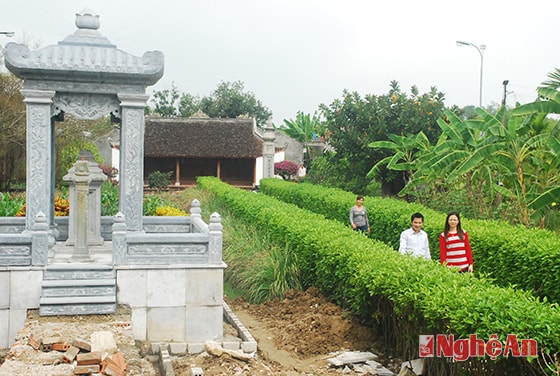 |
| The grounds of the Ho Sy Duong family church historical site, Quynh Doi commune (Quynh Luu district). |
In a story about the Ho family's tradition of valuing education, Mr. Ho Ngoc Toan, Head of the Family Committee, enthusiastically shared: "Over the years, we have done a good job of socializing efforts to preserve and promote the value of the family's ancestral temple. On average, we allocate about 100 million VND annually for restoration, renovation, repair, and the purchase of necessary artifacts. To mobilize contributions from successful descendants living away from home, we established a liaison committee, reviewed the list, and visited those who lived nearby to discuss matters, while those who lived far away received letters or phone calls. Furthermore, every year during the ancestral worship ceremony (on the 11th and 12th of the first lunar month), we directly call upon our descendants to contribute their efforts and resources to build a more magnificent ancestral temple – not only a place of worship for our ancestors, but also a place for descendants to return to during major festivals, Tet (Lunar New Year), and the village festival at the beginning of spring…"
Along with the Ho family ancestral church, the village communal house – a meeting place for patriotic scholars in the Can Vuong movement – has also been restored and renovated thanks to the contributions of the people. The communal house is built in the four-pillar style, with a bell-shaped roof, covered with traditional Southern Vietnamese tiles, and the rafters are intricately carved. In front of the courtyard stand two stone steles detailing the history of the communal house's construction and restoration. Previously, the communal house served as the administrative and cultural center of the village – the place where all communal activities took place. Mr. Ho Duc Thang, a cultural officer of Quynh Doi commune, said: Along with preserving the communal house, since 2012, the Ky Phuc Festival – a traditional festival of Quynh village – has been restored and held right at this communal house after more than 60 years of being lost.
This activity contributes to the preservation and promotion of intangible cultural values, meeting the cultural and spiritual needs of the people in the commune and visitors from all over, aiming to build Quynh Doi into a cultural village tourism destination. The unique feature of the Ky Phuc Festival is the wish for everyone to have good fortune and happiness in the new year, and more profoundly, the spirit of unity, cooperation, and community solidarity. During the traditional festival days of the village, people in the commune, as well as their children studying and working in all parts of the country, and visitors from all over, gather to express their gratitude and remember the contributions of the generations of ancestors who founded the village. In addition to the Ky Phuc Festival held at the village communal house, every year on the second day of the Lunar New Year, Quynh village also organizes the Spring Calligraphy Festival. This contributes to traditional education and inspires a spirit of learning and competition.
Mr. Nguyen Ngoc Quy, Permanent Vice Chairman of the Quynh Doi Commune's Association for the Promotion of Learning, said: "The tradition of 'opening the pen' at the beginning of the year used to be performed by scholars, students, and intellectuals in Quynh Doi village at the moment after midnight on New Year's Eve in front of the ancestral altar to pray for a prosperous year in their studies and examinations. Currently, this traditional 'opening the pen' ceremony has been changed in form and is held on the second day of the first lunar month each year, attracting hundreds of villagers to participate. Every time Tet (Lunar New Year) comes around, the children of the commune eagerly await the 'opening the pen' ceremony to listen to the elders tell stories about the scholarly traditions of their homeland, and together write poems and essays praising the changes in the present era. Some people compose a poem, paint a picture, or create a flower branch, while others write their feelings on the themes of spring, homeland, and country. This is a beautiful tradition that many generations of children in Quynh Doi village have preserved and promoted."
To meet the people's cultural and spiritual needs in conjunction with the new rural development program, in recent years, besides preserving and safeguarding the cultural values inherited from our ancestors, the commune has also focused on consolidating, building, and perfecting cultural and information facilities worth tens of billions of VND. To date, all 8 villages have cultural centers with playgrounds and exercise areas. Each cultural center has a legal library. The movement for weddings following the new cultural lifestyle has been well-received and implemented by many families, officials, Party members, and the people. In funeral practices, some outdated customs have been reduced, such as not hiring bands or scattering paper offerings, demonstrating a more civilized approach to spiritual and cultural activities. The quality of the movement to build cultural families and villages is constantly improving. The percentage of families and villages achieving the title of cultural family and village annually reaches 82-90%, and families participating in sports reach 28%; all 8 villages consistently maintain the title of cultural village.
Mr. Ho Quang Tuan, Vice Chairman of the People's Committee of Quynh Doi commune, affirmed: Currently, the commune has 12 historical sites (including 7 national-level sites and 2 provincial-level sites), making it one of the communes with the densest system of national-level historical sites in the province. Notable examples include the Ho clan's ancestral site, the Nguyen Trieu Co clan site, the Hoang Khanh clan site, the village communal house, the temples and tombs of Ho Sy Duong, Ho Tung Mau, Ho Xuan Huong, Ho Phi Tich… and a system of other ancestral temples in the village that are preserved and promoted by descendants of the clans. In building new rural areas, Quynh Doi has determined that it must progress from culture, using culture as a breakthrough and foundation for socio-economic development. This involves linking traditional and modern culture to create a unique identity for the first cultural village recognized by the Provincial People's Committee. Therefore, in the coming time, the commune will choose to develop culture in conjunction with tourism as the spearhead in building new rural areas. That is also the advantage of Quynh Doi, as the locality is always a familiar destination for tourists when they come to Quynh beach for tourism.
Text and photos:Thanh Thủy - Thu Hương


