
The sorrowful profession of forest keeper
(Baonghean.vn) - Forest rangers, with their arduous and demanding work, receive very low salaries and are often owed money. As a result, in less than two years, nearly 100 people have reluctantly resigned after a long period of dedication.
Salaries are already low, and they're being delayed.
On the first day of December, we met Mr. Tran Dinh Ha (41 years old) as he and three colleagues were packing their belongings, preparing for a multi-day forest patrol. Mr. Ha is a forest protection officer of the Tan Ky Protective Forest Management Board. Knowing they would have to sleep in the forest, and with the weather forecast predicting rain, their luggage was quite bulky. From raincoats and hammocks to packets of instant noodles, their backpacks were crammed full.
"Eating instant noodles in the forest is convenient and saves money," Mr. Ha said with a smile. Looking at the enthusiasm of these forest rangers, no one would think that for the past five months, they haven't received a single penny in salary.
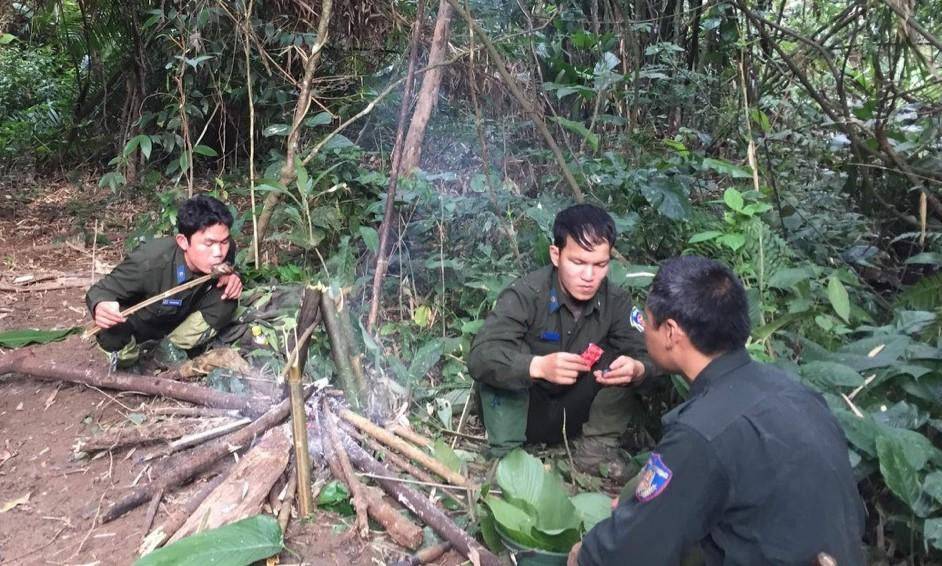 |
A moment of rest in the forest for Mr. Ha and his colleagues. Photo: Tien Hung |
This forest protection station is tasked with managing over 2,200 hectares of forest in the communes of Tan Hop, Dong Van, and Tien Ky. Previously, the station had 8 people, but due to low income and the arduous and stressful nature of the work, 4 younger people resigned. Of the remaining 4, Mr. Ha is the youngest.
Having worked as a forest protection officer for 17 years, Mr. Ha's current salary is only a meager 4 million VND per month. His home is in Lat town (Tan Ky district), 40km away from the station, so he can only visit twice a month. His wife is unemployed, and their two children are of school age, so all household expenses depend on his small salary. "I don't dare go out with friends when they invite me. Each month, with my 4 million VND, I contribute 1 million VND to the food expenses with my colleagues at the station. The remaining 3 million VND I give to my wife," Mr. Ha said.
The salary is low, but even worse, forest rangers like Mr. Ha don't receive their pay regularly every month. Last year, for nine consecutive months, Mr. Ha and his colleagues didn't receive their salaries. "In 2021, we only received one payment in September, and then another at the end of the year. We only receive our salaries twice a year. Because of the delayed salaries, our family life has been turned upside down, and we have to find ways to make ends meet," Mr. Ha added.
 |
A meal in the middle of the forest. Photo: Tien Hung |
The situation in 2022 wasn't much better, as Mr. Ha and his colleagues didn't receive their first paycheck until July. Since then, they haven't received a single penny more. Meanwhile, their work is extremely arduous and dangerous. Each month, they have to spend at least 20 days patrolling far from home. In his 17 years in the profession, Mr. Ha estimates that he's spent more nights sleeping in hammocks in the forest than at home. In recent years, the situation of people clearing forests to plant acacia trees has become increasingly complex. Because of this, conflicts between the people and the forest protection force have also increased. "I've been attacked constantly, luckily I've never been seriously injured. Many times, people came to cut down trees to plant acacia, and when we caught them to prosecute, they would ambush and attack us again the next day during patrols," Mr. Ha recounted when we asked about the dangers of his job as a forest ranger.
"If I hadn't loved the mountains and forests since I was a child, I probably would have quit my job a long time ago. Luckily, my wife understands my passion and encourages me constantly, but I probably wouldn't have been able to hold on much longer," the man, his face tanned by years of enduring the harsh weather in the mountains, said with a choked voice.
 |
Forest patrol. Photo: KLCC |
Alarming increase in job resignations.
Mr. Ha's situation reflects the current reality at many forest protection management boards. Mr. Dinh Van Hai, Head of the Tan Ky Forest Protection Management Board, stated that due to low income and stressful work, 16 people have resigned from the unit since 2018. Of these, 15 were members of the specialized forest protection force. Currently, the Tan Ky Forest Protection Management Board only has 18 people, including 11 on the payroll and 7 contract workers like Mr. Ha. They are responsible for protecting over 8,000 hectares of forest in the area.
The specialized forest protection force consists of contract workers whose salaries are paid by the forest management units themselves. This is the core force responsible for forest management and protection, including directly conducting patrols, guiding and organizing forest protection work, and inspecting the work of those contracted to manage the forests. However, because the forest owners are primarily responsible for managing natural forests, and are currently closed to deforestation, most are facing difficulties in balancing their revenue to ensure salary payments, leading to unstable income and a lack of livelihood for the specialized forest protection force. According to Mr. Hai, previously, the unit used funds from the contracted forest protection policy to pay salaries for these personnel. However, this policy has been discontinued for over two years. Therefore, the unit cannot find any other source of revenue.
 |
Over the past two years, 93 forest rangers have resigned. (Illustrative photo: KLCC) |
“We know that delaying salary payments violates the Labor Law, but there’s no other way. This year we’ve only paid 7 months’ salary, and even that money was an advance, borrowed from the province. If the policy doesn’t change in the future, we don’t know where we’ll get the funds to repay the province, let alone continue paying salaries to our staff,” Mr. Hai said, adding that current forest protection and development policies lack specific regulations to ensure funding for the specialized forest protection force, leaving forest owners without a basis to mobilize resources for this force.
Similarly in Tan Ky district, the Ky Son Protective Forest Management Board has been struggling to pay salaries for its forest protection specialists for the past two years. "Despite our best efforts to find sources of income, we can't guarantee anything and often have to delay paying salaries for several months. Because they couldn't stay, four people have resigned in the past two years, making the already thin forest protection force even thinner," said Mr. Le Hoang, Head of the Ky Son Protective Forest Management Board.
Not only contract employees, but also many permanent staff members, even those holding high positions in the forest protection force, are simultaneously resigning due to low pay and the stressful and arduous nature of their work. According to statistics from the agricultural sector, from 2016 to the end of April 2022, 158 workers resigned. Of these, 34 were permanent staff and 124 were long-term, self-funded contract workers. The number of resignations from 2020 to the present is 93, including 44 forest rangers and 49 members of the specialized forest protection force.
 |
Forest rangers face arduous and stressful work, yet receive very low salaries. (Photo: KLCC) |
Furthermore, according to Mr. Nguyen Anh Tuan, Deputy Head of the Nghe An Forest Protection Department, in recent years, among those who have requested to resign, there are 5 people holding the rank of District Head. Upon receiving their resignation letters, the Department had to repeatedly encourage them, resulting in 3 of them abandoning their intention to leave. Mr. Le Xuan Dinh, Head of the Quy Chau District Forest Protection Department, is one of them.
Mr. Dinh recounted that he submitted his resignation at the end of 2019, when he still had four years left before retirement. “I’ve been a forest ranger for over 30 years, and I’ve never once been assigned to work near home. After nearly 10 years as district chief, I resigned because the pressure was too great; the responsibility of protecting the forest was immense. My health was declining, but the situation of people cutting down trees to plant acacia trees was complicated. Whenever I received news, no matter how far away, I would trek through the forest to get there, which was very difficult,” Mr. Dinh said, adding that due to the immense pressure and responsibility, his deputy and another station chief had also resigned. One of them even sacrificed his years of service to return to his hometown and work abroad.
The Deputy Head of the Nghe An Forest Protection Department stated that the reasons for the resignation of forest rangers are the pressure of managing, protecting, and developing forests, related to individual responsibilities. The working environment is arduous, and living and transportation conditions are difficult. Rising prices in remote forest areas and areas inhabited by ethnic minorities cause significant difficulties in their material, cultural, and spiritual lives. Meanwhile, the salaries and allowances for full-time forest rangers are too low, not commensurate with the effort they put in, and lack stability; prolonged salary and insurance arrears still occur. This is because the forest management units responsible for forest protection lack the resources to pay, depending on state policies.
With over 1.2 million hectares, Nghe An is the province with the largest area of forest and forestry land in the country. According to the latest report from the Nghe An Forest Protection Department, the unit currently has a total staff of 334 people, including 266 civil servants, 41 public employees, and 27 contract workers. In just the past two years, the unit has seen 31 people resign. This means that on average, each person is responsible for nearly 3,000 hectares of forest, and each forest ranger is responsible for over 3,700 hectares. Meanwhile, according to Article 6 of Decision No. 07/2012/QD-TTg dated February 8, 2012, of the Prime Minister – “on average nationwide, there should be one forest ranger for every 1,000 hectares of forest.”
Furthermore, for the Special-Use and Protection Forest Ranger Districts, the total staff is 133 people, including 56 civil servants and 77 public employees. Thirteen people resigned in the past two years. Meanwhile, the specialized forest protection force of the forest owners has 922 people, including 13 civil servants, 203 public employees, and 706 contract workers. 49 people resigned in the past two years.


