
A joyful day on the sacred mountain peak.
(Baonghean) - Every year, around the end of the first lunar month, people of the ethnic groups in the highlands of Ky Son eagerly look forward to the Pu Nha Thau Temple Festival. This is a unique festival, rich in the local historical and cultural traditions and embodying the regional cultural identity. Importantly, it provides an opportunity for the people to express their reverence and remembrance of the merits of their ancestors who fought against foreign invaders, secured the borders, and blessed their villages with prosperity and peace.
Pu Nha Thau Temple is a provincial-level historical and cultural relic, located on the summit of a sacred mountain in Na Luong village (Huu Kiem commune). The temple is associated with legends and stories passed down through generations by the local people. The people of Na Luong village recount that, since ancient times, Princess La Binh, daughter of Son Tinh and My Nuong, granddaughter of King Hung XVIII, was a woman of great virtue and talent, always loving and protecting the people. She enjoyed traveling far and wide, often seeking out mountainous regions and villages to guide and help the people, ensuring they lived peaceful and prosperous lives. The people of the nine villages and ten hamlets greatly admired Princess La Binh and revered her as the Mother of the Mountains. After the princess's death, the people erected a shrine on the mountaintop to worship her and offer incense year-round.
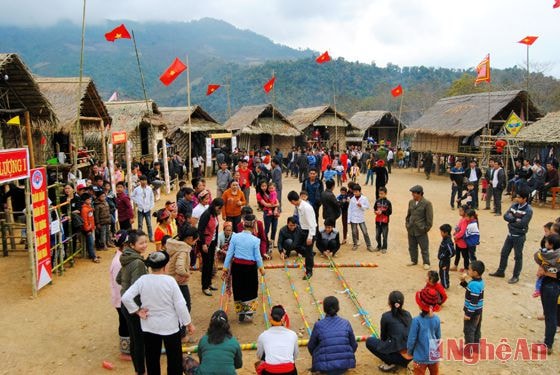 |
| Pu Nha Thau Peak festival day. |
The Pu Nha Thau Temple and Na Luong village are also associated with the event of repelling foreign invaders by the Tran Dynasty generals and soldiers in the 14th century. Around 1335, the Lao invaders crossed the border to invade our country, burning villages, plundering property, and killing innocent people. Emperor Tran Minh Tong decided to personally lead the army into the border region to repel the Lao invaders and appointed Doan Nhu Hai (from Hoi Xuyen village, Tuong Lan district, Hong Chau province, now Gia Loc district, Hai Duong province) as the commander. Upon arriving in Nam Nhung (now belonging to Ky Son and Tuong Duong districts), the Tran Dynasty commander chose a high mountain in the area of Na Luong village - Huu Kiem commune to set up a camp to train soldiers and observe the enemy's activities.
The local people were overjoyed when the imperial soldiers arrived to rescue them. Many young men volunteered to join, contributing their efforts to drive out the invaders and protect their villages. A large number of villagers contributed their labor and resources, providing food for the imperial soldiers, and encouraging their children to join the army. Among them, one elderly woman stood out for encouraging her husband and son to join the imperial army, training in martial arts to fight the invaders. Her elderly husband fought directly in battle, her son was tasked with guarding the weapons and food supplies for the Tran Dynasty army, and she served as a messenger, supplying provisions and cooking for the imperial soldiers.
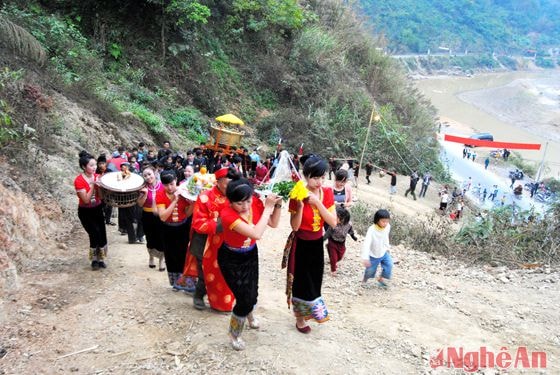 |
| Procession during the Pu Nha Thau Temple Festival |
Our troops set up camp and trained on the mountain, while the enemy planned a surprise attack. Anticipating the enemy's treacherous scheme, General Doan Nhu Hai ordered his soldiers to circle around the mountainside to the river junction to intercept their advance. During the march, Doan Nhu Hai was ambushed and killed. After his death, the imperial court issued a decree instructing the people of Nam Nhung village to build a temple in his honor and hold ceremonies at the beginning of spring, after the harvest and when the weather was warm.
Speaking of the mother who nurtured the soldiers, when her homeland returned to peaceful life, it was also the time she passed away. To express their respect and gratitude for her service to the imperial generals and soldiers, the people of the region named the high mountain where General Đoàn Nhữ Hài once established his camp Mount Bà Già (in Thai, Pu Nhạ Thầu).
In recognition of the meritorious deeds of the Tran Dynasty's military commanders and the silent contributions of the elderly mother who cared for the troops, the people of Na Luong village brought the spirits of these figures to be enshrined in the temple dedicated to the Mother Goddess of the Mountains. Later, the people contributed labor and resources to upgrade it into a temple. Since then, people from all the villages in Nam Nhung often come to offer gifts, express their devotion, and pray for peace and prosperity. The people commonly refer to the temple on the mountaintop in Na Luong village as the Tran Dynasty Temple or the Pu Nha Thau Temple. Throughout hundreds of years and through many ups and downs, the people of the region have always been conscious of preserving and protecting the sacred temple on the mountaintop. Even during the years of the war against the Americans, when the Pu Nha Thau Temple was bombed twice and collapsed, the villagers immediately went into the forest to gather wood to rebuild it.
Every month, on the 1st and 15th, the people of Ky Son prepare offerings and go to the temple to tend to the incense. In recent years, many groups of pilgrims have come to admire the beauty of Pu Nha Thau's landscape. From here, looking out, one sees majestic mountains, and below, the Nam Mo River winds like a green silk ribbon, creating a poetic and charming scene. This beauty easily captivates the heart, alluring and inviting those who enjoy exploration and discovery.
During festivals, the summit of Pu Nha Thau becomes bustling and lively with the resounding sounds of gongs, flutes, lively singing, and boisterous laughter. Joining the procession, visitors are immersed in a sacred atmosphere. The procession starts from Na Luong village, travels along National Highway 7A, and then follows the path up the mountain to the summit, where the Pu Nha Thau temple is located. The sacred tablets of the gods are carried into the temple, and everyone respectfully faces the main hall, where the grand ceremony begins. After offering the gifts, the chief shaman respectfully invites the gods and ancestors to attend the festival and partake in the offerings, blessing the villages with prosperity, abundance of rice, plentiful fish, lush forests, and peace and unity among the people. This is followed by the festivities with cultural and artistic exchanges, rice wine drinking, Lam Vong dancing, and other engaging folk games. In particular, at the festival, visitors will have the opportunity to enjoy the specialties of the mountains and forests, prepared by the skillful hands of the women of Na Luong.
Speaking with us, Ms. Cụt Thị Nguyệt, Vice Chairman of the People's Committee of Kỳ Sơn district, said: “Preparations for this year's festival are complete, and the people of Kỳ Sơn are eagerly awaiting the opening ceremony. This is an opportunity to express admiration and gratitude to those who contributed to fighting the enemy and liberating the villages, and to educate the younger generation about our traditions. The festival is also an opportunity to preserve and promote the cultural values and identity of the ethnic groups in Kỳ Sơn district, and to promote the image of our land and people to friends near and far.”
Text and photos:TUONG ANH - THU HUONG


