
Nghe An province prepares response plan for avian influenza outbreak.
(Baonghean.vn) - Mr. Hoang Nghia Hieu - Director of the Department of Agriculture and Rural Development, provided detailed information aboutPlan for implementing measures to prevent and respond to the H7N9 influenza outbreak in Nghe An province.
 |
| Mr. Hoang Nghia Hieu - Member of the Provincial Party Committee, Director of the Department of Agriculture and Rural Development. Photo: Phu Huong. |
In January 2017, China reported 109 cases of human infection with the H7N9 avian influenza virus, and since 2013, there have been 1,174 cases, including 417 deaths.
Given the current level of trade and travel and the complex developments of the epidemic, the risk of the A/H7N9 influenza virus entering Vietnam and Nghe An province is very high.In the plan, scenarios are categorized into different levels to ensure appropriate response solutions.
The solutions include:Technical solutions include sampling for identification and monitoring; controlling trade and transportation; and strengthening the capacity of the veterinary sector. In the event of detecting the A/H7N9 influenza virus in humans in Nghe An, additional measures recommended by the health sector should be implemented.
The illegal trade and transportation of poultry and poultry products across the border is strictly prohibited. Communication efforts should be intensified to raise awareness of the dangers of the A/H7N9 influenza virus.
Along with coordinated activities to promptly gather information on influenza A/H7N9 and establish a rapid response team to handle the situation when influenza A/H7N9 virus is detected in the province, the Department of Health must also provide guidance on proactive and effective preventive measures against influenza A(H7N9) and A(H5N1) in humans.
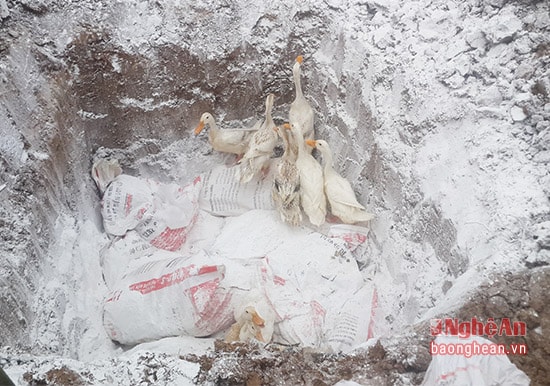 |
| On February 2, 2017, nearly 500 ducks infected with H5N1 in Dien Loc (Dien Chau) were destroyed according to proper procedures. (Photo: Archival image) |
Situation 1:No A/H7N9 influenza virus has been detected in poultry, the environment, or humans: Actions have been taken to minimize the risk of A/H7N9 influenza virus entering Nghe An province, and to promptly detect any virus entry should it occur.
Situation 2:While the province has not detected the A/H7N9 influenza virus in poultry or the environment, there have been cases of human infection. Therefore, activities are aimed at minimizing the risk of the virus multiplying and spreading widely. In addition to the specific activities mentioned above, the locality also needs to focus on implementing general epidemiological investigations, strengthening disease surveillance sampling in poultry flocks and the environment; providing guidance on safe slaughtering and consumption of poultry and preventing disease transmission to humans; and organizing appropriate public awareness campaigns that do not cause panic in the community.
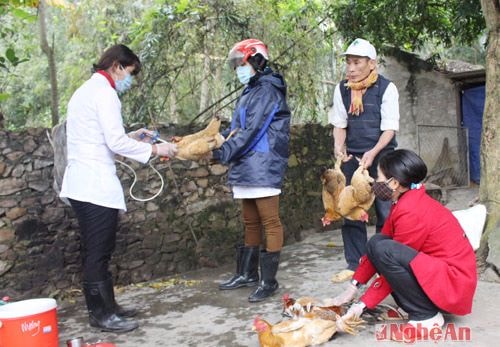 |
| Dien Chau organizes avian influenza vaccination campaign. (Photo: Archival image) |
Local authorities are fully prepared with the necessary resources, including personnel, funding, equipment, chemicals, and burial sites for poultry in case of detecting cases of avian influenza A/H7N9 in animals. The health sector is implementing surveillance activities for the A/H7N9 influenza virus in humans in areas where cases have been reported; coordinating investigations and surveillance of the A/H7N9 influenza virus in poultry, the environment, etc.
Situation 3:In the province, the A/H7N9 influenza virus has been detected in poultry or the environment, but there have been no cases of human infection. The objectives of these activities are to minimize the risk of the virus multiplying and spreading widely, and to prevent the A/H7N9 influenza virus from infecting humans. Local authorities are intensifying epidemiological investigations.
Depending on whether the A/H7N9 influenza virus is detected in samples taken at markets, from poultry farms, or in villages and hamlets where poultry is raised, appropriate intervention measures should be taken. These measures must include epidemiological investigation to trace the source; organized destruction and disinfection; temporary suspension of poultry transportation; and further testing to determine the extent of virus spread in the area.
The Department of Health is implementing surveillance activities for the A/H7N9 influenza virus in humans in areas where positive test results have been found in poultry and the environment. Districts must issue bans on the trading and transportation of live poultry in areas where the A/H7N9 influenza virus has been detected, and simultaneously direct relevant forces and local authorities to focus on implementing response measures according to the guidelines of the Provincial Steering Committee for Disease Prevention and Control.
Situation 4:Upon detecting the A/H7N9 influenza virus in poultry or the environment, and with human cases, the aim of the following activities is to minimize the risk of the virus multiplying, spreading widely, and continuing to infect animals and humans. Simultaneously, measures similar to scenarios 2 and 3 will be implemented, and a request for government support will be made to Nghe An province for epidemic prevention and control./.
Phu Huong
(Recorded)
| RELATED NEWS |
|---|


