
Listen to the people, speak in a way the people understand, and act in a way the people trust.
(Baonghean) - During the past term, Nghe An province achieved and exceeded many targets in economic, political, and social development, the people's living standards have gradually improved, and national defense and security have been maintained. Along with the efforts in leadership and guidance from Party committees and authorities at all levels, the creativity in mass mobilization work in each locality and each Party organization is considered the key to success.
Highlights in mass mobilization work
Among the many successful models of "people mobilization" at all levels over the years, the involvement of forces participating in land clearance work to complete social welfare projects and key national projects in the province stands out. A prime example is the project to upgrade and expand National Highway 1A, carried out from the end of 2013 to the end of 2014. To ensure the project was completed on schedule, the Provincial Party Committee directly directed and required the entire political system to cooperate in mobilizing the people to understand the compensation regimes and the urgency of quickly handing over the land. The difficulty in land clearance was that the road, spanning 73.8 km, passed through the province, affecting many residential areas and a large number of households. In each locality, the Party committee and government prioritized land clearance as the number one political priority, and propaganda, mobilization, and understanding the people's thoughts and aspirations were paramount.
In practice, some areas still face obstacles and difficulties in land clearance, with people frustrated because their compensation demands are not met. In many places, the authorities are truly at a loss and lack solutions. In response to this situation, the Provincial Party Committee's Mass Mobilization Department issued Document 597-CV/DVTU on strengthening the mobilization of people for land clearance to upgrade National Highway 1A, providing guidance on how to organize mobilization efforts for the Mass Mobilization Departments of districts through which National Highway 1A passes. Following the principle of addressing difficulties wherever they arise, the Mass Mobilization Department requested that localities assign reputable, capable, and courageous officials to participate in the working group to mobilize people to hand over the land; and at the same time, effectively carry out mass mobilization work in land handover. They were also instructed to promptly report any issues arising during the mobilization process, identify and recommend action against individuals who deliberately oppose the State's policies, and spread rumors that disrupt public order and security.
Through persistent efforts, from resolving hotspots where households still had questions about compensation policies to addressing long-standing issues stemming from improper land allocation practices prior to 1996 in areas like Quynh Luu and Nghi Loc, the situation has gradually improved. While some points seemed insurmountable, through persistent efforts, persuasive and reasonable arguments, and a strategy of addressing issues from simple to complex, from distant to close, and from general to specific, the localities have successfully handed over the land on schedule. Nghe An has been commended by the Government for completing the land clearance project for the key National Highway 1A project on schedule.
Public relations work in the implementation of land clearance for key national projects also includes the successful campaign to persuade eight households to hand over their land after a four-year delay by the Land Clearance Committee of Quy Hop district for the Ban Mong Reservoir Project. This project has the crucial task of mitigating natural disasters by reducing flooding downstream of the Hieu and Ca rivers, contributing to the protection of people's lives and property during the rainy season, and generating 42MW of electricity to be integrated into the national power grid. The eight households refused to hand over their land because they did not fully understand the policies, guidelines, and the methods used by public relations officers. Recognizing the importance of changing the approach to persuasion, Ms. Tran Minh Sinh, then Secretary of the District Party Committee and Chairwoman of the District People's Committee, directed: "It is necessary to explain things to the people so they understand and trust us. Credibility is paramount. If we promise to resolve a policy issue, we must do so within the deadline. More importantly, if the previous propaganda officers failed to make the people understand, then other, more eloquent and capable officers will replace them."
After two weeks of intensive efforts, on May 31, 2015, eight households in Cong and Trong Canh hamlets handed over their land to allow the N1 canal project, part of the Ban Mong reservoir complex, to resume construction. This was not only a joy for the Party Committee and government of Quy Hop district but also for the people in the area. Another success in mobilizing and persuading people to hand over land thanks to effective public relations work is the construction of the provincial D4 road through Nghi Thiet commune (Nghi Loc district). The D4 road is 2.1 km long and runs through Nghi Thiet commune. The final 500 meters of the road affect 149 households in Dong and Moi hamlets. By September 3rd, the Nghi Loc District People's Committee and the Nghi Thiet Commune Party Committee and People's Committee had successfully persuaded the remaining four households to hand over their land to the construction unit.
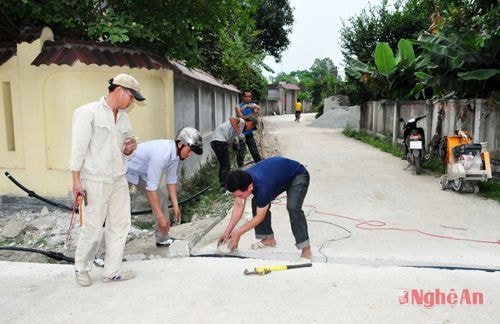 |
| Installing a clean water system in Nam Cat commune. Photo: Mai Hoa |
A highlight of mass mobilization work in localities is the "skillful mass mobilization" emulation movement, which has been widely implemented in many areas in conjunction with the new rural development program. The Mass Mobilization Department advised on the development of Project 06-DA/TU dated April 1, 2014, of the Provincial Party Committee on the "skillful mass mobilization" emulation movement at the provincial and district levels, and it has been effectively implemented. A typical example is the "skillful mass mobilization" model in Dien Yen commune (Dien Chau district) in the new rural development movement. From a locality not selected as a pilot area, with only 9 initial criteria, after only 9 months of implementation, the decisive leadership and mobilization of resources from the people, children working away from home, and businesses located in the commune completed the 6 most difficult criteria, receiving the title of a commune meeting the new rural development standards in November 2014.
For example, Minh Hop commune (Quy Hop district) has mobilized its people to develop household farm and garden economies, improving people's lives and increasing local revenue. While in 2010 only 90 out of 186 households had farms, today, thanks to the effective guidance and mobilization of the commune Party Committee and the people's mobilization task force, all 186 households participate in livestock farming and citrus cultivation. The average per capita income has now reached 62 million VND/year, with 20 households earning between 2 and 3 billion VND. Thanks to their improved living standards, the people have voluntarily contributed 435 million VND to build a cultural center, village gate, football field, etc., contributing to the construction of new rural areas.
Typical examples of effective mass mobilization include the building of national unity in many areas. For instance, in Blocks 5 and 6 of Thu Thuy Ward (Cua Lo Town); and Hamlet 6, Hung Trung Commune (Hung Nguyen District), these are examples of effective mass mobilization in building solidarity between Catholics and non-Catholics. Here, the Party Committee, government, and people are united in their aspirations to build a prosperous, civilized, and warmly united hamlet. Mr. Hoang Duc Nguyen, Secretary of the Party branch and Head of the Fatherland Front Subcommittee of Hamlet 6, Hung Trung Commune (Hung Nguyen District), said: “Effective mass mobilization in my hamlet is natural, because this solidarity has become a tradition; every household in the hamlet participates in a common effort. When movements are launched, everyone participates because they are joyful and meaningful. The lesson here is the unity and solidarity within the hamlet's Party committee and leadership.”
Over the years, the "Effective Mass Mobilization" emulation movement has continued to be effectively implemented throughout the province. Many exemplary models and individuals demonstrating "Effective Mass Mobilization" have emerged, linked to administrative reform and the improvement of working methods among officials and civil servants. Awareness and responsibility among all levels and sectors regarding mass mobilization work have been enhanced, and the sense of responsibility, leadership capacity, and advisory skills of the mass mobilization system and its staff have improved. In the implementation process, the "Effective Mass Mobilization" emulation movement has mobilized the combined strength of the grassroots political system, particularly in issues such as land clearance, new rural development, and fostering solidarity between religious and secular communities. Simultaneously, the synchronized integration of mass mobilization work with management and administration has led to the discovery of effective solutions to address the legitimate needs and aspirations of the people, ensuring a harmonious balance of interests between the State, the collective, and individuals, thus gaining public support and participation.
Following the implementation of the emulation campaign to build "effective mass mobilization" models, localities have annually selected, honored, and commended exemplary "effective mass mobilization" models. While there were 367 models in 2011, this number increased to 2,212 in 2014, and 3,652 models were registered for construction in 2015. Localities have also mobilized the people to donate over 5,000 square meters of land, over 4,000 man-days of labor, and contribute over 4 trillion VND to build new rural areas, and to date, 39 communes have met all 19 criteria. Wherever "effective mass mobilization" models are successfully built, those areas will achieve their economic, political, and social welfare goals.
Promoting grassroots democracy regulations
The political system and grassroots Party organizations have effectively implemented the grassroots democracy regulations in all three types of communes, wards, towns, and agencies. All 21 districts, cities, and towns have established 31 exemplary models for implementing grassroots democracy regulations. Localities have considered practicing democracy as a fundamental method of mass mobilization work. The implementation of grassroots democracy regulations is based on the principles of explaining to the people, discussing with the people, organizing for the people to implement, and jointly reviewing work with the people, in accordance with Ho Chi Minh's thought and the four principles: the people know, the people discuss, the people do, and the people inspect, as affirmed by the Party. In all aspects of mass mobilization work, cadres always internalize President Ho Chi Minh's advice: "Skillful mass mobilization leads to success in everything."
For example, Tan Phu commune (Tan Ky district) has implemented democratic principles in its new rural development program to foster consensus among the people. The commune elected a construction committee comprising representatives from mass organizations, self-governing group leaders, and several qualified residents to assess, calculate, and inspect the details of income and expenditure for rural road construction and cultural centers, which were then publicly disclosed. Thus, along with public awareness and discussion, the direct involvement and oversight of the people have been systematically implemented here. Another bright spot in the implementation of democratic principles is Huu Kiem commune (Ky Son district), achieved through administrative reform. Public service in the area is regularly improved; residents receive attentive guidance when processing paperwork, and commune officials work overtime to handle procedures for the people.
Highlights of grassroots democracy regulations can also be seen in the Legal and Democracy Committee (Provincial Fatherland Front), the Planning and Investment Department of the Southeast Economic Zone, and Binh Minh Trading and Transportation Company Limited (Nghi Loc);… thereby contributing to significant changes in socio-economic, national defense, and security aspects, and building the grassroots political system of the province. The implementation of democracy regulations in the province over the past period has been harmoniously integrated with the "skillful mass mobilization" model, thereby strongly transforming the leadership methods and working styles of Party committees, government, Fatherland Front, and mass organizations. Through this, officials at all levels have become more closely involved with the grassroots, closer to the people, and listened to their opinions.
The effective implementation of grassroots democracy regulations has contributed to the fight against corruption and waste, promoted administrative reform, reduced complaints and denunciations from citizens, and prevented large-scale protests at the central level. This has fostered public peace and contributed to maintaining political stability, social order and security, and national defense and security. Mr. Nguyen Manh Khoi, Deputy Head of the Provincial Party Committee's Mass Mobilization Department, stated: “Recently, citizens and businesses have reported that their applications are no longer processed long at government agencies, and procedures have been streamlined. This is also why investment attraction in the province has increased during the past term, stalled projects have decreased, and citizen satisfaction has been more widespread across many areas.”
During the past term, the government's mass mobilization work has seen significant changes in awareness and action, contributing to building public service ethics and enhancing the awareness, responsibility, and attitude of serving the people and businesses. A prime example is Nam Cat commune (Nam Dan district). During our visit to celebrate the commune's achievement of the new rural standard, Ms. Nguyen Thi Oanh, Secretary of the Party Committee, enthusiastically announced that for movements requiring the mobilization of the people's strength, they don't need to go to each house to solicit contributions. The Party Secretary and village heads only need to broadcast on the village's public address system, and the people immediately contribute because they believe that once the policy reaches their village, they will be the ones to benefit.
Mr. Nguyen Manh Khoi, Deputy Head of the Mass Mobilization Department, stated his viewpoint: Whether to a greater or lesser extent, all citizens have contact with and are involved with the government. Therefore, a welcoming and considerate attitude can build trust among the people, thus making mobilization efforts more effective. Furthermore, the government's task is to concretize the Party's guidelines and policies at all levels into policies for implementation. If these policies align with the people's aspirations and are implemented effectively, the people will be even more enthusiastic and confident in the Party's leadership and the government's management.
During the past term, the Provincial Party Committee's Mass Mobilization Department focused on effectively implementing mass mobilization work in accordance with the spirit of Resolution 26 of the Politburo. Many localities have successfully mobilized the people to comply with the Party and State's guidelines and policies, actively participate in patriotic emulation movements, and effectively contribute to socio-economic development. In addition, mass mobilization cadres have proactively and promptly grasped the situation among the people, identifying pressing issues of concern to the people, and reporting them to the Party committees and authorities for resolution. To date, 480 out of 480 communes, wards, and towns have mass mobilization units, with 5,906 mass mobilization teams operating regularly. These teams have mobilized the people to participate in patriotic emulation movements, the "All People Unite to Build a Culturally Rich Community" movement; the movement to support the "For the Poor" Fund, the "Volunteer Campaign for the Western Region," and the "Joining Forces to Build New Rural Areas" movement…
With positive contributions during the past term, mass mobilization work has created consensus among the people. This is thanks to the Party committees, government agencies, and mass organizations at all levels implementing mass mobilization work based on the principle that mass mobilization in the new era must be innovative, maximizing the people's right to self-governance according to the motto "the people know, the people discuss, the people do, the people inspect," so that "they listen to what the people say, explain things so the people understand, and act in a way that earns the people's trust."
Thanh Nga


