
Nghi Loc is urgently completing the spring rice planting season.
(Baonghean.vn) -At this time, in the rice fields of Nghi Loc, farmers are quickly completing the planting of spring rice. This year, following the directives of the province and district, farmers went to the fields to plant spring rice early to complete it before the Lunar New Year.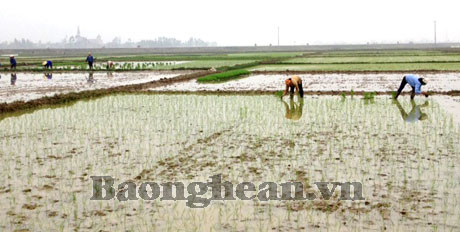
Farmers in Nghi Hoa are actively heading to the fields to sow and plant spring rice.
In the fields of Nghi Hoa commune, farmers are busily plowing, irrigating, and transplanting rice seedlings. For the 2013 spring crop, Ms. Nguyen Thi Yen's family in Hamlet 12, Nghi Hoa commune, planted 1.7 sao (approximately 1.7 hectares) of rice, mainly short-day varieties such as AC5 and Syn 6. According to her, these are short-day varieties that yield good rice, and the high-quality AC5 variety was included in the first crop. She happily shared: “This spring, irrigation is ensured, and the dry weather has resulted in evenly growing seedlings, with no seedling loss or death, so my family has enough seedlings for transplanting. My family started transplanting rice on January 29th and is determined to complete the entire rice planting area before Tet (Lunar New Year).” Along with Ms. Yen, many other farmers are striving to meet their spring planting targets in time to prepare for Tet.
Discussing the current spring crop production situation in the commune, Mr. Nguyen Tho Thieu – Vice Chairman of the Nghi Hoa Commune People's Committee, said: “This year, the commune has planned over 230 hectares of spring rice, with 100% of it being planted late spring. Purebred rice varieties continue to be included in the crop structure, such as Khai Phong 1, Nhi Uu 838, and Huong Thom. In addition, the commune has begun to introduce high-quality rice varieties such as AC5 and RVT for cultivation in four hamlets: Hoa Bac, Hau Hoa, Hoa Tay, and Duc Thanh, with a total area of over 45 hectares. To support production, the commune has invested nearly 80 million VND to repair concrete canals and critical secondary canals, and has encouraged farmers to demarcate areas and contribute 5kg of rice per sao (approximately 1000 square meters) to improve the fields. Currently, nearly 70% of the area has been planted, and the commune is directing farmers to be determined to complete planting before Tet (Lunar New Year) as planned.”
In Nghi Duc commune, according to Mr. Bach Huu Tung - Chairman of the Farmers' Association, the entire commune has completed planting over 70 hectares out of 90 hectares of spring rice. After covering the entire area for spring rice planting, the commune advises farmers to understand the technical schedule, focus on tending and watering the plants in a timely manner to ensure good rice growth in the fields. This season, the commune is implementing the production of 10 hectares of high-quality rice with the BTE1 variety for commercial purposes.
This spring, Nghi Loc district organized the cultivation of over 7,000 hectares of rice, including 3,000 hectares of hybrid rice, 1,000 hectares of high-quality rice, and the remainder being purebred rice. A new feature this spring is the increase in the area of high-quality rice to 800 hectares from the previous spring, along with the implementation of two large-scale model fields, including the Nghi Dong high-quality rice field. Mr. Nguyen Duc Tho, Head of the Agriculture Department of Nghi Loc district, said: following the provincial directive, the district focused on instructing farmers to sow and plant long-duration rice varieties first, followed by short-duration varieties. The entire spring rice crop began sowing and planting from January 10th onwards and was completed before the Lunar New Year (February 10th), ensuring the rice would flower before April 20th. As of February 5th, the entire district had completed the spring rice planting, reaching nearly 7,000 hectares. Communes that have implemented planting and cultivation well include Nghi Phuong, Nghi Kieu, Nghi Van, Nghi Hoa, etc. The remaining unplanted area is mainly in low-lying areas in communes such as Nghi Huong and Nghi Thuan.
It is understood that, along with directing the completion of planting quickly, actively, and promptly, the district continues to direct farmers to focus on timely pest and disease control on rice crops such as blast disease, planthoppers, and leaf curl, and to concentrate on water-saving irrigation solutions to combat drought in the spring crop. In this spirit, the district advises farmers to absolutely stay in their fields to strengthen the care of the first transplanted rice crop 14 days after planting the spring rice crop.
Luong Mai


