
Nghi Loc: Developing industry and small-scale handicrafts.
(Baonghean)Located adjacent to the dynamically developing Vinh City, and possessing numerous inherent advantages, Nghi Loc district has gradually risen in recent years, effectively attracting investment and focusing on developing industry and handicrafts in conjunction with building new rural areas.
The year 2013 presented many difficulties and challenges, causing significant obstacles for businesses in Nghi Loc district in terms of investment, production, and business activities. However, with the attention and support of higher authorities, the leadership of the District Party Committee, and the supervision of the District People's Council, Nghi Loc effectively implemented key solutions for socio-economic development, achieving positive and comprehensive results. The total production value in 2013 reached VND 6,055 billion, exceeding the planned target and increasing by 8.7% compared to 2012. Of this, the production value of agriculture, forestry, and fisheries reached VND 1,312 billion, industry and construction reached VND 3,490 billion, and trade and services reached VND 1,253 billion. The economic growth rate reached 8.3%, and per capita income reached VND 18.9 million per year. The economic structure continues to shift in the right direction, with industry and construction accounting for 42.4%, trade and services 32.1%, and agriculture, forestry, and fisheries 25.5%.
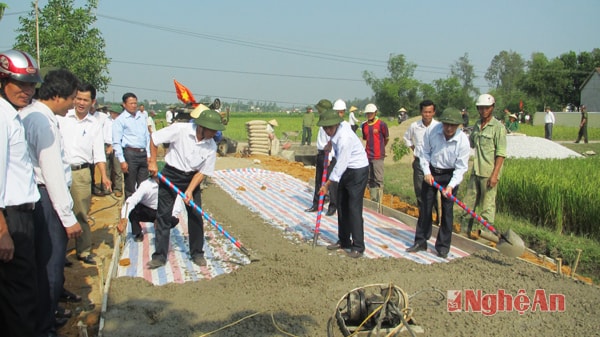 |
| Building rural roads in Nghi Loc. |
Over the past year, Nghi Loc district has continued its success in restructuring crop patterns, increasing income per unit area, and applying scientific and technological advancements towards sustainable and highly efficient agriculture. The district has successfully established four large-scale model fields for high-quality rice in Nghi Dong, Nghi Kieu, Nghi Hoa, and Nghi Long communes. In addition, the area of high-quality rice cultivation continues to expand, gradually replacing low-yield, low-quality rice in Nghi Kieu, Nghi Lam, Nghi Hoa, Nghi Dong communes, etc. The socio-economic development of the locality is always linked to the process of building new rural areas. Currently, 100% of the communes in the district have completed and published their planning. Six communes have achieved 12 or more criteria for building new rural areas, including Nghi Thai, Nghi Xuan, Nghi Lam, Nghi Trung, Phuc Tho, and Nghi Long. The campaign to build new rural areas in Nghi Loc has always received timely support from the entire population.
The district's key industries all showed growth compared to the previous year. Notable examples include wooden shipbuilding (up 7.14%), beer production (42.45 million tons, up 4.8%), steel structure fabrication (up 177.4%), NPK fertilizer production (up 45,000 tons, up 350%), and wood chip exports (up 3.45%). The infrastructure of the Nam Cam and Truong Thach industrial clusters continues to be improved, attracting investment projects. The district continues to promote the activities of 22 craft villages, creating jobs for thousands of workers, including many well-functioning and highly efficient craft villages such as shipbuilding, rattan and bamboo weaving, and rice cake making. Particularly, with the efforts of the entire political system and the people, Nghi Loc has strived to accelerate the construction and completion of many basic infrastructure projects over the past year, such as the upgrading of the Left and Right dykes of the Cam River, the Quan Hanh – Cho Son road, the road to the Nghi Cong production forest, the National Highway 1A – Nghi Phuong – Nghi Hung – Nghi Dong road, infrastructure for craft villages in Nghi Thai and Phuc Tho communes, and the 3-story office building of the District Party Committee. Five office buildings and one meeting hall/office building in the communes have been completed and put into use. The facilities of schools are increasingly being improved, meeting the teaching and learning needs of teachers and students.
The movement for building a cultured way of life among the people has seen many positive changes. In 2013, Nghi Loc district celebrated the recognition of 18 "Cultural Villages" and 13 "Cultural Clans," along with many other historical and cultural relics such as Cua Temple and the tomb of General Ninh Ve in Nghi Khanh commune, Tam Toa Temple, Trang Liet Temple, etc. Local traditional festivals continue to be maintained, attracting many tourists and truly becoming highlights of the district, such as the festival at the temple of Grand Tutor Cuong Quoc Cong Nguyen Xi, the Cua Temple festival, and the commemoration of the 140th anniversary of the birth of patriotic scholar Dang Thai Than. The quality of education has improved significantly. During the year, 192 students won prizes in the English Olympic competition, one student won a national bronze medal, two students received honorable mentions, and 1,700 students were admitted to universities and colleges. Six more schools achieved national standards, bringing the total number of schools meeting national standards to 57. The district continued to effectively implement vocational training plans, creating new jobs for over 5,000 workers, including sending more than 1,200 to work abroad. Healthcare services for the people were continuously improved, with effective implementation of national health programs and good preventive healthcare practices, preventing outbreaks of dangerous diseases. National defense and security were maintained, ensuring political stability and creating a solid foundation for socio-economic development.
In 2013, Nghi Loc district continued to promote administrative reform, improving the quality of service at the district's and commune/township's one-stop service centers, as well as administrative and public service agencies in the area. It built and applied a quality management system according to ISO 9001:2008 standards at the District People's Committee, along with simplifying administrative procedures and applying information technology to public processes. The district continued to direct the innovation of the management work of the People's Committees at all levels towards improving the efficiency and effectiveness of state management, promptly resolving pressing issues in production and people's lives. It also effectively implemented the rotation of officials and the consolidation of personnel in schools and localities.
Party building and the political system have been given due attention. Party resolutions have been promptly disseminated and implemented, coupled with leadership and guidance to strengthen political and ideological propaganda and education for cadres, Party members, and the people. The campaign to study and follow the moral example of Ho Chi Minh has become increasingly effective, in-depth, and a regular task for Party committees and organizations within the political system. The activities of the Fatherland Front and other mass organizations have become increasingly effective, with many new models and good practices in mass mobilization, personnel organization, and administrative reform being implemented.
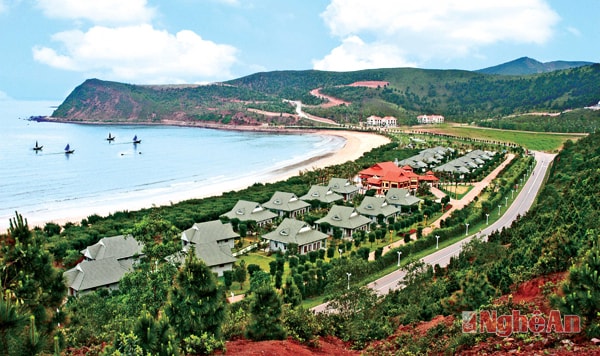 |
| Bai Lu Tourist Area. |
In 2014, Nghi Loc continued to effectively mobilize and utilize resources, focusing the leadership and guidance of Party committees, government agencies, departments, and mass organizations from the district to the grassroots level to invest in socio-economic development. This created a solid foundation for development and sustainable economic restructuring, ensuring social welfare, maintaining political stability, and guaranteeing national defense, security, and social order. The goal was to achieve a total production value of 6,594 billion VND, an average per capita income of 21.1 million VND/year, and an economic growth rate of 8.4%.
To achieve the above goals, Nghi Loc district has identified the need to continue focusing on solutions to overcome difficulties in production and business, and to promote investment in effective projects. The district will concentrate on accelerating the development of industry and handicrafts, recognizing this as a fundamental goal for economic growth, linked to the restructuring of the economy towards industrialization and modernization. It will improve the quality and diversify products, creating highly competitive products that meet market demands. The district will continue to attract investment in tourist areas, improving the quality and efficiency of tourism and service activities. Furthermore, it will transform agricultural production into a marketable commodity, supplying agricultural products and services to urban areas, industrial zones, tourist areas, and residential areas, gradually linking production with processing and consumption of agricultural products.
Leveraging internal resources, taking advantage of capital sources, increasing budget revenue, and saving on public expenditure to invest in development. Continuing to link socio-economic development with the task of building new rural areas, focusing efforts on construction and guidance in pilot communes, and integrating programs and projects to achieve the goals of building new rural areas. Strengthening the dissemination of the Party and State's policies and guidelines to the people, ensuring social security, strengthening national defense and security, ensuring social order and safety; paying attention to the development of cultural and social fields and addressing pressing issues, strengthening administrative reform, strengthening the leadership of Party committees, governments, and mass organizations at all levels, and promptly handling obstacles and difficulties at the grassroots level to successfully complete the socio-economic development tasks of the locality.
Nguyen Khoa


