
Nghi Phong: The effectiveness of developing the export-oriented rattan and bamboo weaving craft.
(Baonghean)With its barren sandy soil, agricultural production is entirely dependent on nature. If Nghi Loc relied solely on farming, the lives of its people would be very difficult. In recent years, developing the export-oriented rattan and bamboo weaving industry has been identified as a way out of poverty for many localities, especially in Nghi Phong (Nghi Loc).
Mrs. Hai's family (in Phong Canh hamlet) owns two plots of agricultural land, originally used for growing sesame. The area is barren, and the irrigation and drainage system is limited, so yields are usually only 4-5 kg per plot, making life very difficult. Since developing the rattan and bamboo weaving craft, if they work diligently, the three family members can regularly earn an average income of 50-60 thousand dong per person per day.
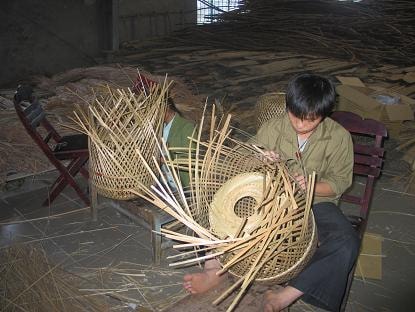
The rattan and bamboo weaving craft provides many jobs for people in Nghi Phong.
According to Mr. Nguyen Trong Hieu, Vice Chairman of the People's Committee of Nghi Phong commune: Because rattan and bamboo weaving is a traditional craft of the locality, Nghi Phong has the advantage of having many highly skilled artisans. Every year, the commune develops a plan to train 1-2 new classes with 50-60 workers, and also organizes retraining and advanced training to improve the quantity and quality of labor. As a result, to date, there are more than 1,000 skilled workers in the commune, and the number of craft villages recognized by the Provincial People's Committee has reached 4 villages, including the Phong Phu hamlet's traditional paper-making village. The commune is also expanding to include 5 more villages with traditional crafts to further develop the craft industry.
Thanks to the development of rattan and bamboo weaving, people's lives have improved, and the face of the countryside is constantly changing. In 2001, the value of production in the construction industry accounted for less than 10% of the total production value, but by 2010, that figure had reached 30.6%, with the value of production from craft villages and villages with traditional crafts accounting for 30% of the industrial, handicraft, and construction production sector. Each year, the craft villages of Nghi Phong produce 50-60 thousand export products, with an average income of 1.3-1.5 million VND/person/month, and skilled workers in enterprises earning 1.5-2 million VND/person/month.
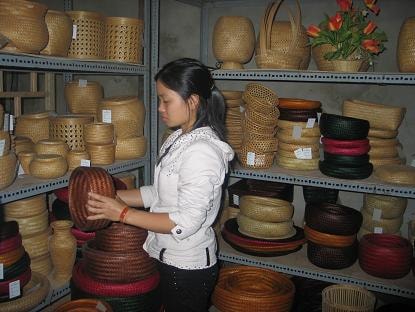
These products are becoming increasingly sophisticated and are exported to many countries around the world.
The construction and development of craft villages, in addition to creating jobs, providing vocational training for people, and increasing income for individuals and society, also gradually creates employment opportunities for people with the motto "leaving agriculture but not leaving home." Infrastructure serving economic and cultural life is also increasingly being invested in and built to a higher standard. In recent years, thanks to state investment and the mobilization of local resources, Nghi Phong has built two more roads passing through the craft villages, bringing the total length of rural asphalt roads in the commune to nearly 30 km. Furthermore, the commune has built a transformer station and a low-voltage power system in the craft villages, serving the production and daily life of the people in the commune.
Phu Huong


