
He was the one who introduced pepper and orange varieties to the land of Quế.
(Baonghean) - Driven by a desire to find ways to develop the local economy, Mr. Hoang Trung Thong, Vice Chairman of the People's Committee of Kim Son town, Que Phong district, has invested in planting oranges and peppers on a farm scale. These are the first crops introduced to the Que Phong area.
Leading us on a tour of his family's pepper and orange orchards, Mr. Thong couldn't hide his joy at the healthy growth of these plants, which are well-suited to the local soil conditions. Despite his busy work as a government official, his passion for agriculture led him to conceive the idea of growing pepper in early 2014. Before implementing his plan, he visited many pepper-growing regions in Vietnam, such as Quang Binh and Quang Tri, to learn about their economic value, techniques, and cultivation experiences. After careful consideration, he personally went to Quang Tri to purchase seedlings and planted 4,500 pepper plants on his family's 3-hectare farm in June 2014. Feeling unsure of the techniques, he hired the owner of the pepper plantation from which he bought the seedlings to provide technical guidance for the first few months, paying him 10 million VND per month.
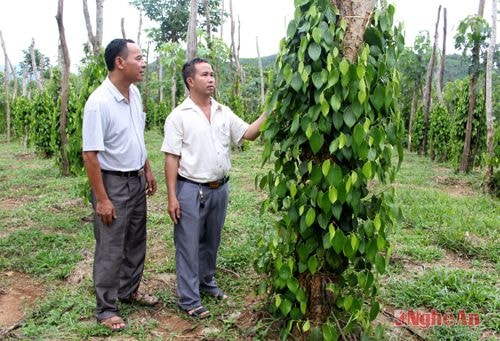 |
| Mr. Ho Trung Thong (on the right) introduces his family's pepper garden. |
Initially, things weren't easy. Because pepper plants are climbing vines, they require supporting trees for them to cling to and grow. He invested a total of 800 million VND to buy and plant Terminalia catappa trees, but the survival rate was only 1 in 10. This resulted in a loss of 500 million VND. Undeterred, he researched and replaced the pepper plants with other crops like kapok and cotton. Furthermore, out of the 3 hectares of pepper plants, only 2 hectares had sandy red soil suitable for pepper growth; the remaining 1 hectare of red soil was unsuitable, causing slow pepper growth. While considering alternative crops, he was introduced to orange cultivation models in Quy Hop to learn from their experience. After calculating the economic value of orange trees and their suitability for red soil, he decided to convert the entire 1 hectare of poorly growing pepper plants and buy an additional 4 hectares of land to plant oranges.
Five hectares of orange trees were gradually established on land previously used for low-value crops. Mr. Thong also applied drip irrigation techniques to provide the most efficient and economical water supply for his plants. However, just like with pepper, the story of growing oranges also involved many difficulties. He still cherishes memories of living and sleeping alongside his orange trees. Whenever the orange trees showed signs of disease, he would rush around searching for information and learning from experienced growers to care for his orchard. After hearing him recount the hardships and even significant economic losses he faced in introducing pepper and orange varieties to Que land, I asked why he didn't choose other established local crops like passion fruit instead of these. He said, “Based on the local climate and soil conditions, I find that pepper and orange trees are perfectly suitable and adapt well; their economic value is also higher than cinnamon and passion fruit. Personally, I really want to introduce new plant varieties to Que Phong. The journey may be fraught with setbacks and failures, but those are valuable experiences in the process. When I successfully implement it, I will try to replicate it so that many farmers can follow suit. Certainly, their investment costs will decrease because they won't have to learn as they go along like I did.”
Looking at the thriving pepper and orange orchards of Mr. Hoang Trung Thong's family, we shared the joy of the Vice Chairman of Kim Son Town, who is passionate about agriculture. He affirmed: "Next year, the pepper garden will start bearing its first fruits. If we consider the current market price of pepper, the family will recover its initial investment after only two years of harvesting." Mr. Thong's new crop models promise to bring economic benefits to his family, but for now, his farm provides regular employment for 10 workers, with an income of 100,000 VND/day/person. What is particularly commendable is that all the workers are from impoverished households or are recovering addicts. With determination and systematic investment, we hope Mr. Thong's pepper and orange farming model will be successful in Que Son.
Phuong Anh


