
People who raise "clean" wild boars.
(Baonghean) - By raising wild boars in a semi-wild environment and using traditional Vietnamese and Chinese medicinal herbs for feed and disease prevention, Mr. Tran Phuc Dat (born in 1965) in Tan Vinh hamlet, Tan Thanh commune (Yen Thanh district) has built a reputable brand of "clean" wild boar farm, earning hundreds of millions of dong annually.
"Resigning from his official position," he returned home to practice traditional medicine and raise wild boars.
After being discharged from the army in 1988, Mr. Tran Phuc Dat returned to his hometown and actively participated in the commune's Youth Union activities. Through his work, studies, and dedication, he was elected Chairman of the Tan Thanh Commune People's Committee. He was a capable and reputable chairman, trusted by both the people and the government. However, in 2010, he resigned from his position. Mr. Dat confided: "My family has a traditional Chinese medicine practice, so when my father became old and frail, I decided to leave my job at the commune to continue the family tradition. If I don't take the position of commune chairman, someone else will, but if this traditional medicine practice is lost, it would be a sin against my ancestors and the people..." According to our research, Mr. Dat's family has been famous and reputable for generations. Mr. Tran Do, a local resident, said: "Mr. Dat is a virtuous and compassionate traditional medicine practitioner; he has cured thousands of patients. He never charges poor patients for his medicine, and sometimes even gives them money."
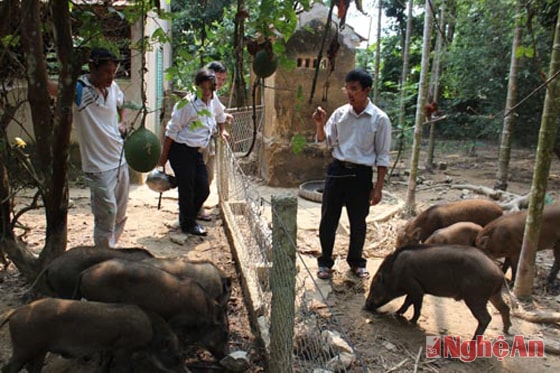 |
| Mr. Tran Phuc Dat guides visitors around the wild boar farm. |
With his family's traditional herbal medicine and a few leased rice paddies, his family's life wasn't wealthy, but they lived comfortably in the countryside. However, the passion for farming and animal husbandry remained strong within him. One day, after watching a wild boar farming model on television, Mr. Dat thought: If he could successfully raise wild boars in a semi-wild style, it would generate high income because wild boar is a specialty product. He decided to put his idea into action, researching and buying a pair of breeding wild boars in Quynh Luu. However, after more than eight months of care, both boars died from African swine fever. Undeterred by the failure, he researched wild boar farming methods and bought two more breeding pairs. This time, with more experience, the two pairs reproduced after a year… Gradually, he built a wild boar farm covering over 1 hectare with nearly 100 boars, including breeding sows, mating sows, and piglets.
Unique farming methods
Leading us on a tour of his farm, Mr. Dat explained that raising wild boars is easy, but creating a brand of "clean" wild boar that ensures food safety and hygiene and is favored by consumers is not something everyone can do. According to Mr. Dat, wild boars are wild animals, so the same farming methods as domestic pigs cannot be applied. The first step is to obtain a farming permit. The pens are simple to build; however, it is necessary to understand some characteristics and habits of wild boars to arrange the pens and classify them by age. The pens must be cleaned daily, leftover food removed, and the feed and water troughs washed thoroughly. Another important aspect is that the fences must be strong and sturdy. From our observation, his pens are built on high ground, in a cool, airy location with drainage for cleaning; there is a clean water source, not only providing enough water for the pigs to drink but also maintaining a rich vegetation and appropriate humidity for the wild boars. "Raising pigs in a 1-hectare forest is no different from raising wild boars, but I've trained them to follow a schedule for eating, sunbathing, exercising, and going into their pens in an orderly manner. These things contribute to producing delicious and clean pork."
Another unique aspect is that, in addition to grasses, plants, sprouts, roots, grains, and tubers, Mr. Dat also supplements the wild boar's diet with medicinal herbs from both Vietnam and China to boost their immunity and prevent diseases. “Wild boars are wild animals that have only recently been domesticated, so they have high resistance and are less susceptible to disease. However, wild boars can still suffer from some diseases such as swine fever, diarrhea, hemorrhagic septicemia, foot-and-mouth disease, liver flukes, scabies, and other common ailments. I have applied medicinal herbs from both Vietnam and China to their feed and treatments, so the herd is always healthy and the meat quality is good,” Mr. Dat shared about his disease prevention and control secrets. However, he also cautioned: “The wild boar's diet is primarily plant-based. It's not advisable to overuse nutrient-rich feed for wild boars because it can alter meat quality and sometimes cause digestive disorders like diarrhea…”
His unique methods have proven effective, resulting in high-quality meat and popular wild boar products, generating hundreds of millions of dong in annual income. Currently, Mr. Dat not only supplies breeding pigs and pork to farms and restaurants in Yen Thanh but also acts as a supplier to many districts and towns in Nghe An province. Commenting on Mr. Dat's wild boar farming model, Mr. Nguyen Quang Vinh, Vice Chairman of the Tan Thanh Commune People's Committee, said: "Mr. Dat's wild boar farm is the first of its kind in Tan Thanh commune; it's highly effective and generates high income. This is also a model that the local Party committee and government are planning to organize visits for people to learn from and replicate."
Tien Dung


