
The pioneer in Na Xai village
Following Mr. Nguyen Ba Kiem, Deputy Secretary of the Party Committee of Hanh Dich commune (Que Phong district), we visited the farm of Mr. Ha Van Viet in Na Xai village, Hanh Dich commune. From the center of the village, after more than an hour's walk on the road that is currently being expanded, we were amazed by a vast farm of over 20 hectares, with the endless green of cinnamon, melaleuca, and mahogany forests in their growth stage, and lush green terraced rice fields in their heading stage. The sounds of roosters crowing and ducks quacking filled the air…
(Baonghean)Following Mr. Nguyen Ba Kiem, Deputy Secretary of the Party Committee of Hanh Dich commune (Que Phong district), we visited the farm of Mr. Ha Van Viet in Na Xai village, Hanh Dich commune. From the center of the village, after more than an hour's walk on the road that is currently being expanded, we were amazed by a vast farm of over 20 hectares, with the endless green of cinnamon, melaleuca, and mahogany forests in their growth stage, and lush green terraced rice fields in their heading stage. The sounds of roosters crowing and ducks quacking filled the air…
It was 11 a.m., the sun was shining, and Mr. Viet was still working. In front of me was an old man, about 70 years old, thin, slightly hunched, but still very agile... He recounted: Orphaned and a former soldier who fought in the K5 battlefield in Laos, during the campaign he was honored as a "Victorious Soldier" for three consecutive years. After completing his mission and returning home, he started a family and lived in Tri Le commune, Que Phong district. In 1994, he and his wife and children moved to Na Xai village. In this new land, he decided to find a place to clear land and start a new life. From Na Xai village, he walked until his legs ached before reaching the location of his current farm.
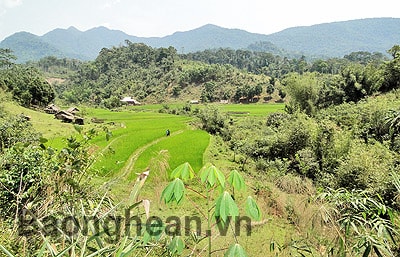
A panoramic view of Mr. Ha Van Viet's farm.
Pointing to the terraced fields in front of his house, he said: "These terraced fields used to have huge trees, some with diameters of a meter. Transforming them into rice paddies was very hard work. Thanks to the perseverance and hard work of my wife and I, they have now become fertile terraced fields, providing enough rice for the whole family to eat each year, and even some to sell."
He and his wife and children could handle land clearing, farming, digging ponds for fish, and fencing the garden, but securing capital for production and purchasing livestock proved very difficult. He decided to borrow from the bank, and with the support of various levels of government and agencies, he invested in raising livestock and poultry. In recent years, recognizing that the area was suitable for raising buffalo and yielded higher economic returns than raising cattle, he decided to sell his cattle and switch to raising buffalo. Currently, he has a herd of 14 buffalo and 3 cows. He doesn't let the buffalo roam freely in the forest, but keeps them in shelters. He dug high trenches to prevent the buffalo from coming into contact with the surrounding environment, thus avoiding disease. His buffalo and cattle herds are thriving. Some buffaloes have been offered over 20 million dong by traders, but his family hasn't sold them yet. He has divided his farm into different areas for specific crops and livestock. Where water sources are favorable, he digs ponds for fish farming, which both provides irrigation for the fields and allows the fish to grow quickly. He also developed poultry farming, raising chickens and ducks… At times, he had hundreds of chickens and ducks, especially the famous and delicious Muscovy duck breed from Que Phong.
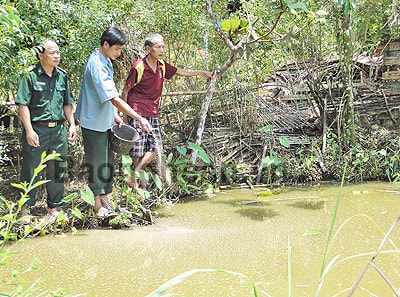
Fish farming model.
He also cultivates over 1 hectare of <i>Hoang Linh</i> trees, a type of timber tree with high economic value. Currently, some trees have reached a diameter large enough for a person to embrace, promising a considerable income for his family when harvested.
Over the past three years, the VACR model has provided Mr. Ha Van Viet's family with an annual income of 80 to 100 million VND. Not only has he been able to repay his bank loan, but he now has over 300 million VND in savings.
Many households in Na Xai village have adopted the VACR (Vegetable, Animal, Fish, and Fish) economic model, enriching their families and their hometown.
Text and photos: Hai Thuong (Border Guard)


