
The cause of the mass fish deaths in Central Vietnam.
Wastewater from the shore has decomposed rapidly, depleting oxygen in the deep water; cyanide, a toxic substance used in fishing, could be the cause of the mass fish deaths along the coast of four central provinces.
According to Dr. Vu Thanh Ca, from the Department of International Cooperation and Science and Technology (General Department of Seas and Islands), incomplete statistics show that from the beginning of the year until now, there have been more than 30 cases of mass fish deaths worldwide, mainly related to the marine environment. There are many causes leading to this, such as:Sudden temperature changes, pollutant leaks, outbreaks of toxic algae due to eutrophication, oxygen depletion due to decomposition of organic matter in deep water layers, diseases caused by bacteria, viruses, or parasites...
In shallow sea areas, organic pollutants discharged from the shore will not be diluted quickly. If seawater temperature rises sharply, the decomposition of organic matter will occur rapidly, leading to high oxygen consumption. Surface heating will create strong stratification of seawater density; if the wind is not strong enough and surface waves are insufficient to create water turbulence, oxygen will be depleted in the lower layers of the water, killing fish.
The mass fish deaths in the coastal areas of North Central Vietnam between April 14th and 18th occurred during hot, sunny days with relatively calm seas, meaning the wind blowing from the shore was insufficient to create significant water disturbance. "Therefore, the reason for the mass fish deaths could be due to wastewater from the shore decomposing rapidly, causing oxygen depletion in the lower water layers," Mr. Ca said..
Sharing the same view, Dr. Nguyen Huu Dung, who previously worked at the Vietnam Association of Seafood Processing and Export, pointed out more clearly that the source of the waste causing the sudden environmental changes in the sea is highly likely to originate from the Vung Ang industrial zone (Ha Tinh province). "The toxic substances flowed into the sea with the water currents, then spread to other sea areas," Dr. Dung said, adding that...This is the first time Vietnam has recorded such a large number of large deep-sea fish dying..
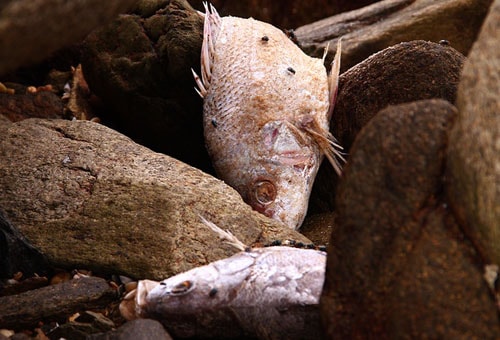 |
Massive fish deaths have caused widespread concern in central Vietnam. Photo: Duc Hung. |
According to fisheries expert Bui Quang Te, normally, polluted marine environments cause algal blooms, depleting oxygen and killing fish. However...In the central coastal region, the fact that algae cannot even grow indicates an extremely severe level of pollution. In 2001-2002, the Ninh Thuan and Binh Thuan coastal areas experienced a red tide phenomenon, also known as an algal bloom, caused by pollution in an area 25 km long and 5 km wide, resulting in mass deaths of fish and shrimp raised in cages. Subsequently, this phenomenon also occurred in numerous other coastal areas.
Meanwhile, a marine resource expert advised authorities to check for cyanide in the fish. This is a toxic substance used in fishing by affecting the fish's nervous system and acting as a sedative, making fishing easier. The Philippines has previously requested that China refrain from using this substance in fishing.
"In my experience, fish in rocky reefs are very hardy, and I think poisons like cyanide killed them," he said.
Scientists have also suggested other possible causes, such as waste from oil rigs that China previously placed at the mouth of the bay.
Despite numerous hypotheses regarding the cause of the fish deaths, fisheries and marine environmental experts believe that to clarify the incident, authorities need to collect water samples from various depths at multiple locations and analyze them to determine the level and composition of pollutants. Furthermore, authorities must inspect production facilities and residential centers on shore that may be discharging waste and polluting the seawater.
The phenomenon of mass fish deaths was first recorded in sea cages near the Vung Ang economic zone (Ky Anh town, Ha Tinh province) in early April. Subsequently, wild marine fish, cage-farmed fish, and fish in coastal lakes of Ha Tinh, Quang Binh, Quang Tri, and Thua Thien - Hue provinces died en masse. Every day, fishermen in coastal communes collected tons of dead fish, each weighing from a few hundred grams to 50 kg.
Do not eat dead fish. While awaiting the results of determining the cause of the unusual mass fish deaths, the Ministry of Agriculture and Rural Development advises people in Central Vietnam not to consume the dead fish in any form. The Ministry also requests that localities urgently collect and dispose of the dead fish according to regulations to minimize environmental pollution; organize public awareness campaigns to prevent panic, and guide people on how to distinguish between fish that died unusually and fish caught at sea or farmed fish. The ministry also requested that localities coordinate with specialized agencies to collect samples, determine the cause of the fish deaths, and propose solutions to address the problem. |
According to VNE


