
Farmers actively work in the fields after the "drought-relief" rains.
(Baonghean) - After the rain on the night of June 21st, people in the districts of Hung Nguyen, Nam Dan, Anh Son, Quynh Luu, Dien Chau, etc., took advantage of the opportunity to go to the fields to get water for production. Although the rain was not heavy, it is considered a "golden rain" that has somewhat quenched the "thirst" for agricultural production after long days of drought.
We arrived early in the fields of Hung Nguyen, Nam Dan. Ms. Nguyen Thi Hau (Hamlet 4, Nam Giang, Nam Dan) smiled and shared: “Listening to the rain at night made me so happy I couldn't sleep. I just wanted the morning to come so I could get to the fields to replant the seedlings, to ease my worries about the rice crop after the recent drought.” In the higher fields of Kim Lien commune (Nam Dan), people also poured out to work. The rain brought joy, but there was still worry because it wasn't enough to replenish all the fields. Ms. Chu Thi Huong (Hoi 4 Hamlet, Kim Lien) said: “I took some water into my field and then let it flow down to the fields behind, sharing a little with each place, because the higher fields behind were severely affected by the drought.”
However, overall, thanks to this "golden rain," a large amount of water was added to the canals in Hung Dao and Hung Nguyen town; people enthusiastically used hoes and shovels to bring water to their fields. The newly sown summer-autumn rice crop turned greener, and in some fields, the water level reached almost half the height of the plants, helping them withstand the heat for a certain period. Not only rice, but other crops such as beans and sesame also "revived." However, according to farmers, only the lower fields and those near the canals benefited the most from the rain, while the higher fields still had to wait for more rain to plant the summer-autumn crop.
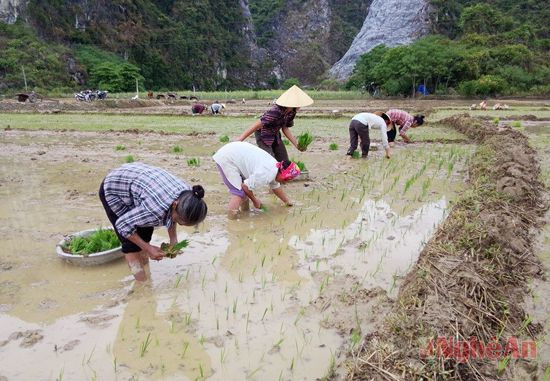 |
| Taking advantage of the rain, farmers in Hoa Son commune (Anh Son district) are heading to the fields to plant summer-autumn rice on the remaining land. Photo: Huyen Trang (Anh Son Radio) |
Taking advantage of the rainy weather, Anh Son district is directing relevant departments, localities, and farmers to accelerate the care and planting of the new crop. In many communes, the atmosphere in the fields after the rain is as joyful as a festival. Farmers in Hoa Son commune are taking advantage of the rain to plant summer-autumn rice on areas that have been dry for a long time. While quickly building embankments in her fields, Mrs. Nguyen Thi Huong from Hamlet 2, Hoa Son commune, excitedly said: "Thanks to the rain, my family's 5 sao (approximately 0.5 hectares) of rice can now be planted. There is hope for this year's summer-autumn crop again!" In vegetable-growing communes like Cam Son, watermelon and green squash fields are looking much greener after the rain; according to the farmers, the rain is worth months of watering.
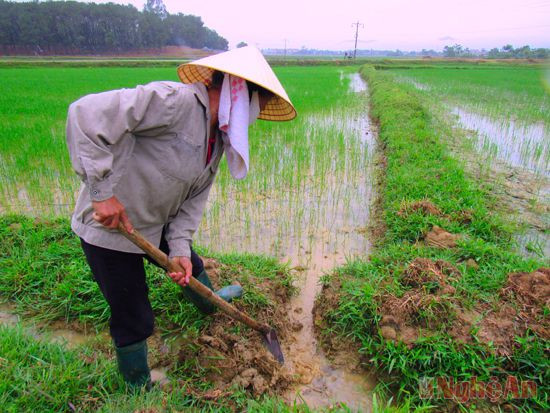 |
| Farmers in Hung Dao (Hung Nguyen) are out in the fields regulating water to care for their summer-autumn rice crop. Photo: Quang An. |
According to the plan, Anh Son district will plant 2,900 hectares of rice during the 2015 summer-autumn crop season. To date, 1,677 hectares have been planted. Several communes have basically completed planting in areas with reliable water sources, including Tao Son, Lang Son, Linh Son, Long Son, Phuc Son, Duc Son, Thach Son, Vinh Son, and Tuong Son. Farmers are taking advantage of rain to continue planting in the remaining areas. For corn and beans, Anh Son district has directed localities to focus on planting short-day, drought-resistant varieties such as B06, DK6919, and VLN61. The planting season is until June 25th and no later than June 30th, 2015. For other crops, depending on the soil conditions and experience of each region, Anh Son district has directed localities to proactively arrange the crop structure, such as melons, pumpkins, gourds, etc., to ensure high economic efficiency.
In the fields of Quynh Luu district, heavy rain from the evening of June 21st to the morning of June 22nd created favorable conditions for rice growth. Some areas of unplanted rice seedlings received water for land preparation, and farmers began planting the summer crop; in some places, they weeded the rice, applied nitrogen fertilizer, and sprayed pesticides to control diseases. Ms. Le Thi Tam from Hamlet 6, Quynh Hong commune, said: "During the prolonged hot weather, the water in the fields dried up, making weeding impossible. Thanks to this rain, the whole family went to the fields to weed and care for the rice." The prolonged hot weather over the past few days has prevented some localities in Quynh Luu district, such as Quynh Hoa, Quynh Bang, and Quynh Thanh, from planting the 2015 summer-autumn crop; approximately 100 hectares of land in the entire district remain unplanted. Taking advantage of the rain, communes in drought-stricken areas are directing farmers to pump and irrigate, utilizing rainwater to plant rice and complete the summer crop before June 30th.
Mr. Truong Minh Chau, Head of the Crop Production Department of the Nghe An Department of Agriculture and Rural Development, said: “On June 22nd, the department inspected and provided assistance to agricultural production in many districts throughout the province. Farmers are currently in the fields tending to their rice crops. Before June 21st, the entire province still had 5,000 hectares of land without water for planting. This is a favorable time for districts to direct farmers to complete the planting of the remaining summer-autumn rice crops. At the same time, farmers need to go to the fields to care for, thin out, weed, and fertilize the rice; and plant summer-autumn vegetables and legumes.”
According to farmers' experience: After sowing and transplanting, if it rains, it is necessary to fertilize the rice plants to encourage tillering once they have rooted and turned green. The recommended amount is approximately 3-4 kg of urea + 2-3 kg of potassium chloride per sao (1000 square meters), or 8-10 kg of NPK Dau Trau L1 or a three-color fertilizer (12:5:10-14). Maintaining a water level of 2-3 cm helps the rice tiller to tiller effectively. If there are heavy rain showers during the tillering fertilization period, the amount of nitrogen should be reduced to balance the rice's nutrition.
Quang An, Huyen Trang, Viet Hung
| According to the North Central Meteorological and Hydrological Center, the rainfall measured during the rainstorm on the evening of June 21st was as follows: Que Phong 2mm, Quy Chau 12mm, Quy Hop 32mm, Tuong Duong 40mm, Tay Hieu 6mm, Nam Dan 17mm, Vinh 17mm, Cua Hoi 13mm…. |


