After 136 years since its construction, Notre Dame Cathedral (Ho Chi Minh City) still retains its majestic appearance, but in reality, many parts of the cathedral have deteriorated. Most of the tiled roofs of the church's sections have been damaged.
 |
| Notre Dame Cathedral in Paris Commune Square (District 1) is a must-see attraction for many domestic and international tourists visiting Ho Chi Minh City. It is also one of the city's most iconic historical architectural landmarks. |
 |
| Unlike other churches that stand alone within walls, this cathedral, measuring 93 meters long, 35 meters wide, and over 60 meters high, sits in the middle of a square, surrounded by bustling cars and motorbikes. This religious building, a historical and cultural landmark and symbol of Saigon, is nearly 140 years old. |
 |
| The exterior of the building is constructed of exposed brick, yet it remains free of dust and moss, retaining its original color. At first glance, it appears sturdy, but a closer look reveals that several parts of this architectural masterpiece are deteriorating. |
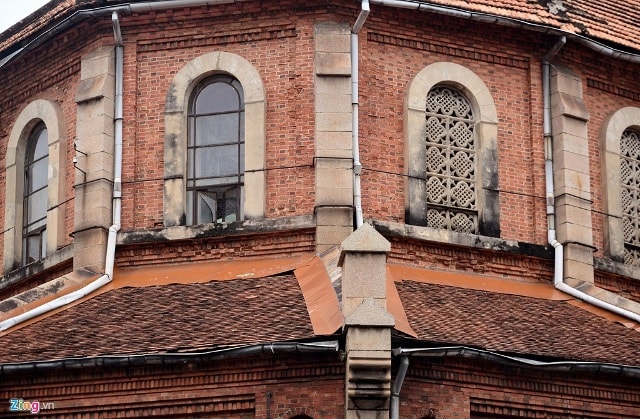 |
| Currently, most of the tiled roofs of the church's sections have been damaged. The ridges of the rear sections of the church have been covered with brown-painted corrugated iron sheets to prevent water from seeping in. One roof section was previously rotten, and the church had to temporarily replace it with a corrugated iron roof to avoid danger. Recently, the Department of Culture and Sports submitted a proposal to the Ho Chi Minh City People's Committee for approval of urgent repairs to the church's tiled roof and several other items. |
 |
| The proposed repair for the church's tiled roof, measuring 91 meters long, 35 meters wide, and 57.3 meters high, involves replacing and supplementing the original Western-style tiles, fish-scale tiles, and yin-yang tiles, as well as rebuilding the roof ridges, eaves, and gutters. Looking from below, the two side roofs of the cathedral, covered with thousands of broken or washed-away Western-style tiles, show large holes patched with plastic sheeting. |
 |
| The four edges of the roof, between the horizontal and vertical sections, were previously covered with new tiles, but many have now been washed away, exposing large gaps in the corrugated iron sheets. The funding for the church's repair is being raised through social mobilization by the Saigon Archdiocese. The project is expected to be completed between 2017 and 2019. |
 |
| The roof of the rear section facing Le Duan Street was severely damaged when the wavy yin-yang tiles fell and shattered, forming large chunks near the corner. The church had to temporarily insert aluminum and rigid plastic sheets while awaiting comprehensive repairs. |
 |
| Many of the fish-scale roof tiles on the low eaves of the church were also blown off and scattered around. Some were piled up on the roof edge. |
 |
| The lower part of the roof at the back is cracked with long fissures, and the two ridge edges are also severely damaged and temporarily covered with blue corrugated iron sheets. According to Father Ignatius Ho Van Xuan, Vicar General of the Archdiocese of Saigon, nearly 130,000 roof tiles were severely damaged, further damaging the steel beams and causing the walls to crack and the bricks to rot. |
 |
| Many sections of the aqueduct were also damaged, leaving large gaps along the outside of the cathedral. |
 |
| The two corrugated iron roofs of the bell tower, made of gray-white imitation tiles, have rusted, and many pieces of the corrugated iron have fallen off underneath. |
 |
| Some of the small roofs of the spire have been temporarily patched up, but they could be blown away by the wind at any time, posing a danger to pedestrians and visitors below. |
 |
| The other spires were temporarily attached with new sheets of corrugated iron, resulting in an aesthetically disjointed appearance. |
 |
| Besides the roof tiles, many of the stained-glass windows around the cathedral are also broken but have not yet been repaired. |
 |
| The brickwork is weathered, water seeps in, causing moss to grow, and many areas are chipped. Along the brick walls on both sides, there are numerous graffiti and signatures left by thoughtless people. |
 |
| The tiled roofs at the back are covered in moss, turning them black, and weeds grow in the gaps between the bricks and along the edges of the stream. |
 |
| Many large, lush trees grow above the church's roof and eaves. Many sections of the walls are losing their original color as dirty water seeps down from the gutters above and clings to them. |
According to Zing.vn



