
'World-renowned poet': The meaning of fame can vary greatly!
(Baonghean.vn) - In recent days, netizens have once again been stirred up by a person named TTN, associated with a series of titles that, just by mentioning them, leave listeners stunned: World Poet, President of the High Council of the Union of Poets (UMP)...
Being careless in naming oneself
The name TTN quickly became a trending topic on Facebook. Some sources shared that Ms. TTN is a Vietnamese expatriate residing in the United States. The back cover of the poetry collection "101 Love Poems" (published by Dam Books Media Joint Stock Company in collaboration with the Vietnam Writers Association Publishing House) also includes impressive information about the profession and "literary background" of this "world-renowned poet." According to this information, Ms. TTN was formerly a lecturer at Ho Chi Minh City University of Education (this information has not been verified), has published six poetry collections, has "over 200 poems set to music," and has "received numerous major awards both domestically and internationally."
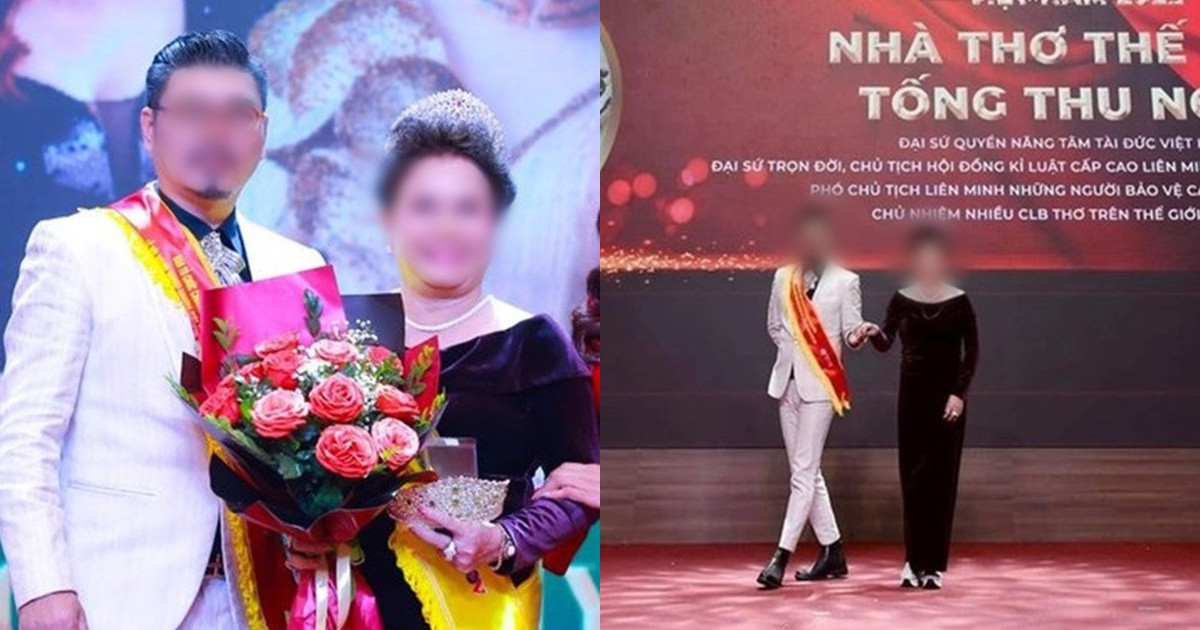 |
The program honoring 'world poets' with a series of titles has caused a stir in public opinion. Photo: Internet |
Most artists and writers, especially those in the literary community, find the "world poet" TTN and the event organizers ridiculous. Writer Le Minh Ha (residing in the Federal Republic of Germany) commented:"TTN's poetry is truly individualistic, individualistic in its naive invitation to eat boiled meat, in its vulgar expression of passionate love... That poetry doesn't elevate anyone to any higher level.".
Literary critic Nguyen Xuan Nguyen expressed his indignation:"This is an insult, a mockery of poetry and culture.".
Quyen Gavoye, a Vietnamese-born writer and Master of Culture and Heritage currently working in Besancon, France, expressed:"It's too easy to claim the title of poet in Vietnam these days. The public's leniency towards titles, competitions, and gala events is also a reason for fame-seekers to take advantage.".
Journalist Chu Minh Khoi, a reporter for the Vietnam Economic Times, said he was once a member of the selection and editing team for several poetry anthologies in the style of a movement, and that "world poet" TTN was no stranger to him. TTN was a sponsor and also had poems included in the anthology "Five Fingers of Time" (2019), but this person's poems gave him the most "headaches and stomachaches." The journalist also revealed:
“The collection of poems that you sent me that I had to read included: 15 poems titled: “The One Thousand and One Hundredth Love Poem”, and 10 poems with the same title: “Inviting You to Boiled Pork with Fermented Fish Sauce, One Thousand and One”; “Inviting You to Boiled Pork with Fermented Fish Sauce, One Thousand and Four” up to the poem “Inviting You to Boiled Pork with Fermented Fish Sauce, One Thousand and Tenth”"
What readers find, supposedly composed by the "world poet" TTN and considered "poetry," is in reality just a jumble of awkward (even vulgar) sentences, jumbled together to create rhymes:"Tomorrow I'm getting married / I offer you boiled meat, but my heart aches.","My lips aren't a fish's tail, so why do you keep rubbing your beard against them all day?",...
The TTN event reminds many of the "phenomenon" of HQT exactly 10 years ago. At that time, there were large-scale seminars about HQT's "supernatural" poetry, his "divine" writing. This was because, in one night at the Bai Dinh - Trang An spiritual tourism complex, this "Zen poet" unconsciously wrote... 121 poems. Shortly after, many discovered that his poems written at Bai Dinh - Trang An or Yen Tu were largely similar to poems/passages in several books that had appeared at these locations. HQT even published two volumes of poetry to enter the Nobel Prize in Literature, and a unique collection of poems weighing 120 kg was awarded a prize by the Asian Record Organization. A few years later, HQT stopped writing poetry, and today, if anyone mentions his name, they only chuckle or shake their heads in dismay!
The problem of "obsession with fame" needs to be addressed.
Every year, the literary world is abuzz with incidents of someone "mistakenly" taking another person's work. In some cases, these "mistakenly taken" works even end up being entered into relatively large, prestigious, and academically high-level competitions and winning awards. Recently, some poets shared stories about poetry competitions and author recognition events where, according to the organizers, award-winning or honored authors have to pay substantial fees compared to the income of most writers today.
 |
Fame obsession partly stems from a lax attitude, a tendency to flatter and encourage each other on social media. (Illustration: Internet) |
So where do these "phenomena" come from? They can be explained from several perspectives.
Firstly, the Vietnamese people possess a vast and rich treasury of folk songs, proverbs, idioms, chants, and rhymes. This form of folk literature has permeated life through many generations, becoming deeply ingrained in the blood of many, especially the older generation. In their daily lives, they can incorporate the expressions and feelings of folk songs, chants, and rhymes into their speech. Furthermore, Vietnamese is a language rich in musicality, easily rhyming. When people manage to rhyme sentences, but lack knowledge of literary genres and have limited literary appreciation, they easily mistake them for poetry. Therefore, everyone writes poetry, every household writes poetry. Many jokingly say, "Vietnam is a superpower of poetry," meaning that out of ten people you meet on the street, nine are poets!
Secondly, our country has endured thousands of years under a feudal regime, where the selection of people for public office was linked to examinations heavily focused on literature – assessing creative ability and literary appreciation. Therefore, the general societal mentality was to value literacy. This mentality led people to prioritize learning, partly promoting intellectual enlightenment, but on the other hand, it also fostered a sense of vanity in society.
Thirdly, in the literary and artistic world, it can be said that the world of poetry and prose is most prone to illusions and misconceptions. Evaluating the quality of a literary work is sometimes very difficult because it is relative and qualitative; what is good to one person may not be good to another, and those with expertise may have a different perspective than the average reader. Therefore, with the mentality of "my writing, someone else's wife," many newcomers to the literary world think they are great authors, that their works will live on forever. They clothe themselves in garments that are far too large for them.
Fourth, some people use various tricks to glorify those who are wealthy and have status but are obsessed with fame, in order to deceive and profit materially or for other benefits. Or, stemming from a gullible mentality, flattery, encouragement, or even praise born of resentment, "praise to kill you,"... leading to those who are deluded becoming even more delusional. And the more delusional they become, the more they chase after superficial values without real talent.
It can be said that plagiarism, paying for awards and honors, as manifested in the "phenomenon" of HQT or the events related to Ms. TTN mentioned above, are expressions of vanity, even reaching a new level of fame delusion. That is, people without real talent, with an excessive illusion of their own "talent," even engaging in morally and culturally deviant behavior or violating the law to gain attention and fame. This is a chronic disease affecting a segment of the population, not only in the literary world. If these phenomena are not addressed by public opinion or promptly dealt with through the law when illegal acts occur, it will lead to a reversal of social values, negatively impacting the lifestyles of many people in the community, especially young people.
More than two hundred years ago, in his poem "Self-Reflection on Taking the Examination," the poet Nguyen Cong Tru wrote:"Having been born into this world, one must leave a mark on the mountains and rivers."Seeking fame, establishing a reputation, and leaving a mark on the world—that is the beautiful aspiration of every individual in the vast sea of humanity, in the endless expanse of time. Those who use their intellect, talent, and morality to compete with the world, help the world, and bring lasting, good, humane, and humane values to society will be recognized and honored. Those who lack real talent, who seek fame and fortune by any means and methods, deserve to be condemned, ridiculed, and punished to purify the cultural environment of the entire society.
It's true that fame comes in many forms!


