
Identifying fish preserved with urea and borax.
Borax and urea are banned chemicals in food, but in reality, vendors commonly use them to preserve seafood. So how can you distinguish between fish preserved with urea and borax?
Fish preserved with borax and urea stay "beautiful" and "fresh" for longer.
The "protein coating" technology is very simple: fish brought from the sea are dipped into a container of ice water mixed with urea, then taken out and sold to customers. For fish transported to distant provinces, additional urea is sprinkled into the ice blocks, allowing the fish to remain fresh for 4-5 days, or even a week.
Not only fish, but also shrimp, squid, etc., after being marinated with chemicals such as bleach, borax, and urea, will have a white, fresh, and appealing appearance to customers.
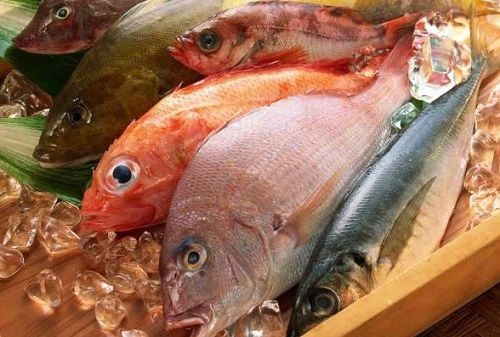 |
| Fish stays fresh longer thanks to preservation with borax (Illustrative image: Internet) |
Dangers of using borax and urea to preserve fish.
Borax, also known as sodium borax, is the sodium salt of boric acid. It is an antiseptic used in healthcare to kill mild bacteria and fungi. Urea is a chemical fertilizer used in agriculture that inhibits bacterial growth.
Because of their low cost, many seafood vendors have used urea and borax to keep their products fresh for longer and prevent spoilage. However, both urea and borax are on the list of chemical additives not permitted by the Ministry of Health for use in food preservation and processing, so their overuse can be harmful to consumers' health.
Dr. Tran Van Ky - Vietnam Association of Food Safety and Technology (Southern Office) said that consuming fish, squid, meat, etc., with high levels of urea and borax residue can cause acute poisoning with symptoms such as abdominal pain, nausea, diarrhea, dizziness... and can even lead to death.
Even in small amounts, urea and borax, when ingested, accumulate in the body over the long term, causing chronic poisoning, manifested by unexplained headaches, insomnia, memory loss, liver and kidney damage, loss of appetite, and general weakness.
Neurologically, borax can cause irritation leading to depression or meningeal irritation, and changes in body temperature. In the urinary tract, it causes particular damage to the kidneys and the whole body, leading to dysfunction, weakness, impotence, menstrual disorders, hair loss, etc.
How to identify fish preserved with borax and urea.
Gill
When buying fish, visually inspect the gills for blood; if the fish is still fresh, it's likely to have been treated with borax. Conversely, if the gills aren't red but the fish still looks fresh, it has almost certainly been preserved with borax.
Black foam appears when cooking fish.
Fish that has been treated with borax will produce black foam on the surface of the water when cooked, and the fish bones will also turn black. With fresh fish, no black foam will appear on the surface of the water when cooked, and the bones will be white.
How to freeze
If the fish is fresh, vendors usually display it with plenty of ice to keep it fresh longer; fish preserved with borax usually doesn't need as much ice.
The fish meat is mushy and the scales detach easily.
With careful observation, we can distinguish between fresh fish and fish treated with chemicals. Fish preserved with borax or urea may look very fresh, but when pressed, the fish's body feels soft and indents due to low elasticity, and it has an unusual smell instead of the typical fishy odor.
Fish that easily lose their scales, have mushy flesh, and sunken eyes... similarly, they may look fresh but when cooked will lack the natural sweetness and aroma, resulting in soft, mushy, and foul-smelling flesh...
According to khoahoc.tv


